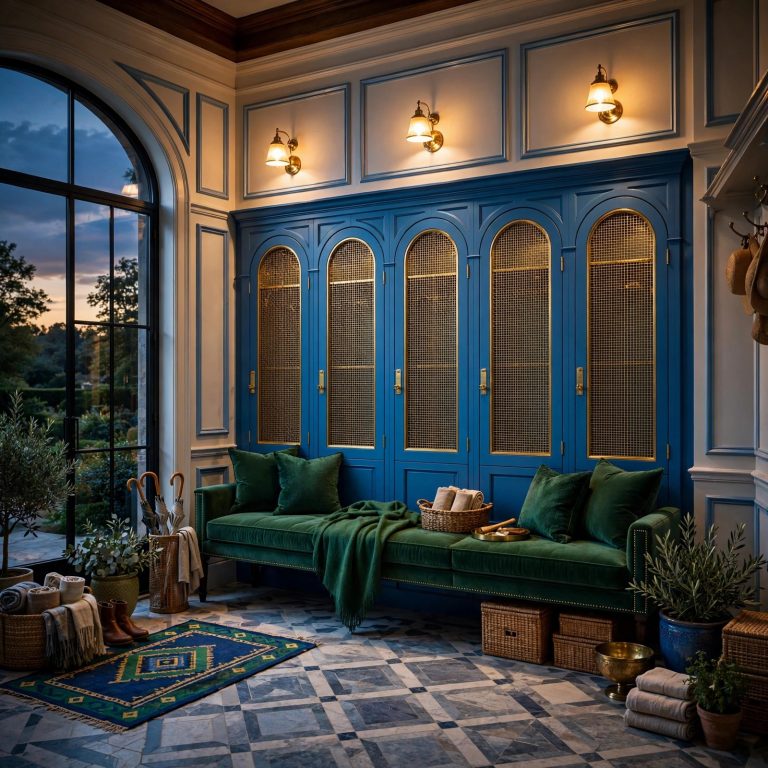
A japandi living room is where two quiet philosophies meet: the Japanese love of imperfection and stillness, and the Scandinavian devotion to warmth and light. The result is a room that calms you the moment you walk in, low, textural, and honest, with nothing shouting for attention. These japandi living room ideas follow the 2026 direction of the style, which has grown warmer and moodier, with limewash walls, dark walnut, and wabi-sabi surfaces replacing the paler minimalism of earlier years. Whether your space is grand or compact, you will find a way in here.
Designing a japandi living room comes down to restraint done richly: fewer pieces, better materials, and light that flatters everything it touches. These 62 japandi living room ideas cover walls, floors, furniture, and the small rituals, from tea corners to candlelight, that make the style feel lived-in rather than staged. You will also see how the look flows into open living spaces without losing its serenity. Each idea is practical and specific, so you can start with one wall or one chair and build from there.
Why it is trending now: Japandi is having its warmest moment yet in 2026. Designers describe a quiet but powerful comeback, with limewash having a massive moment, dark walnut replacing pale oak, and wabi-sabi texture everywhere. The new japandi living room is moodier, earthier, and more tactile than the minimalism of five years ago.
62 japandi living room ideas
1. The limewash feature wall
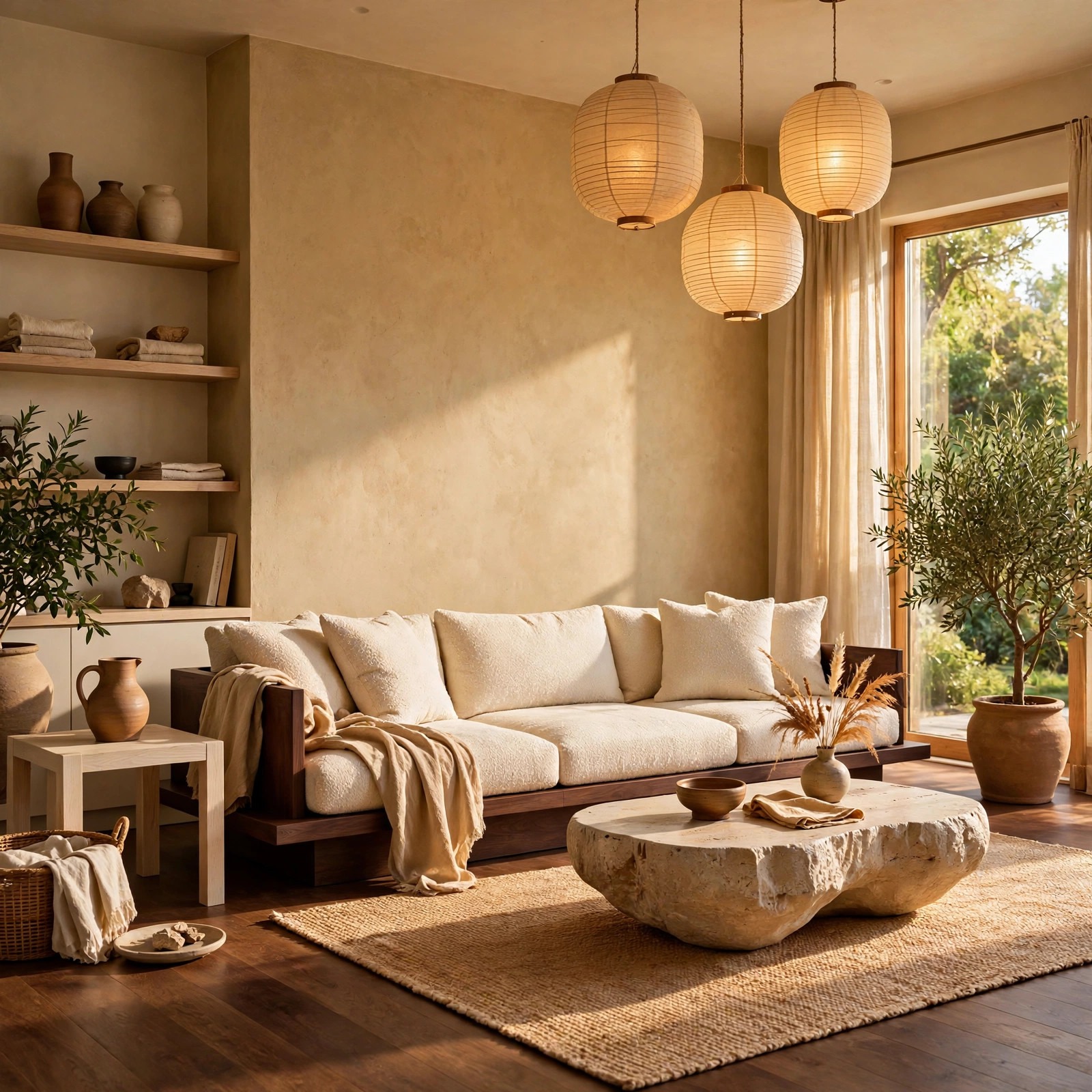
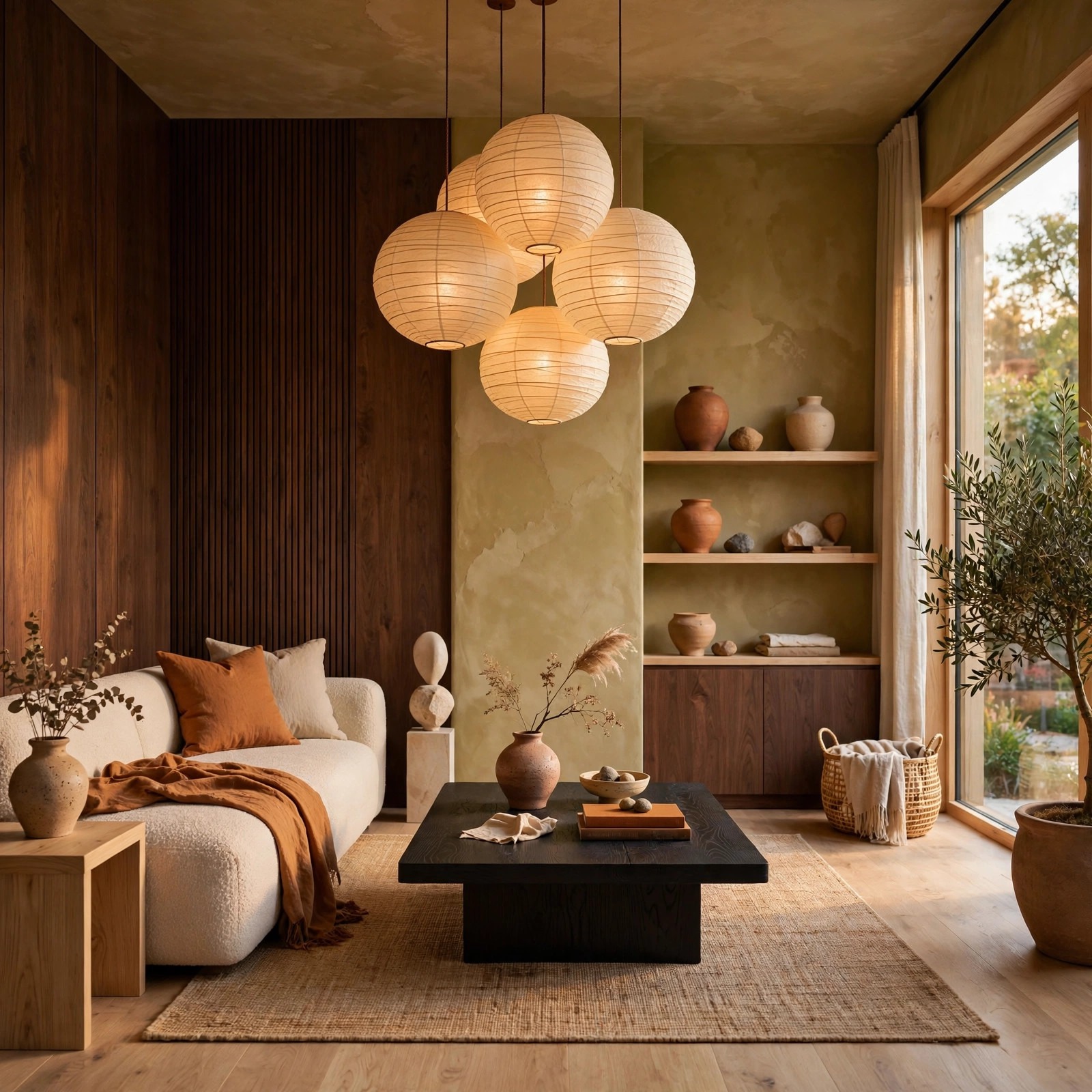
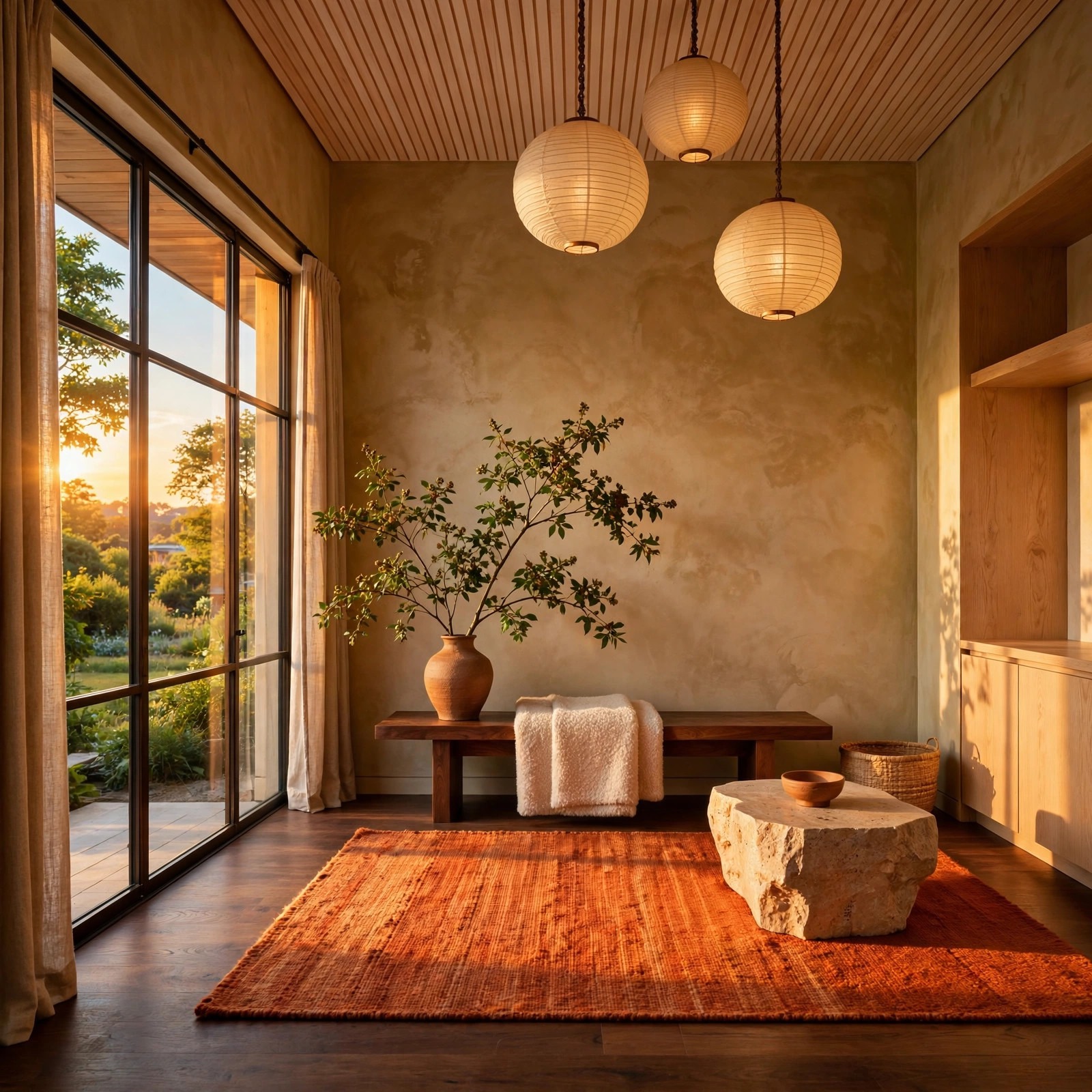
A limewash feature wall is the fastest way to give your living room a japandi soul. The cloudy, hand-applied finish catches light the way flat paint never can, and its soft movement makes the whole room feel calm and artisanal. Choose a warm beige or pale clay tone and let the texture do the talking. One wall is enough; the restraint is the point. Your japandi living room will instantly feel collected rather than decorated.
2. The low-slung platform sofa
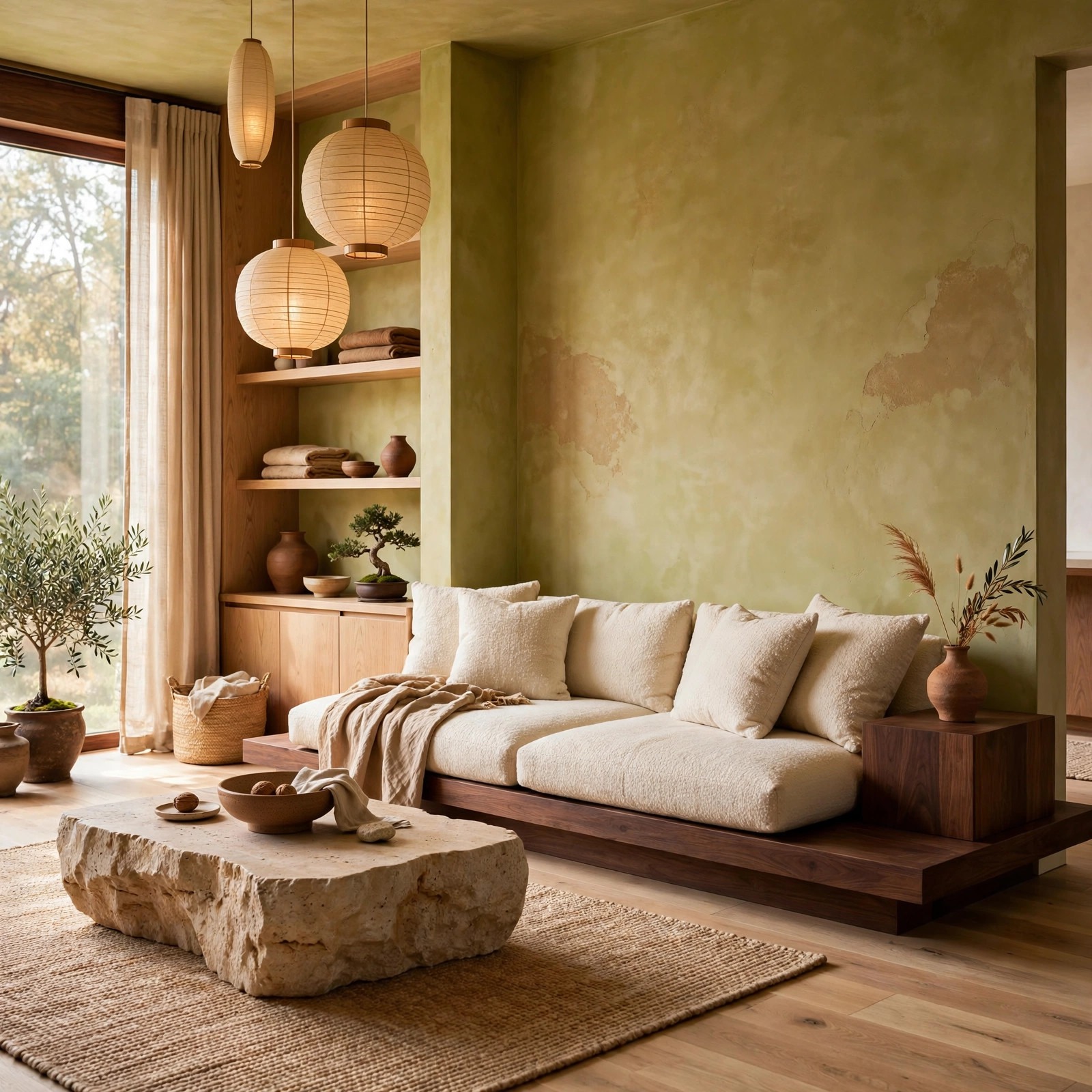
Low seating is the heartbeat of a japandi living room. A platform sofa that sits close to the floor changes how the whole room feels, more grounded, more relaxed, more connected to the space. Look for a dark wood base with thick cushions in cream boucle or natural linen. Keep the back low so sightlines stay open. You will find yourself lingering longer in a room that meets you at this calmer height.
3. Warm dark walnut floors
The 2026 japandi living room has moved decisively toward dark wood, and walnut floors are the foundation of that shift. Wide planks in a deep, warm brown ground the room and make pale textiles glow against them. The contrast is what gives the style its new richness. If replacing floors is too much, a large dark-stained area rug over existing boards gives you the same grounding effect for far less commitment.
4. The shoji screen divider
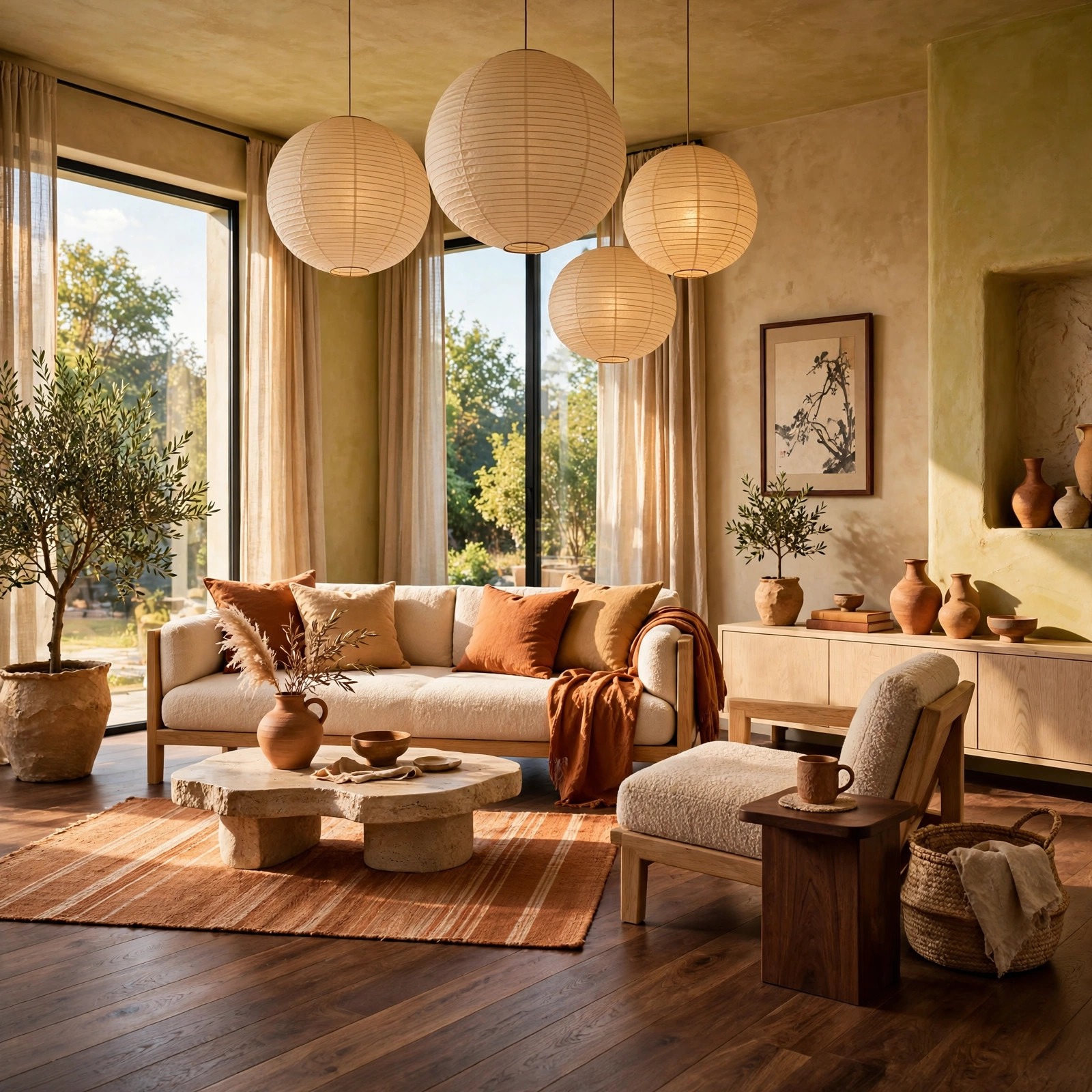
A shoji screen is the most poetic way to divide a japandi living room without building a wall. The wooden lattice with rice-paper panels filters light into something soft and golden, and it slides away when you want the space open again. Use one to carve a reading corner from a larger room or to hide a workspace. It is functional sculpture, and it brings authentic Japanese craft into the room in a single move.
5. Wabi-sabi plaster texture
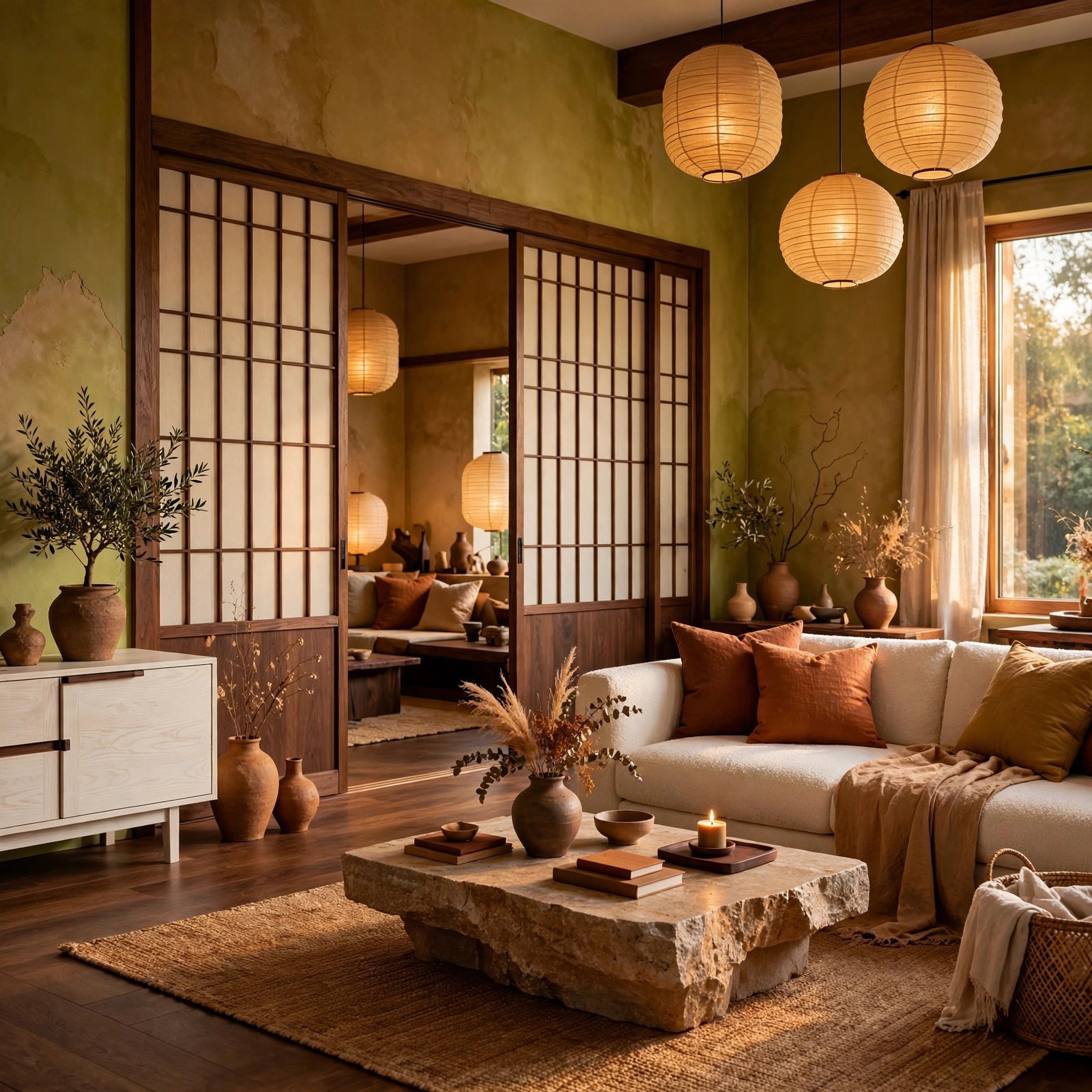
Wabi-sabi is the philosophy of finding beauty in imperfection, and hand-troweled plaster walls are its purest expression in a japandi living room. The subtle ridges and variations catch daylight differently every hour, so the wall feels alive. Keep furniture minimal against it so the texture reads clearly. This is luxury that whispers: a wall finished by hand, imperfect on purpose, and more interesting than any wallpaper could be.
6. The paper lantern pendant cluster
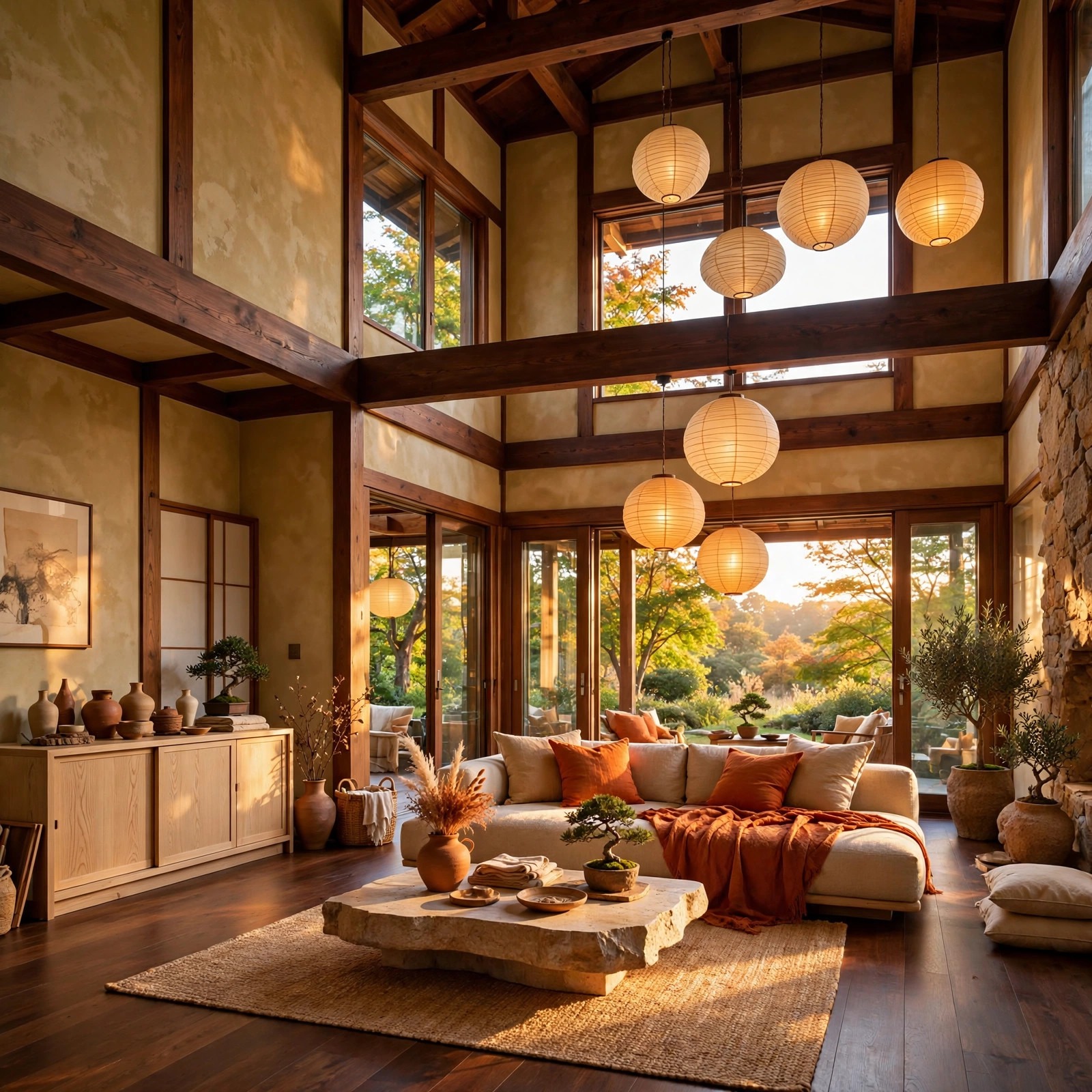
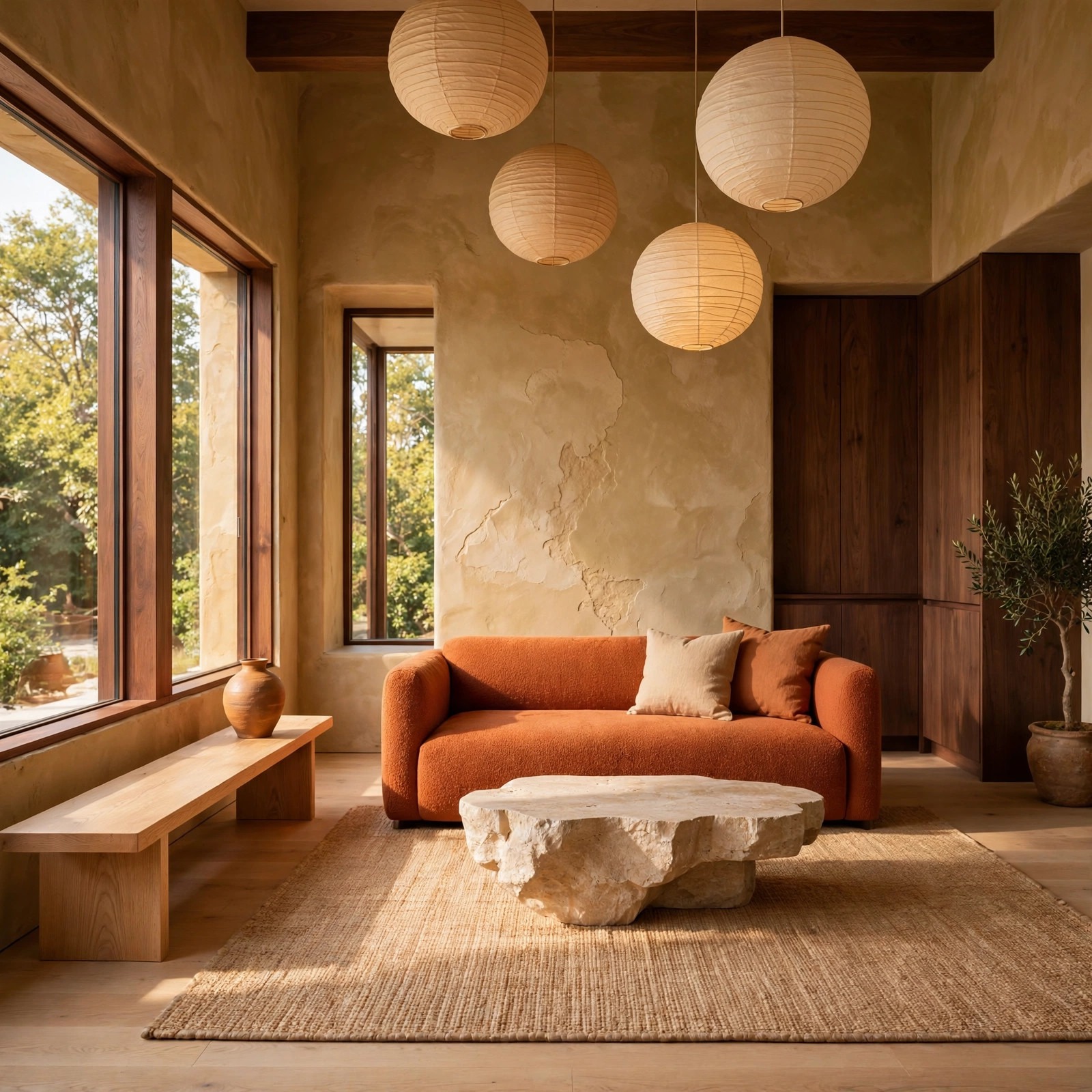
Nothing says japandi living room quite like washi paper lanterns glowing overhead. Hang three at staggered heights over your coffee table or seating zone for a soft, moonlike light that flatters everyone in the room. The paper diffuses glare completely, so evenings feel gentle. Choose warm white rather than cool daylight bulbs. When they glow at dusk, the whole room seems to exhale, and that is exactly the atmosphere you are building.
7. The tokonoma display alcove
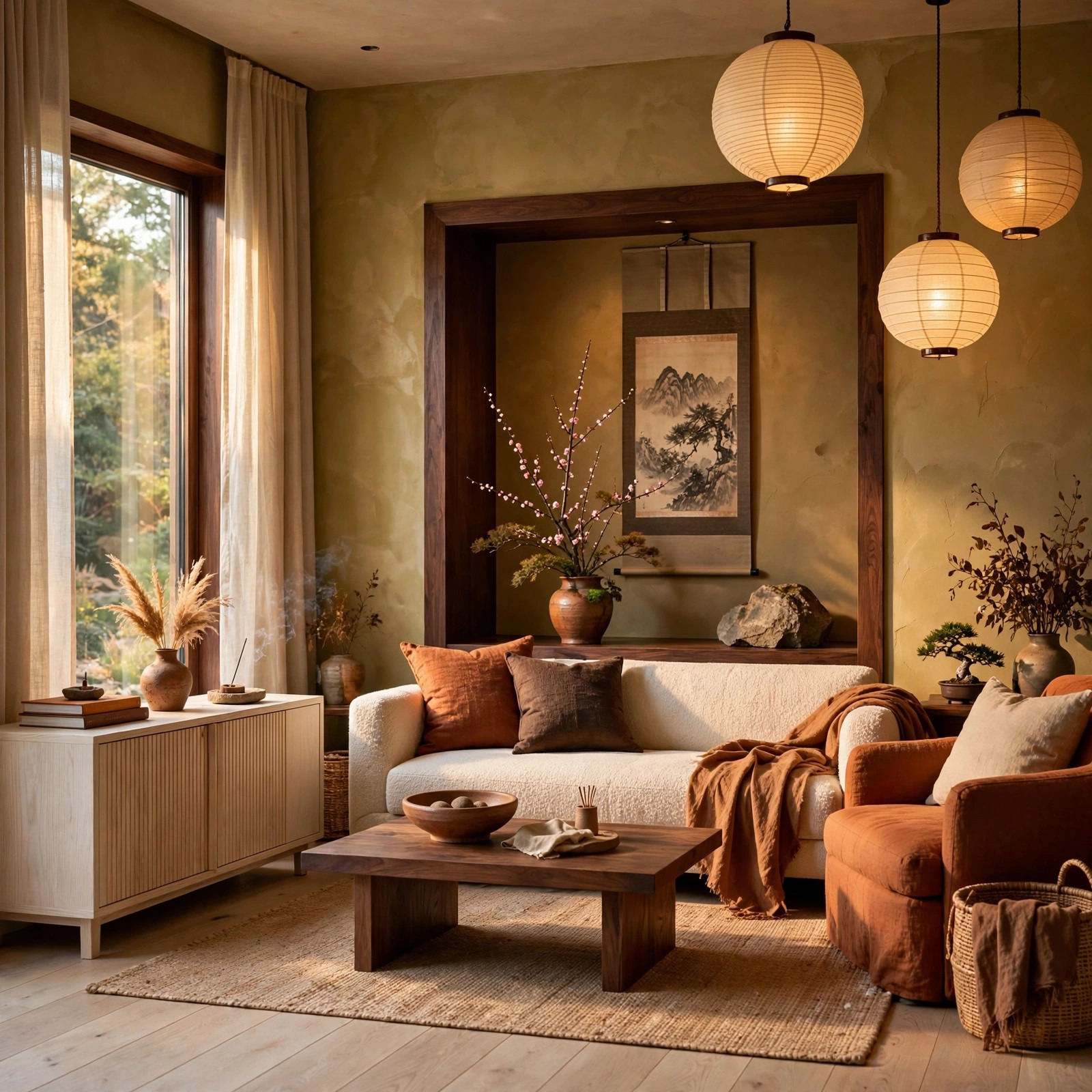
Borrow the tokonoma, the Japanese display alcove, and give your japandi living room a soulful focal point. A shallow recessed niche holding one hanging scroll, a small ikebana arrangement, and a single stone becomes the quiet heart of the room. The discipline of displaying only three things teaches the whole space restraint. If you cannot build a recess, a simple oak picture ledge styled with the same discipline gives you the same meditative effect.
8. Boucle meets linen layering
Texture is the color palette of a japandi living room, and the boucle-plus-linen combination is its richest expression. A cream boucle armchair with a washed natural-linen throw gives you two depths of softness in one seat. The nubby wool against the slubby flax reads as luxury without any pattern or shine. Layer them generously; in a style this restrained, textiles carry the sensory weight of the whole room.
9. The blackened oak coffee table
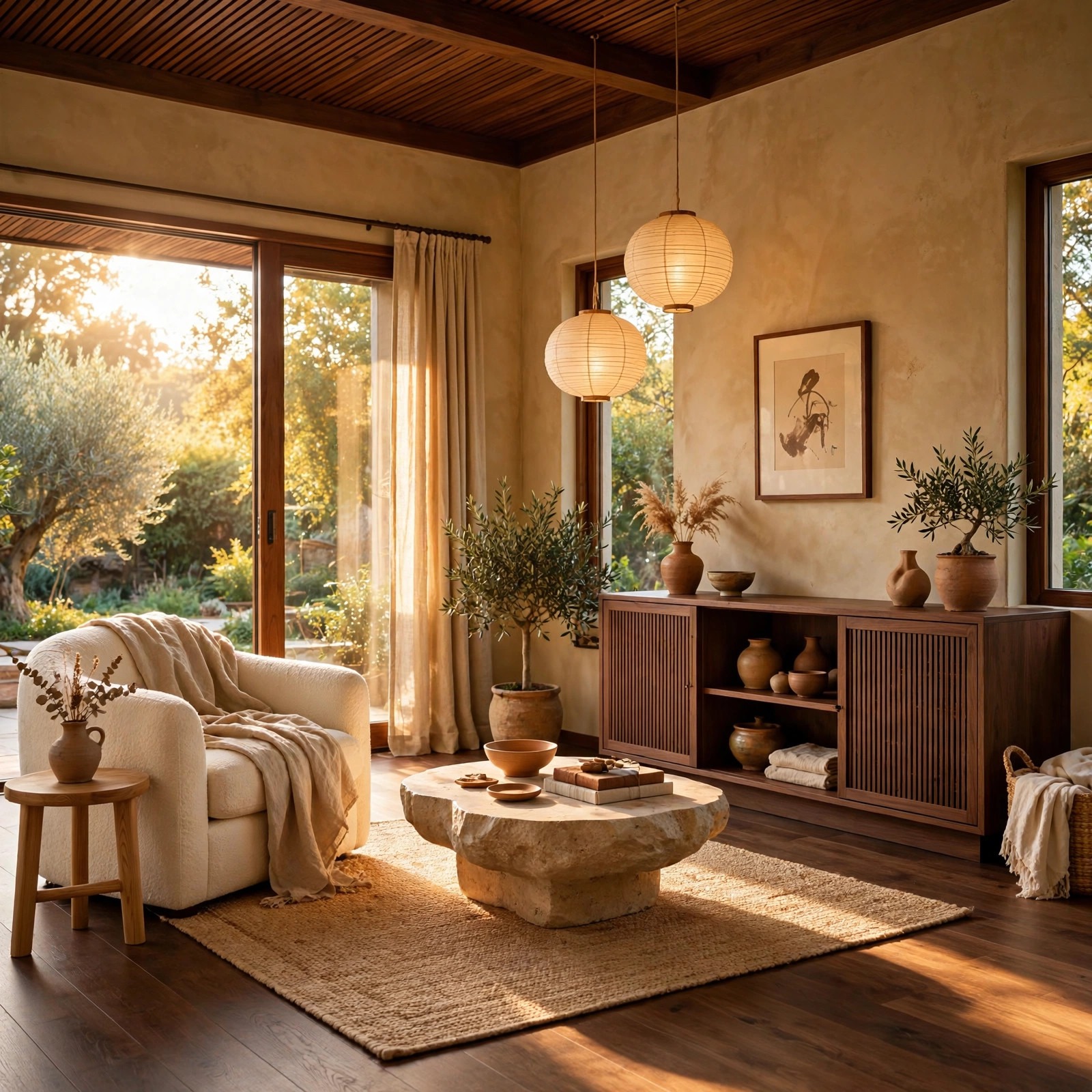
A low coffee table in blackened oak anchors a japandi living room the way a hearth once did — and at Christmas the same low table takes a festive turn, as christmas coffee table decor ideas show. The near-black wood has a charred, elemental quality that feels both ancient and modern, and its low height keeps the room’s sightlines calm. Style it with almost nothing: a stone bowl, one handmade ceramic, space to breathe. The table’s dark mass against pale textiles is the contrast that makes the 2026 version of this style feel so grown-up.
10. The tatami-textured area rug
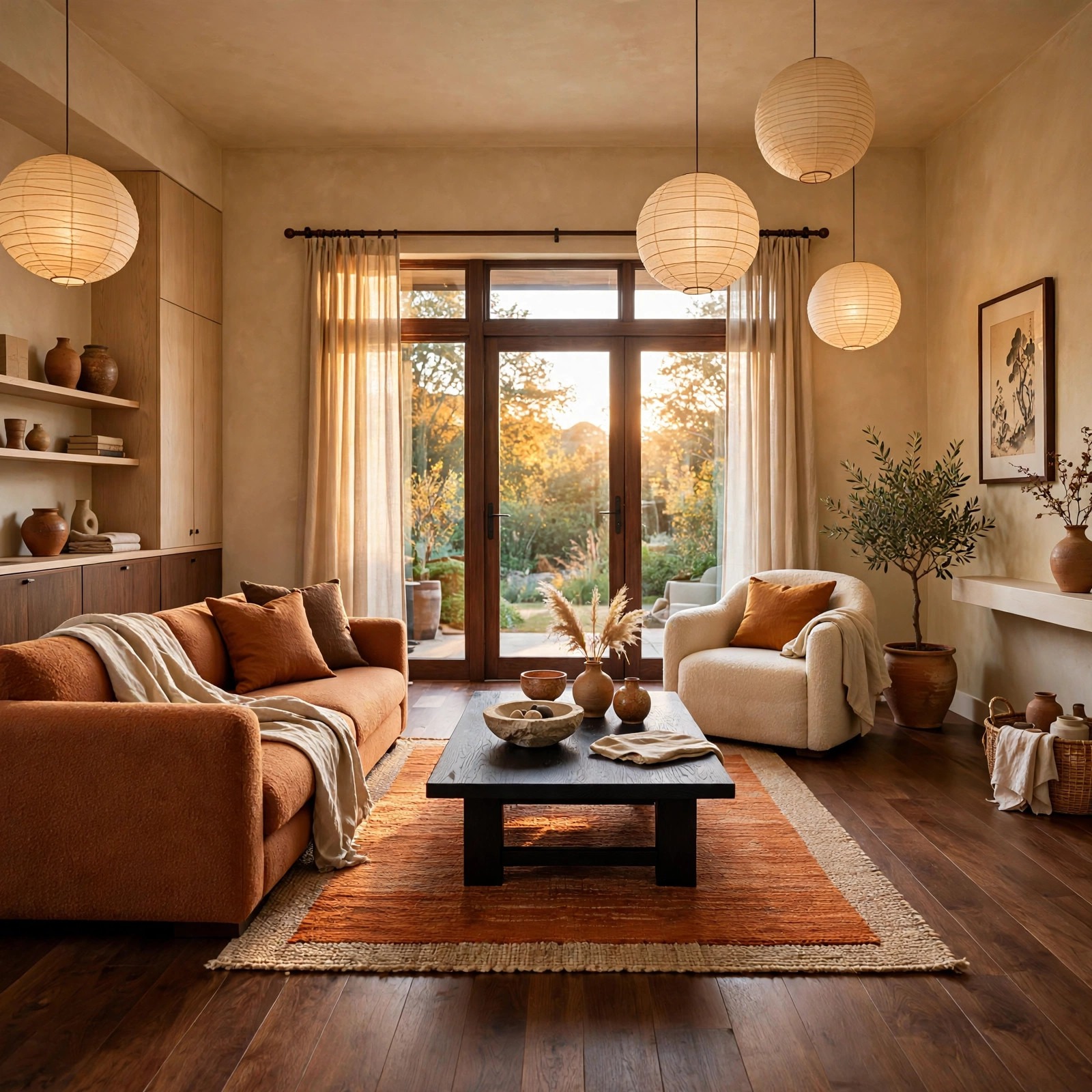
A rug with the tight, grassy weave of tatami brings Japanese material honesty straight underfoot in your japandi living room. Natural fibers like jute, sisal, or seagrass give you that same crisp texture with serious durability. Layer a smaller wool rug on top for softness where feet land. The woven surface adds pattern through texture alone, which is the japandi way: interest without busyness, comfort without clutter.
11. The bonsai focal point
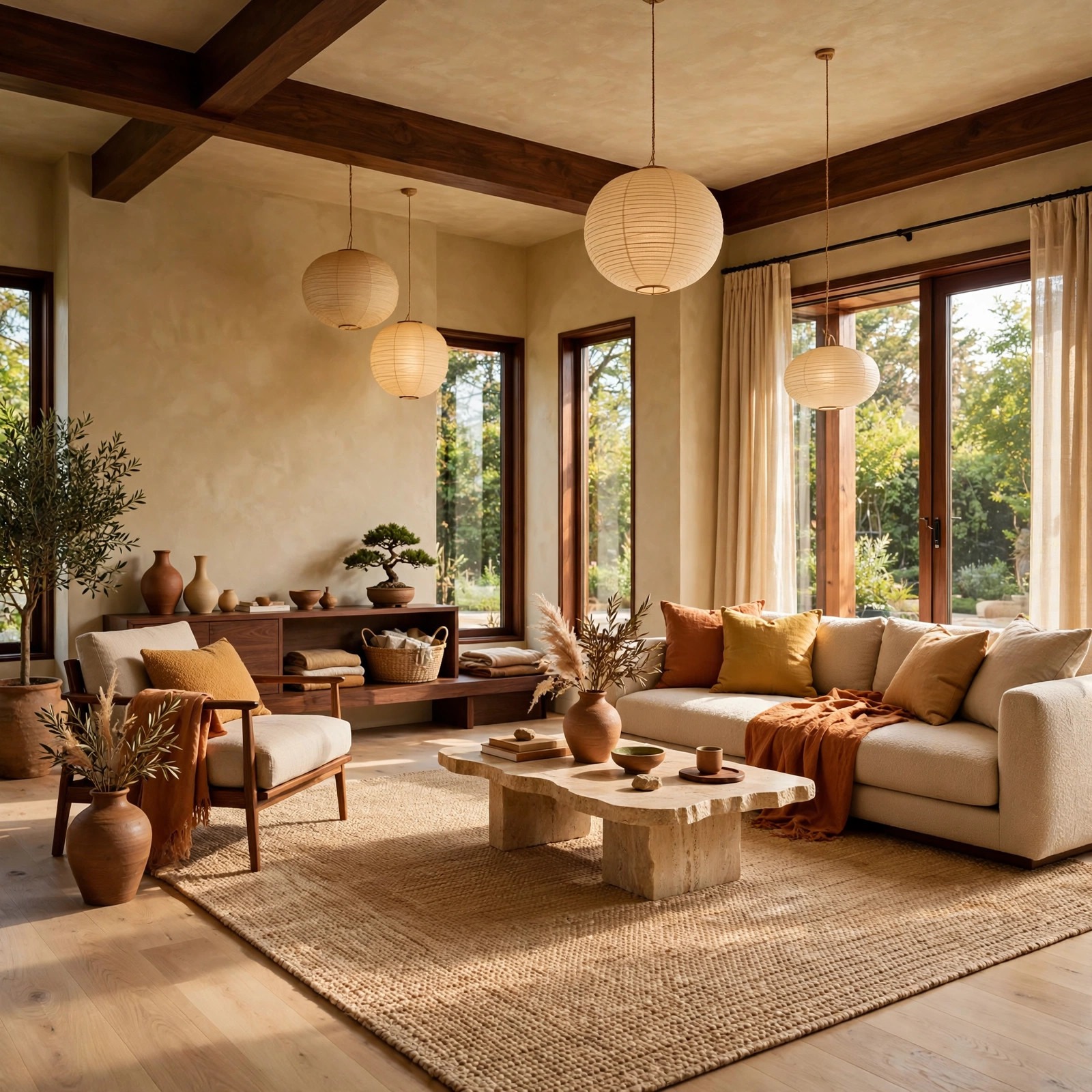
One sculptural bonsai, given pride of place on a dark wooden plinth, can carry the entire spirit of a japandi living room. It is living art shaped by patience, and its tiny scale against the room’s calm makes everything feel more deliberate. Give it good daylight and a simple backdrop so its silhouette reads clearly. A bonsai asks for a little daily care, and that small ritual of attention is very much part of the philosophy.
12. Ikebana on the mantel
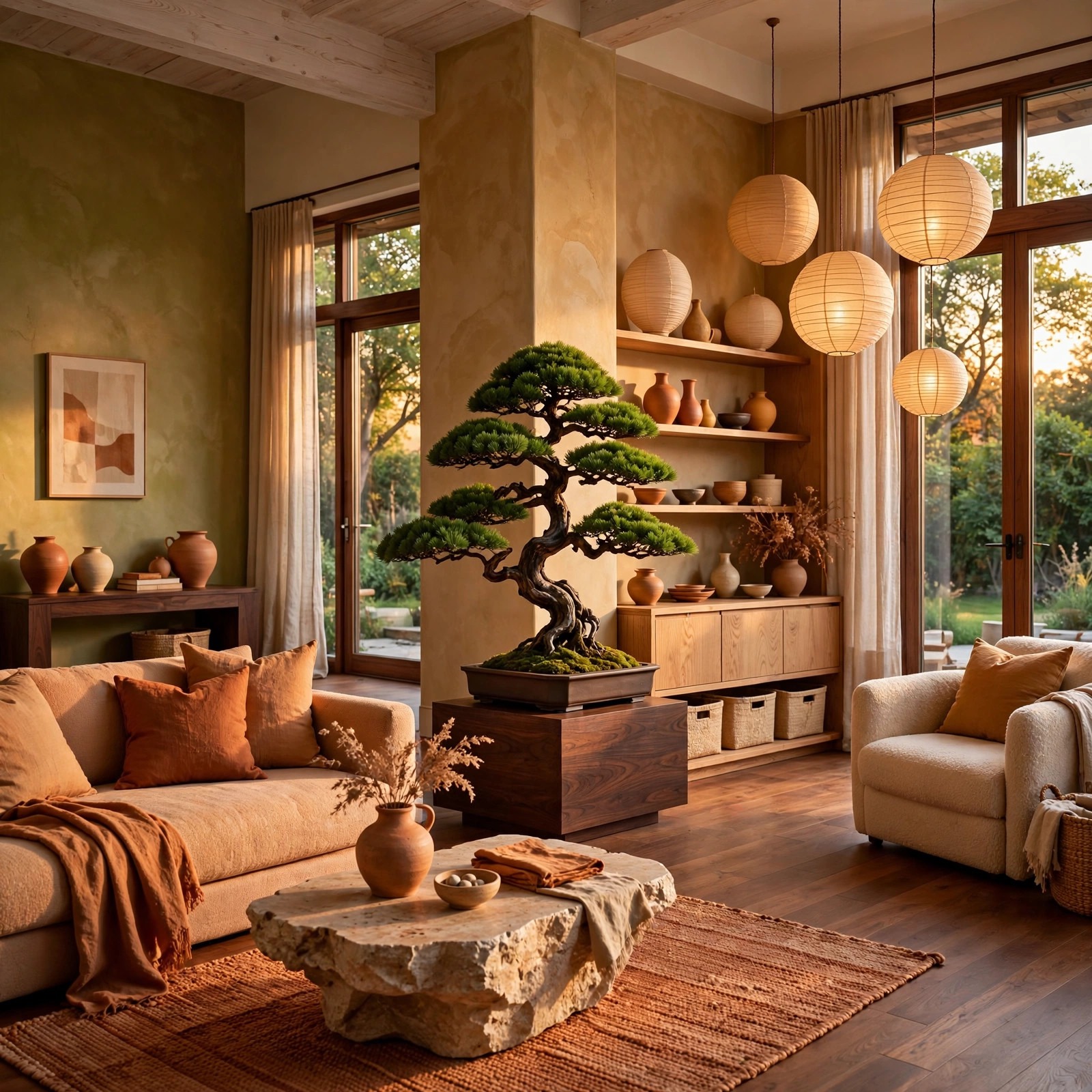
Ikebana, the Japanese art of flower arranging, turns a mantel into a meditation in your japandi living room. Unlike Western bouquets, it celebrates line and empty space: three stems, one branch, room to breathe. A tall arrangement in a handmade clay vase needs nothing else around it. Change it with the seasons and the mantel becomes a living calendar. Autumn is the richest season for that swap, and these fall living room decor ideas show the palette at its warmest. At Christmas, the same mantel takes on the season with one branch and a candle, as these christmas mantel decor ideas show. This single discipline will teach you more about restraint than any decor book.
13. Fluted wood paneling
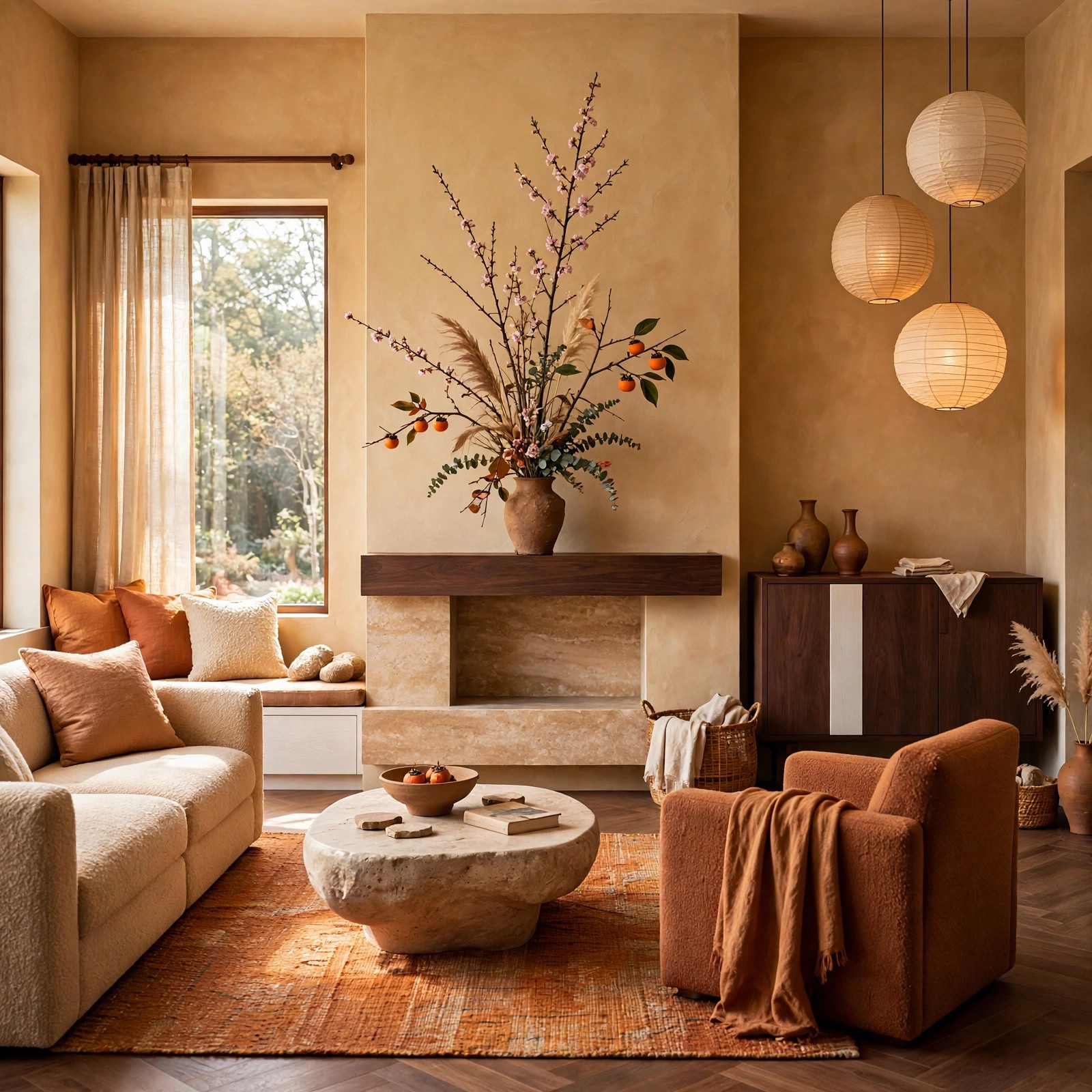
Fluted oak paneling gives a japandi living room rhythm and shadow without any ornament. The vertical reeds catch light in narrow stripes, so a flat wall gains depth and craft. Use it behind the sofa or as a full feature wall in white oak for lightness, dark walnut for drama. The repetition is quietly hypnotic, and it hides a television beautifully if you mount one against it. That pale-oak-against-black discipline is the whole idea behind these white oak and black kitchen ideas. Texture, again, doing the work that color does elsewhere.
14. The sunken conversation corner
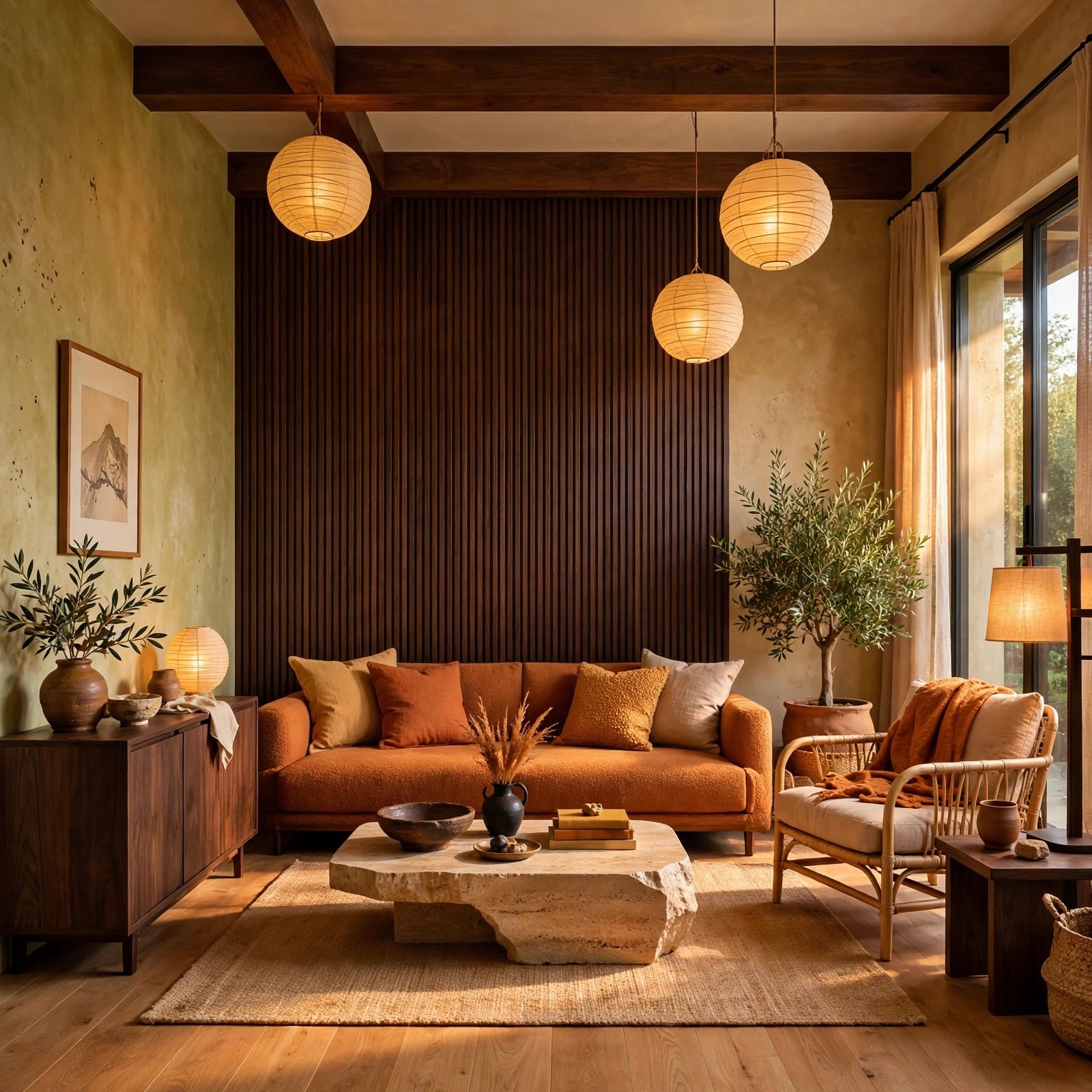
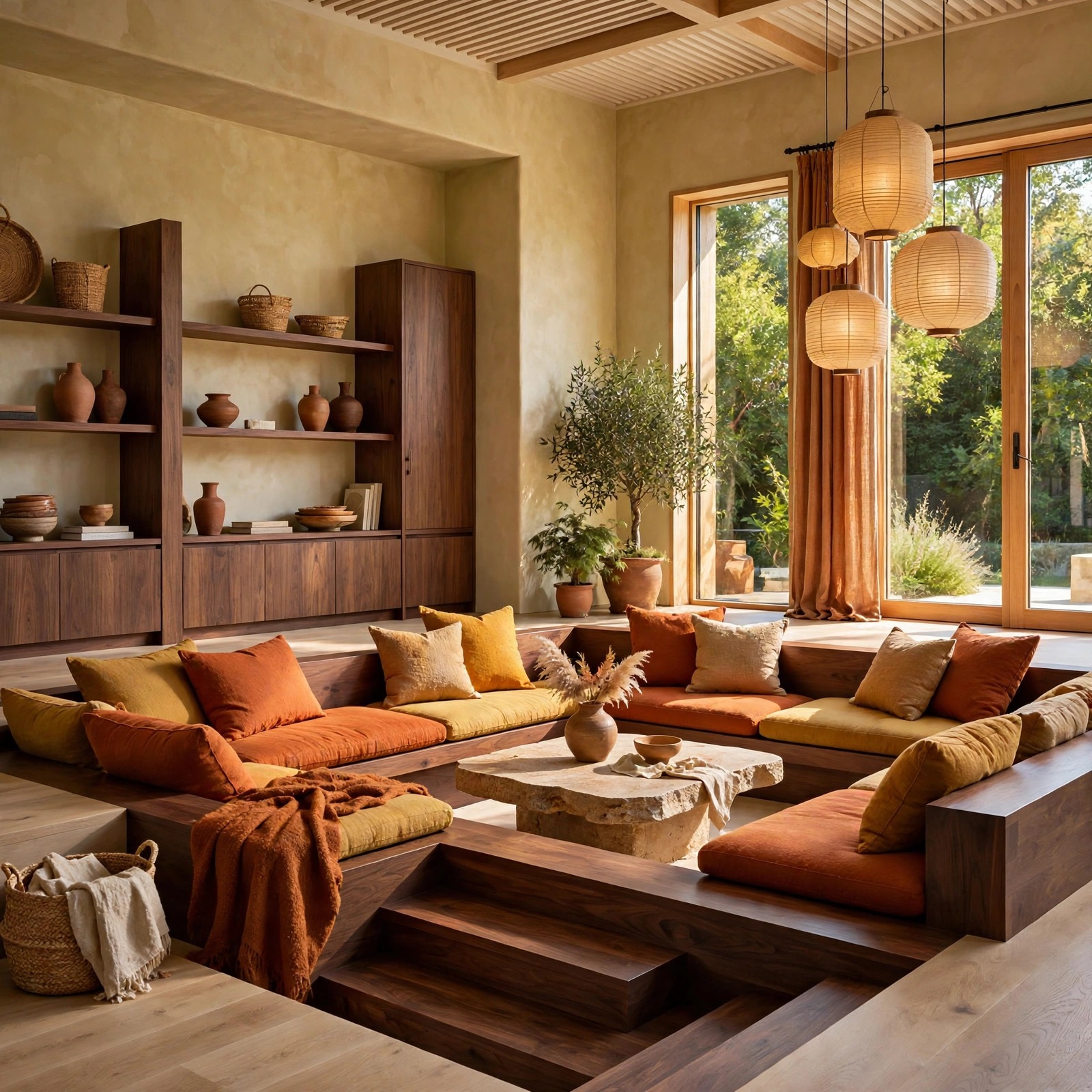
If your architecture allows it, a sunken lounge area is the ultimate japandi living room gesture. Dropping the seating zone by even one step creates intimacy and ceremony around conversation, with built-in benches and deep cushions doing the work of sofas. It feels ancient and modern at once, like a fire pit given architecture. Even a defined rug zone with floor-level seating captures some of this gathered, grounded magic.
15. Clay and stone accents
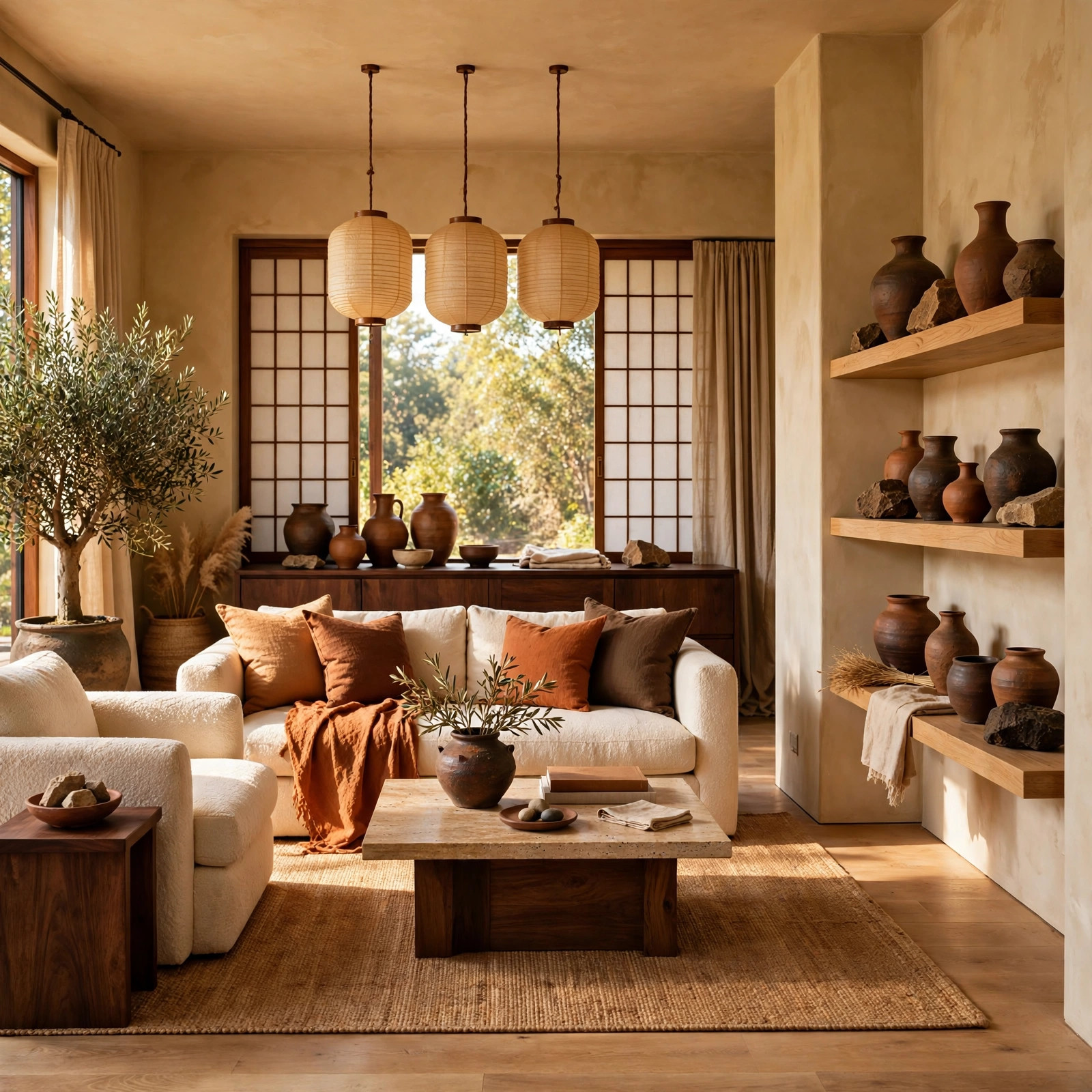
In a japandi living room, the smallest objects carry the most meaning. A rough clay vessel, a smooth river stone, a hand-carved wooden bowl: these elemental pieces connect the room to the natural world. Group them in odd numbers on oak shelving and give each space. Their imperfections are the point, wabi-sabi made tangible. When everything else in the room is calm and pale, these earthy notes keep it feeling human and warm.
16. The noren curtain doorway
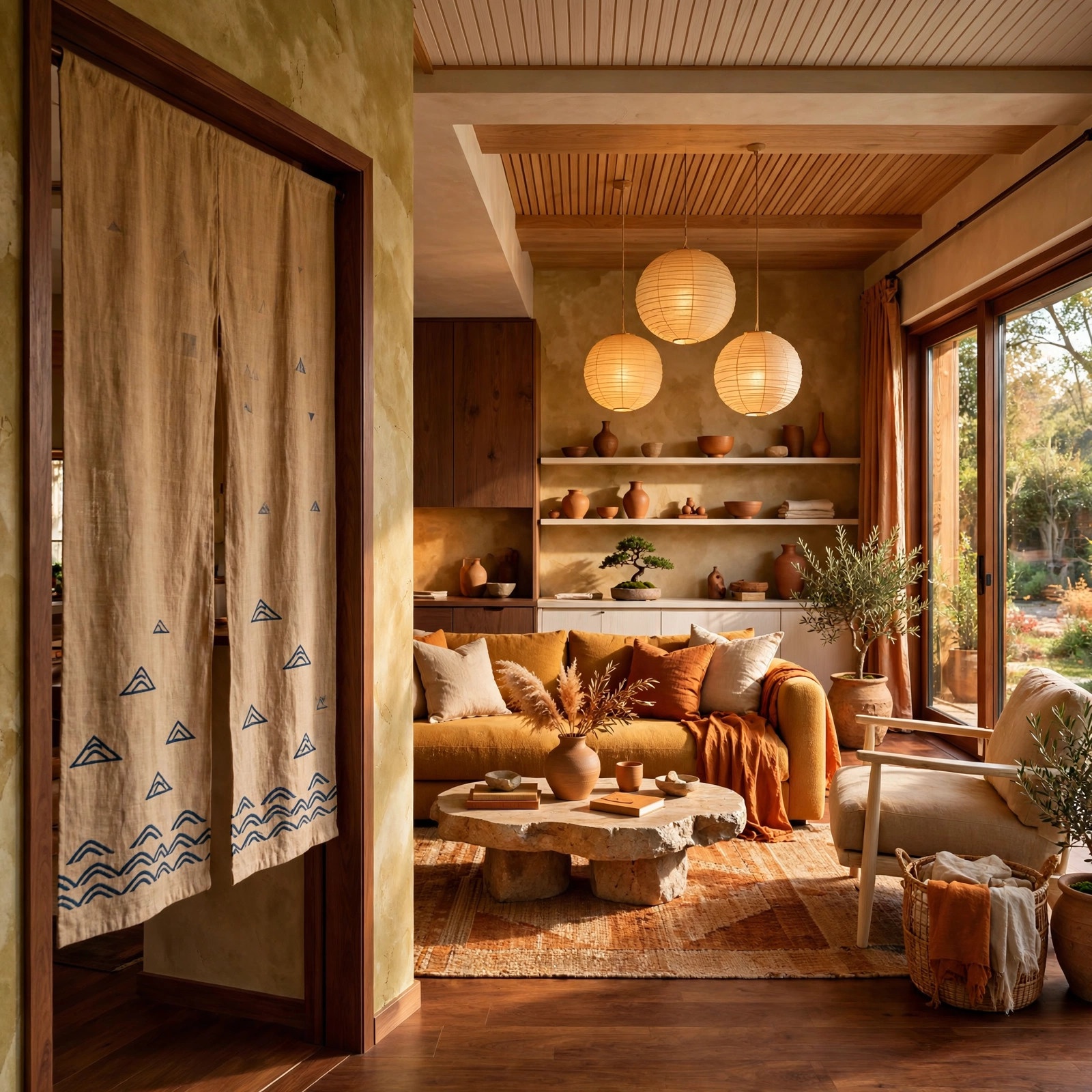
A noren, the split fabric curtain hung in Japanese doorways, is a beautiful soft threshold for a japandi living room. It marks the passage between rooms without a door’s hardness, swaying gently and filtering both light and sound. Choose natural linen in undyed beige or with a simple indigo motif. It is a small move with an outsized effect: every time you push through it, you feel you are entering somewhere intentionally calm.
17. The low bookshelf divider
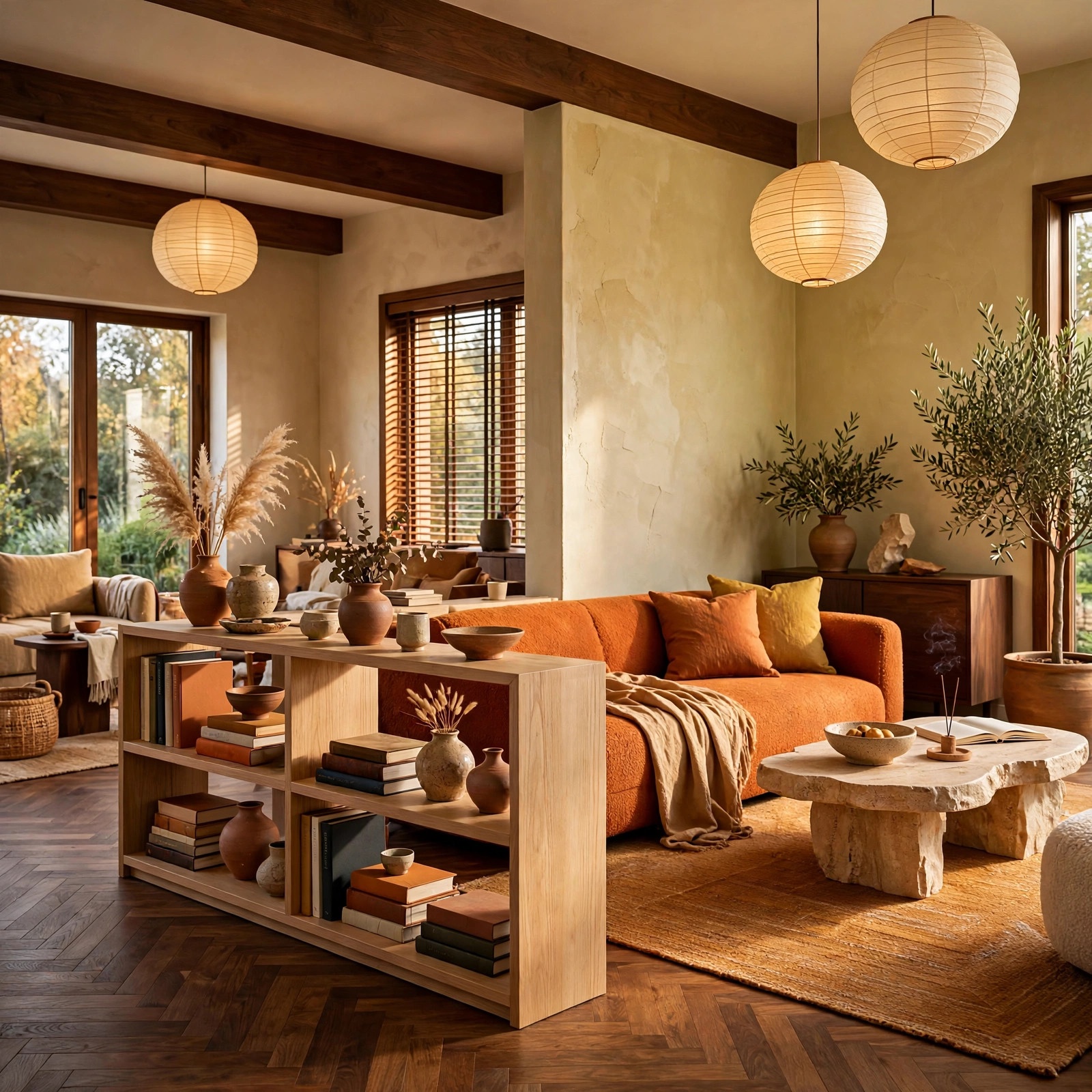
A low oak bookshelf, no taller than your hip, divides a japandi living room into zones while keeping every sightline open. It holds books and ceramics at exactly the height where they invite touch, and its top becomes a long display shelf for objects you love — the same book-lined calm as luxury home library ideas. This is zoning the japandi way: defined but never closed. Style the shelves sparsely, with breathing room between stacks, so the divider reads as furniture sculpture rather than storage.
18. The meditation nook
Carve one corner of your japandi living room into a dedicated stillness zone: zabuton cushions on a tatami mat, a low wooden altar holding a candle and a smooth stone, nothing else. It does not need to be large; it needs to be intentional. Even in a small space, a two-foot square of calm teaches the whole home restraint. Use it for morning tea, evening breath, or simply sitting. The room will feel larger for containing such deliberate emptiness.
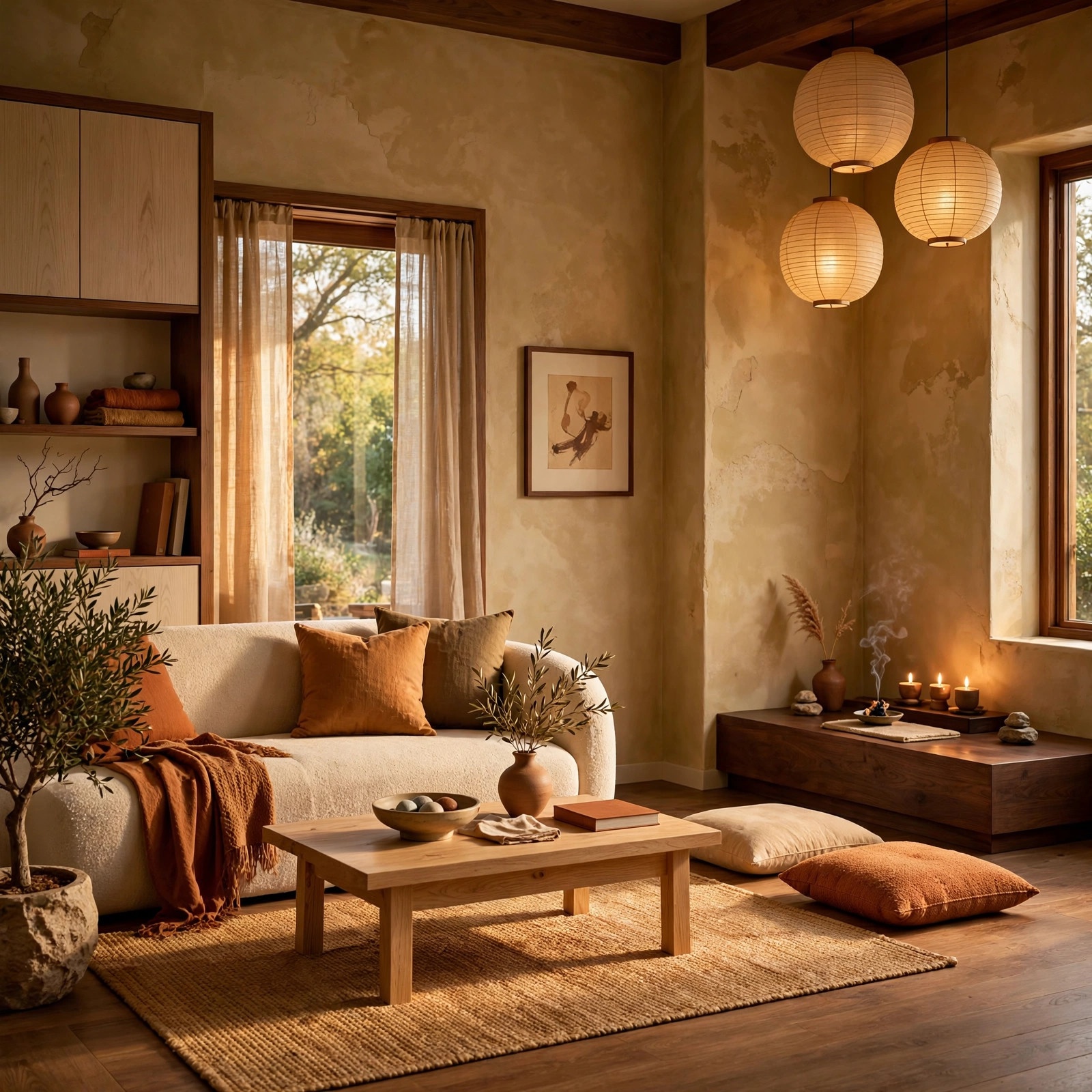
19. The warm minimal fireplace
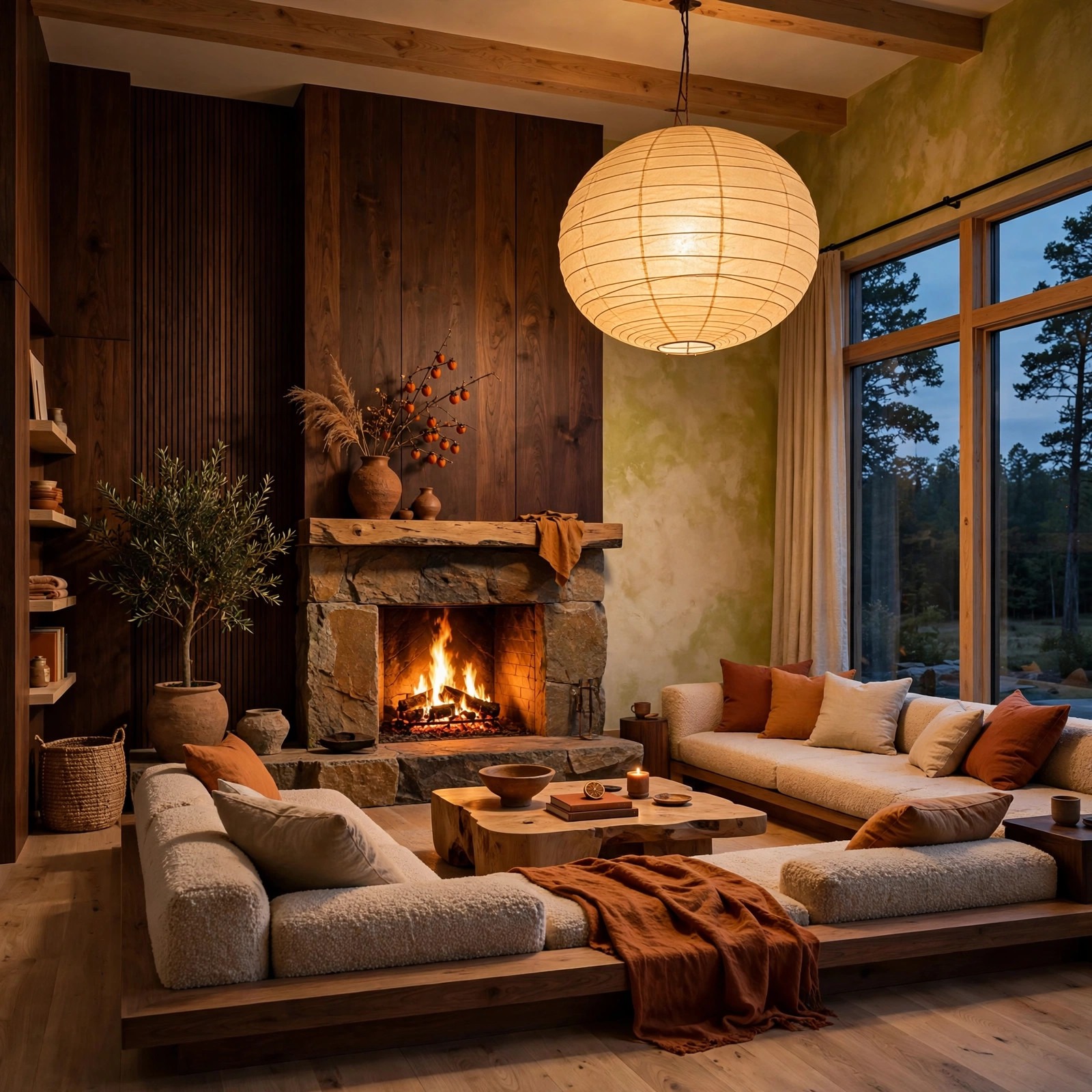
A fireplace in a japandi living room should feel carved from the wall itself: a simple linear opening with a limewash plaster surround, no mantel clutter, no fussy trim. The fire becomes a living texture, the one moving element in a still room. Flank it with low walnut benches rather than bulky seating. In the evening, with only the fire and one paper lantern lit, the room achieves the deep calm this whole style is chasing. The same firelit calm fills a whole living room in these cozy fireplace living room ideas.
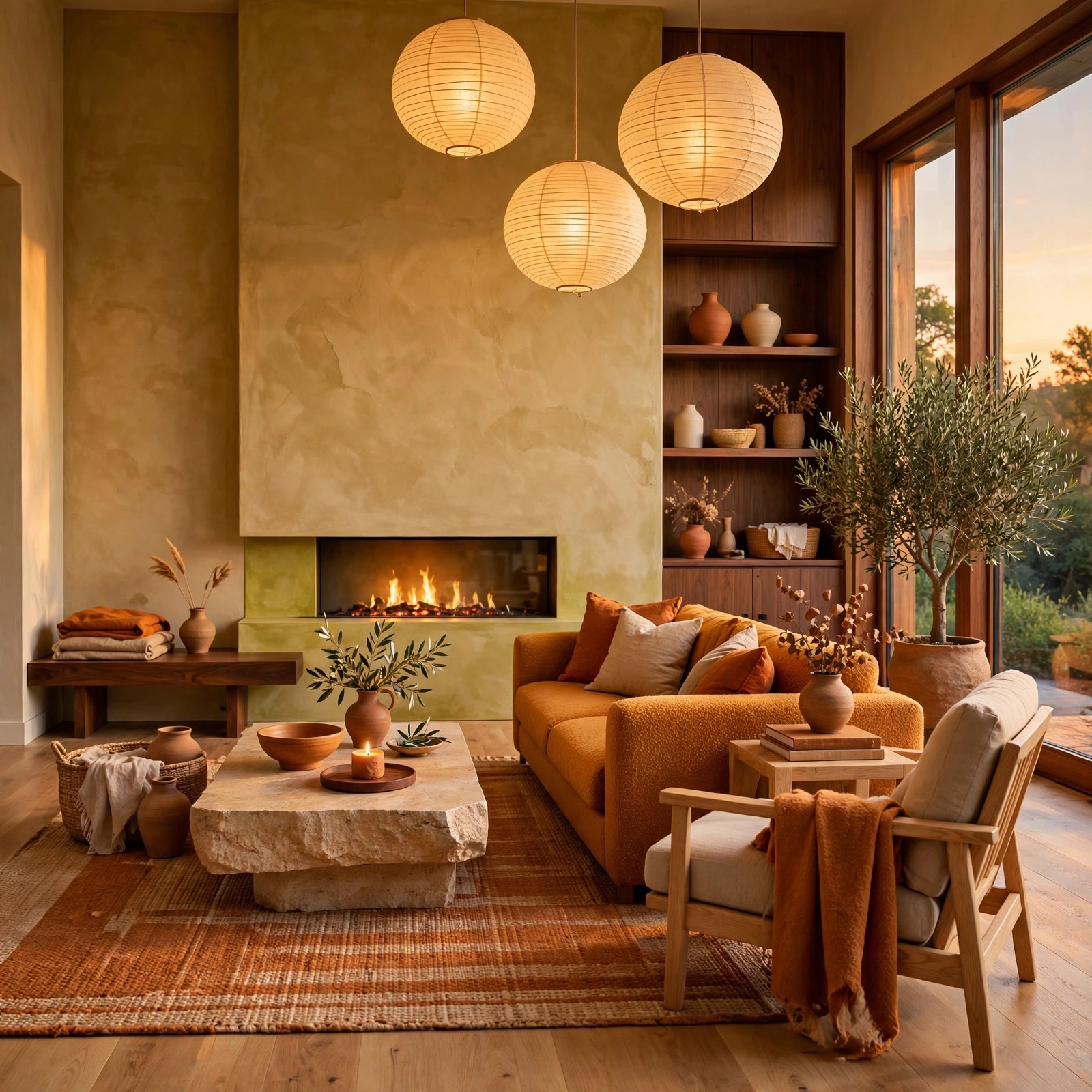
20. Rattan and cane details
Rattan and cane bring a hand-woven warmth that keeps a japandi living room from feeling austere. A rattan armchair with a deep linen cushion, or an oak cabinet with cane-front doors, adds craft and breathability to the material palette. The open weave plays beautifully against solid walnut and smooth stone. These pieces have a vintage soul that suits the 2026 direction perfectly: collected, tactile, and quietly luxurious without trying.
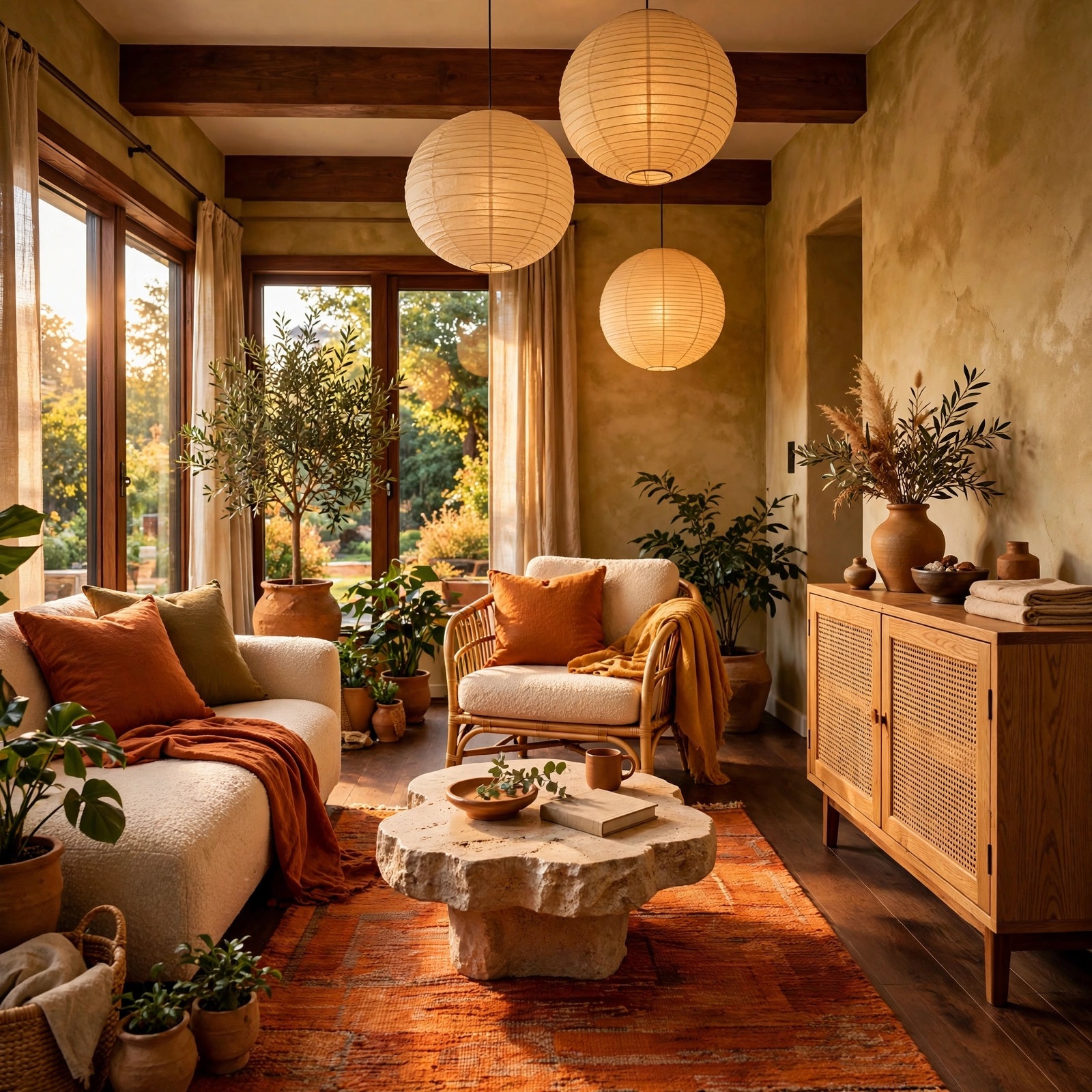
21. The tea ceremony corner
Dedicate a corner of your japandi living room to tea: a low table, a tatami mat, a beautiful tea set arranged with care. You do not need to master the ceremony; the point is having a place where slowing down is the activity. Keep a small tea station nearby with your favorite leaves in handmade jars. Guests will remember this corner long after they forget your sofa, because ritual is what makes a house feel like a home. An evening drinks corner follows the same ritual thinking, and these luxury home bar ideas show how to style one.
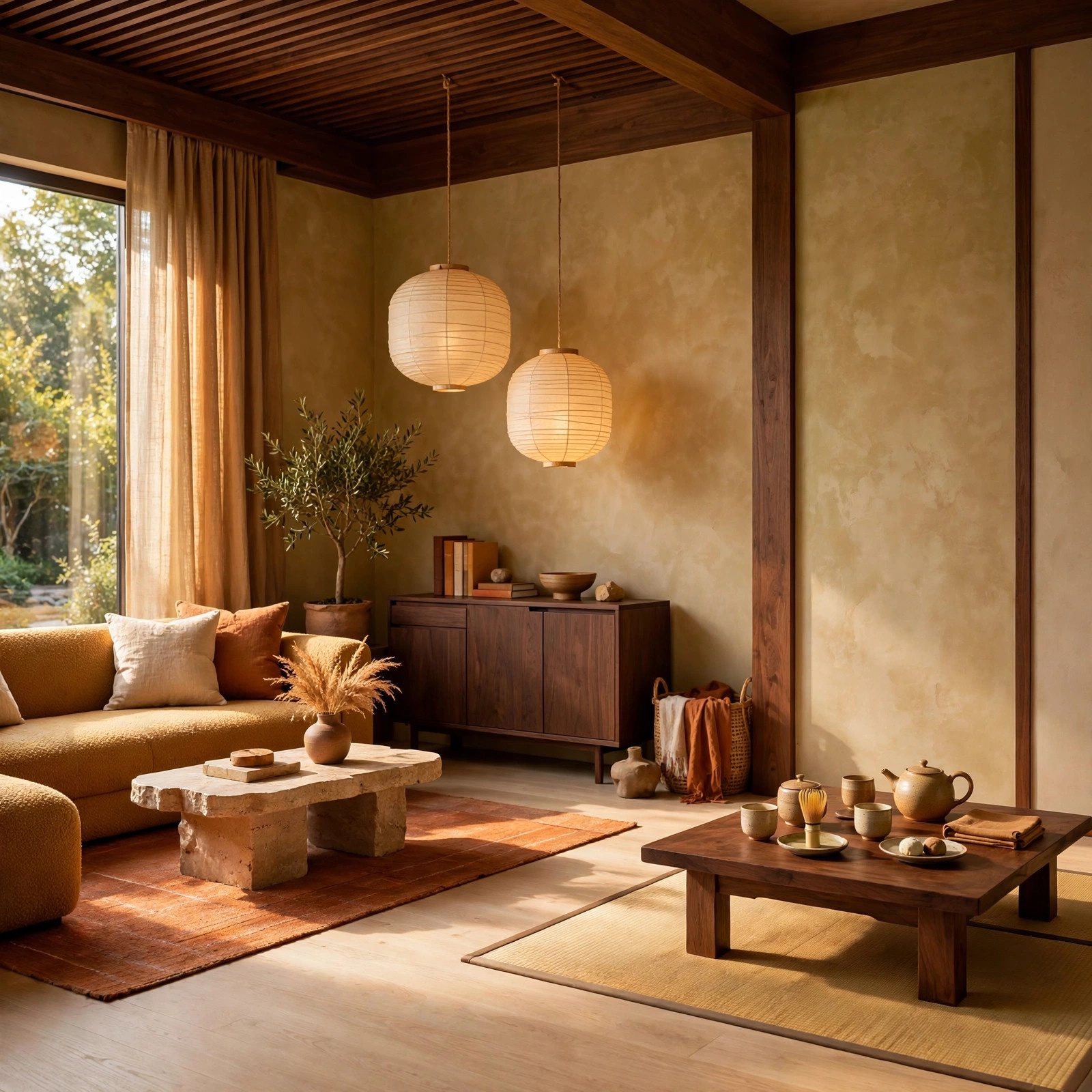
22. Oversized floor cushions
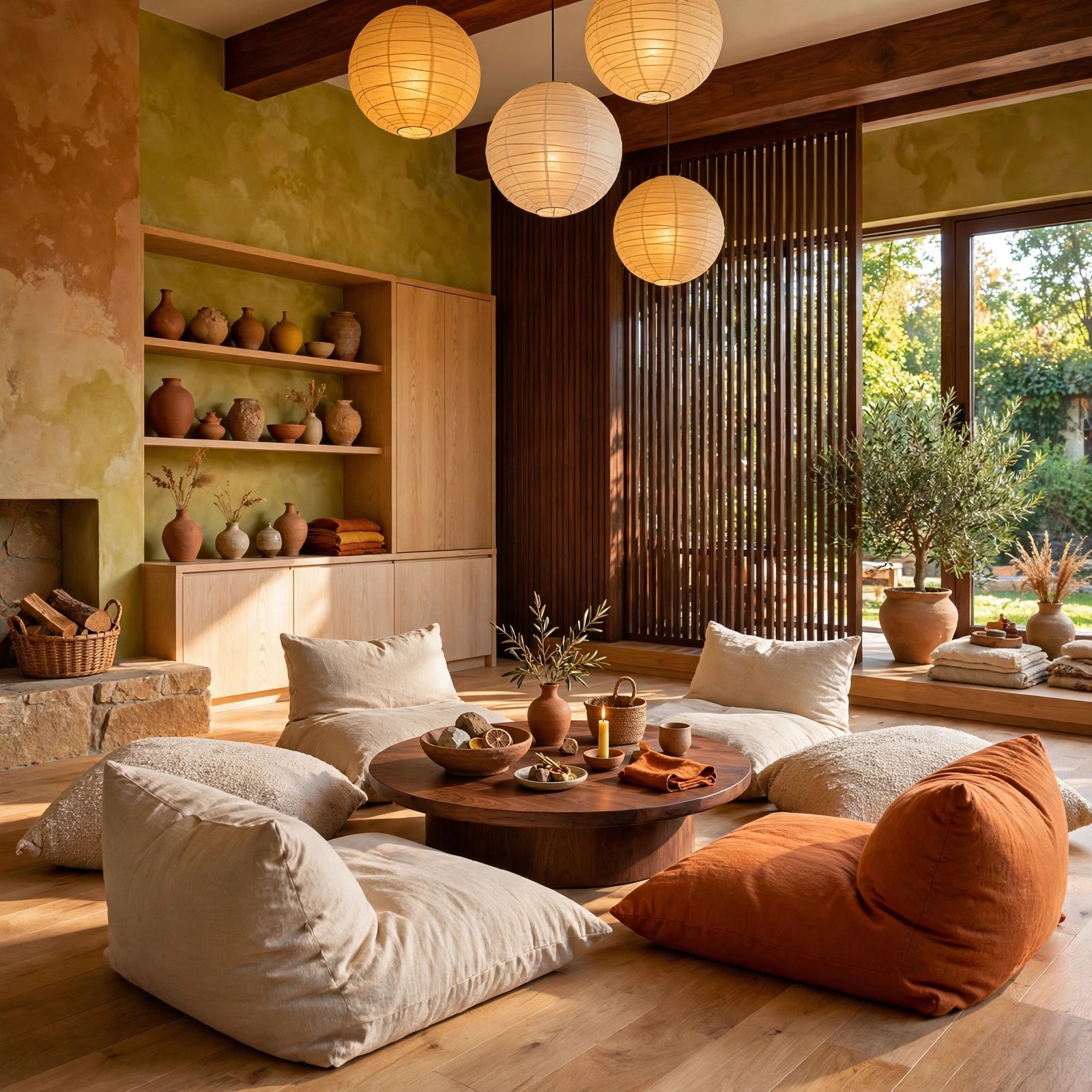
Oversized floor cushions in natural linen turn any japandi living room into an invitation to sprawl. They are the most democratic seating there is: pull them around a low table for an evening that feels like a beautiful picnic indoors. Choose dense, supportive fills so they hold their shape, and covers you can remove and wash. Their informality is their luxury, a room confident enough to let you sit on the floor in style.
23. The charcoal and cream palette
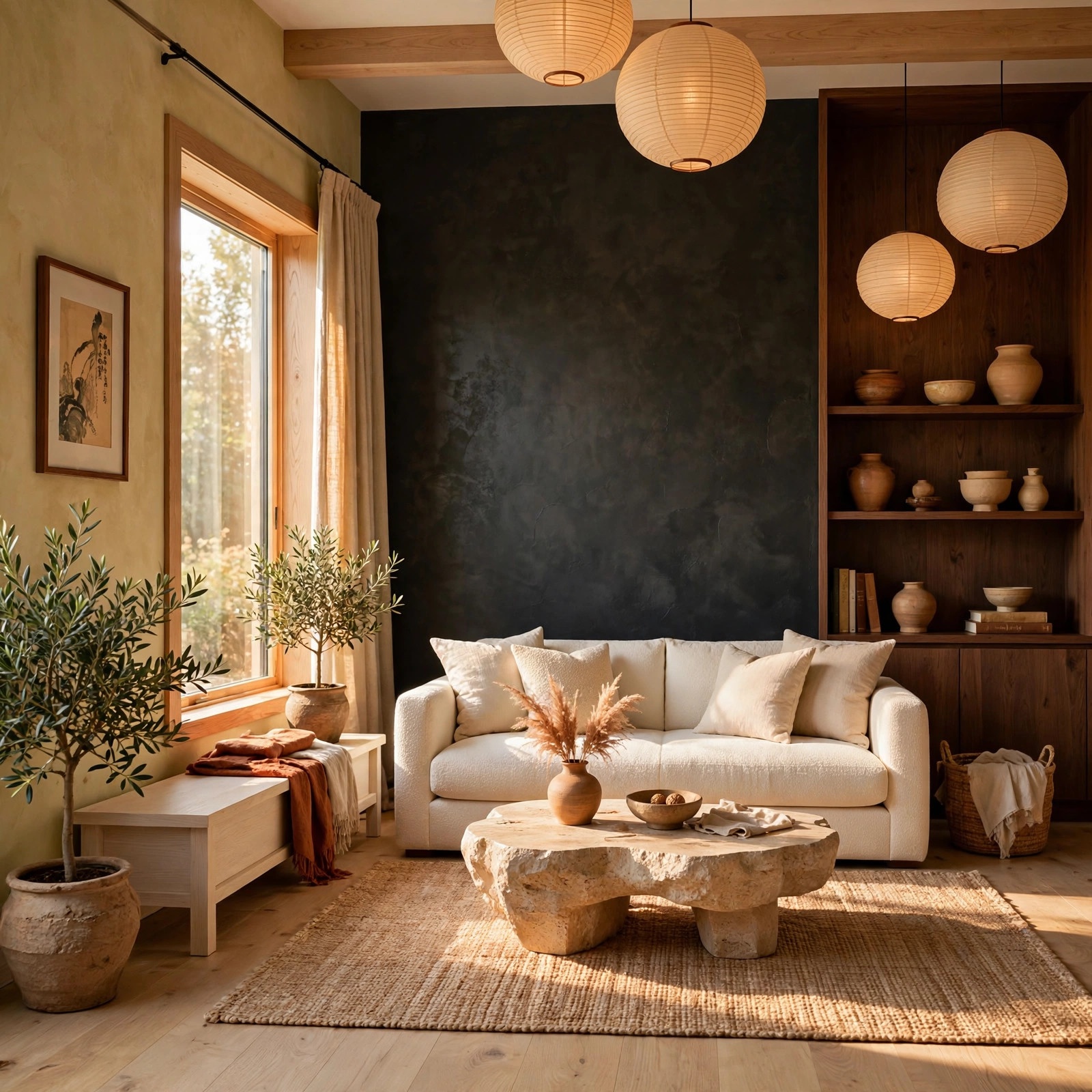
The 2026 japandi living room is not afraid of darkness, and a charcoal accent wall behind cream upholstery is its signature contrast. The deep, warm gray makes pale linen glow and gives walnut furniture a gallery-like presence. Keep the charcoal warm rather than blue, and balance it with plenty of natural light. This is mood without gloom: the room feels cocooning at night and sophisticated by day, a palette with real emotional range. If you love the darker end of this palette, these dark cottagecore kitchen ideas take the same shadowy mood into the kitchen.
24. The sculptural floor lamp
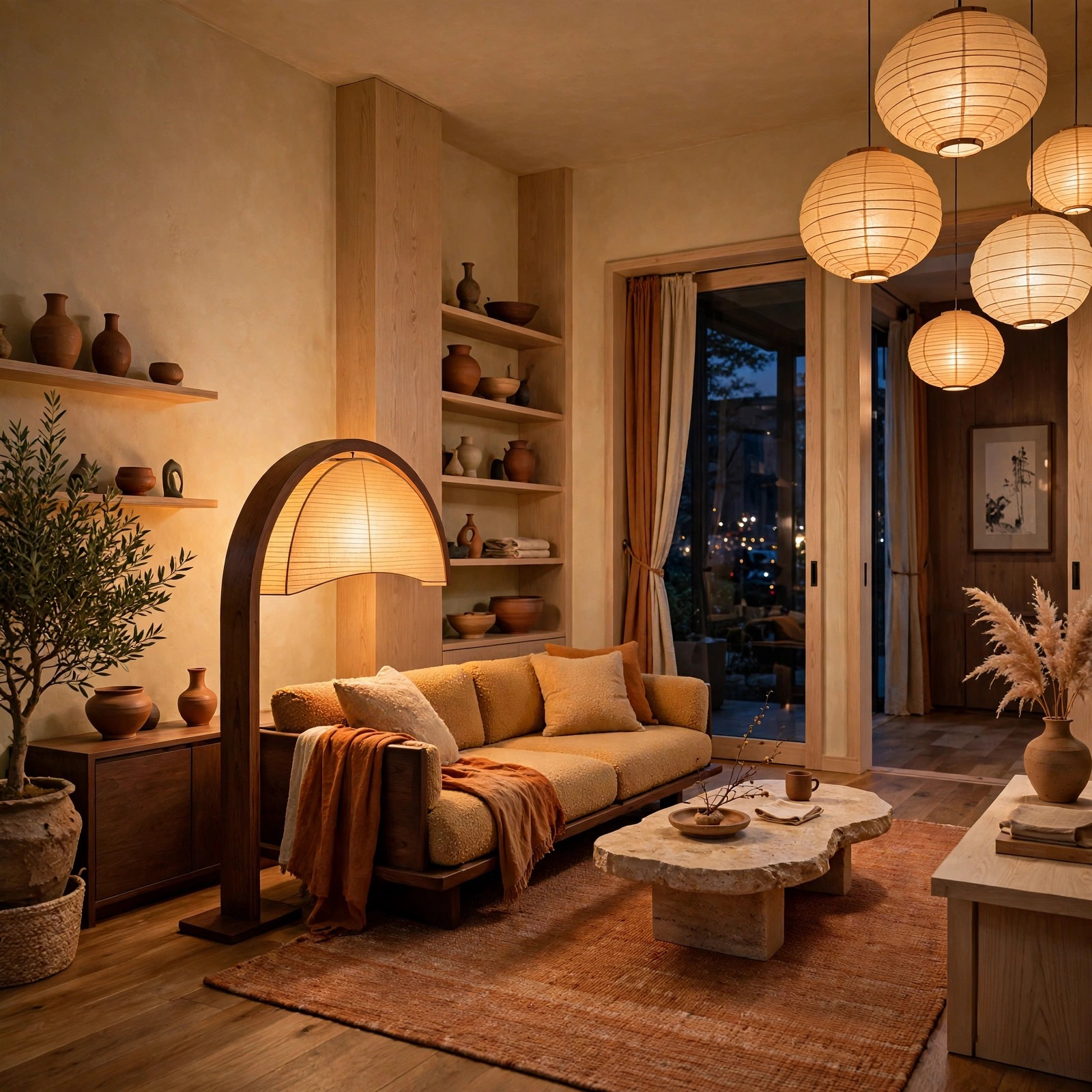
One sculptural floor lamp can be the jewelry of a japandi living room. An arched washi-paper shade or a bent-wood arc throws a pool of warm light exactly where evening reading happens, and its silhouette reads as art even by day. Place it beside your lowest chair so the light falls over your shoulder. In a style built on restraint, a single beautiful light source earns its place by working twice as hard.
25. The live-edge wood bench
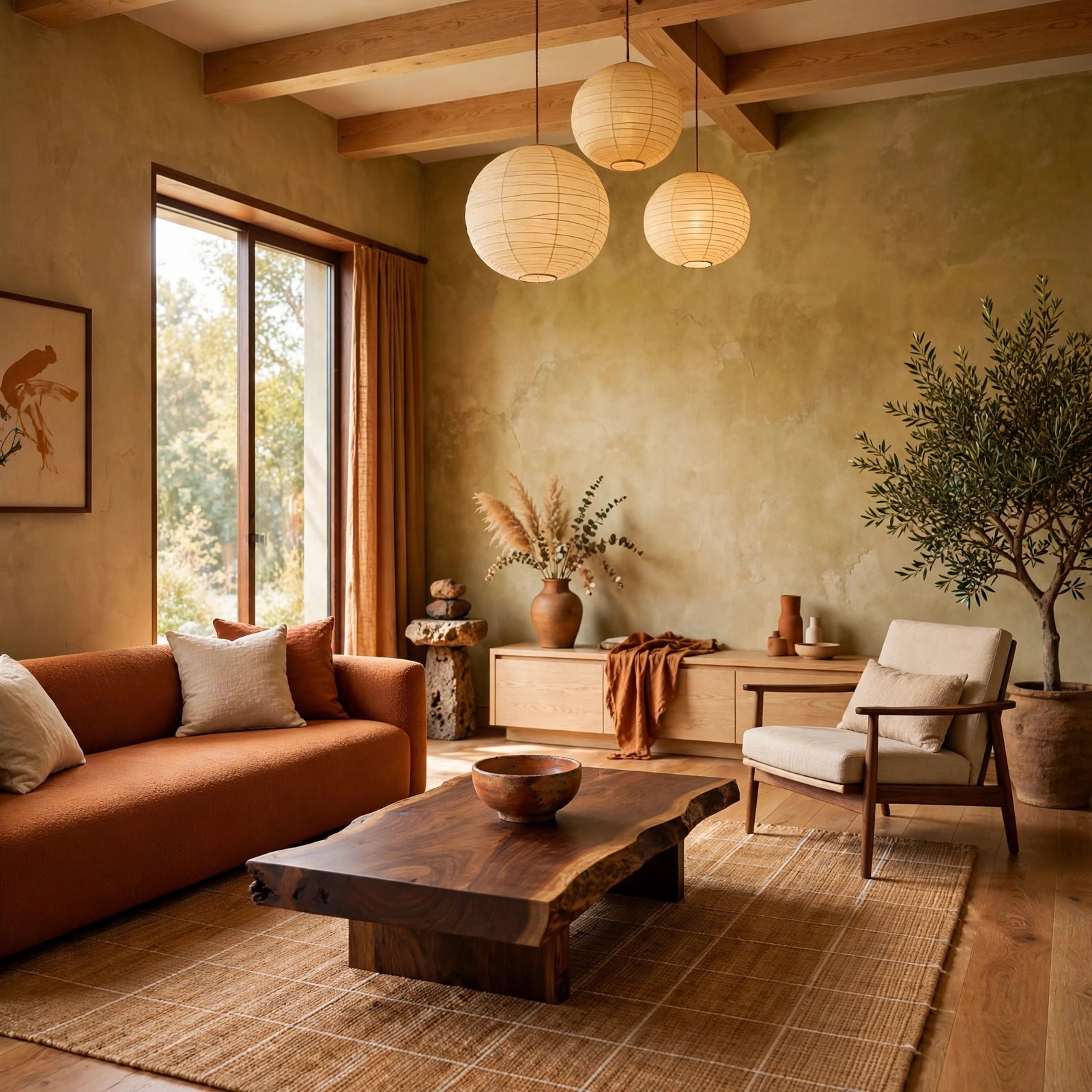
A live-edge walnut bench, its natural edge preserved, brings the forest directly into your japandi living room. Use it as a coffee table and it becomes a landscape you gather around: every grain line and knot on display, completely unrepeatable. The organic edge softens all the room’s straight lines. Pair it with the honest craftsmanship of a natural wood kitchen elsewhere in the home and the material story flows beautifully from room to room.
26. The soft rounded armchair
In a style full of straight lines and low planes, one soft rounded armchair is a relief your eye will thank you for. A curved boucle chair in cream has no hard edges to catch on; it invites curling up in a way angular furniture never does. Let it be the room’s embrace while everything else stays disciplined. The contrast between its softness and the room’s architecture is exactly the tension that makes japandi feel designed rather than merely empty.
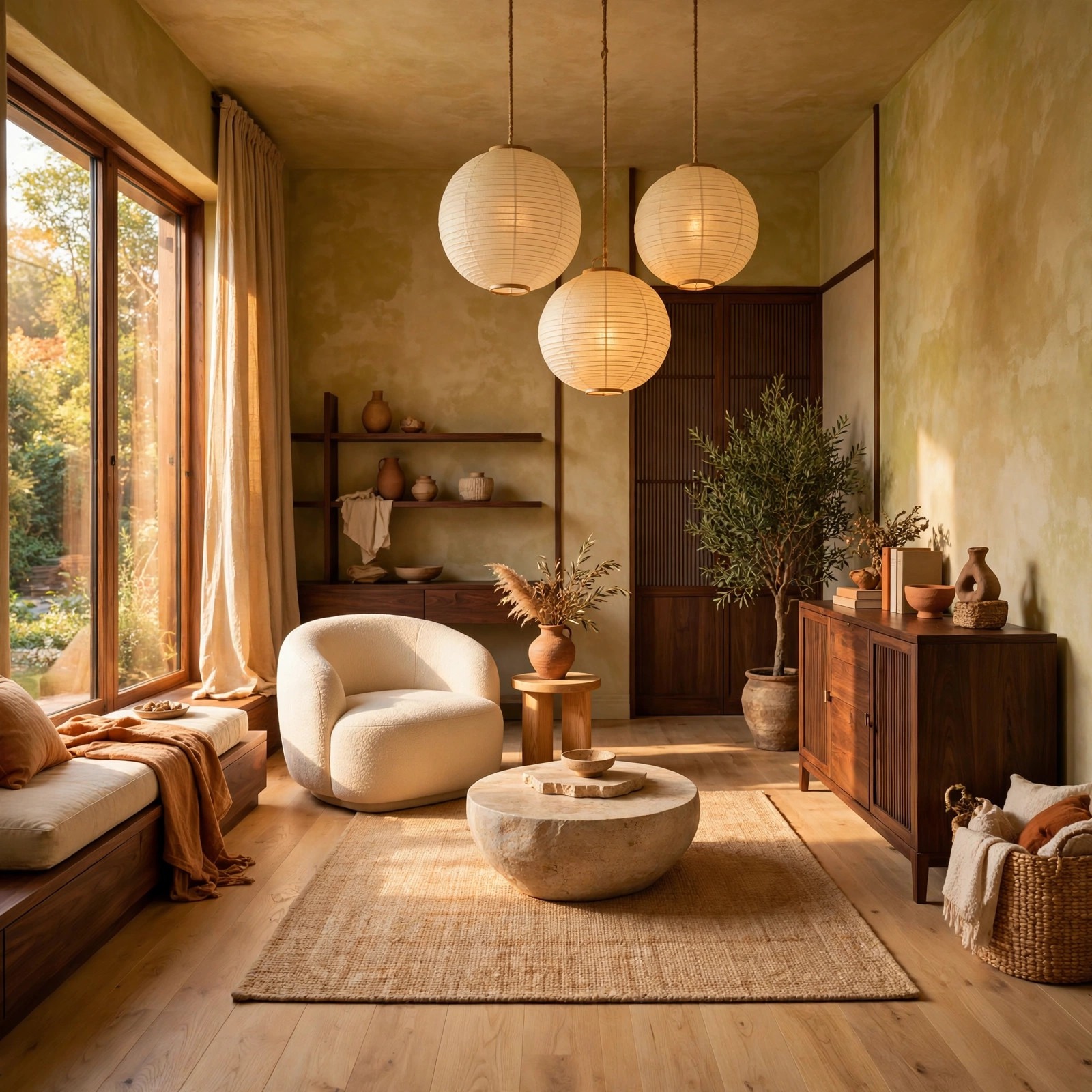
27. The indoor garden moment
A japandi living room should always hold something alive. An olive tree in a handmade clay pot, ringed with natural stones and a patch of moss, creates an indoor garden moment that changes with the light — the same deep olive green as olive green kitchen ideas. It is the room’s breathing element, softening all that wood and plaster with green life. Choose one statement plant rather than a collection; the style asks for a single gesture, not a jungle. Water it slowly and let the ritual slow you too.
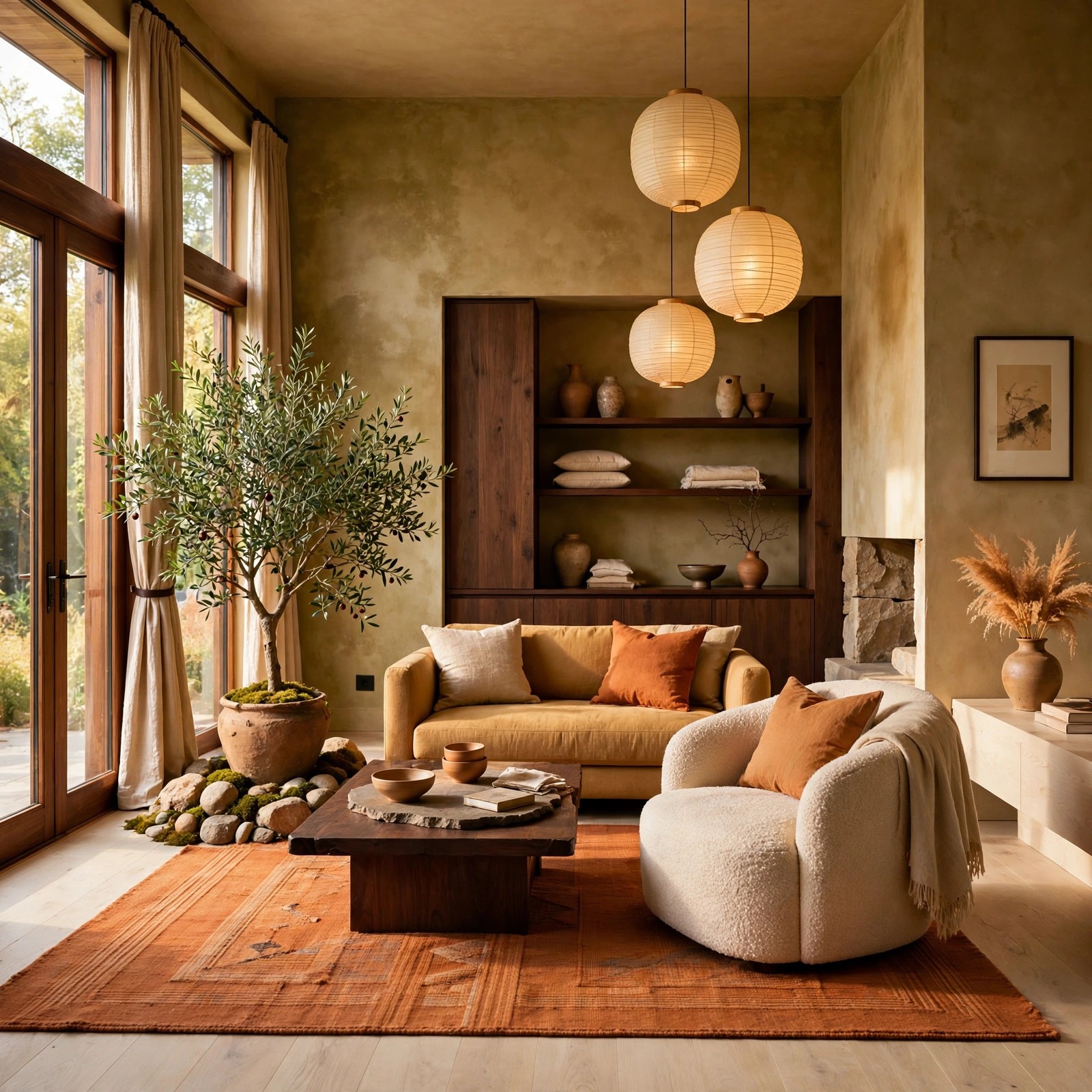
28. Muted sage textiles
Muted sage is the green that japandi was waiting for: gray enough to stay calm, green enough to feel alive. Layer sage cushions and throws over cream linen seating and the whole japandi living room gains a quiet, mossy depth — the same sage-and-cream pairing as sage green and cream kitchen ideas. It echoes the bonsai and the garden view without shouting nature. Keep the sage desaturated and warm, never minty or bright. This is color at a whisper, and in this style, whispers carry further than shouts.
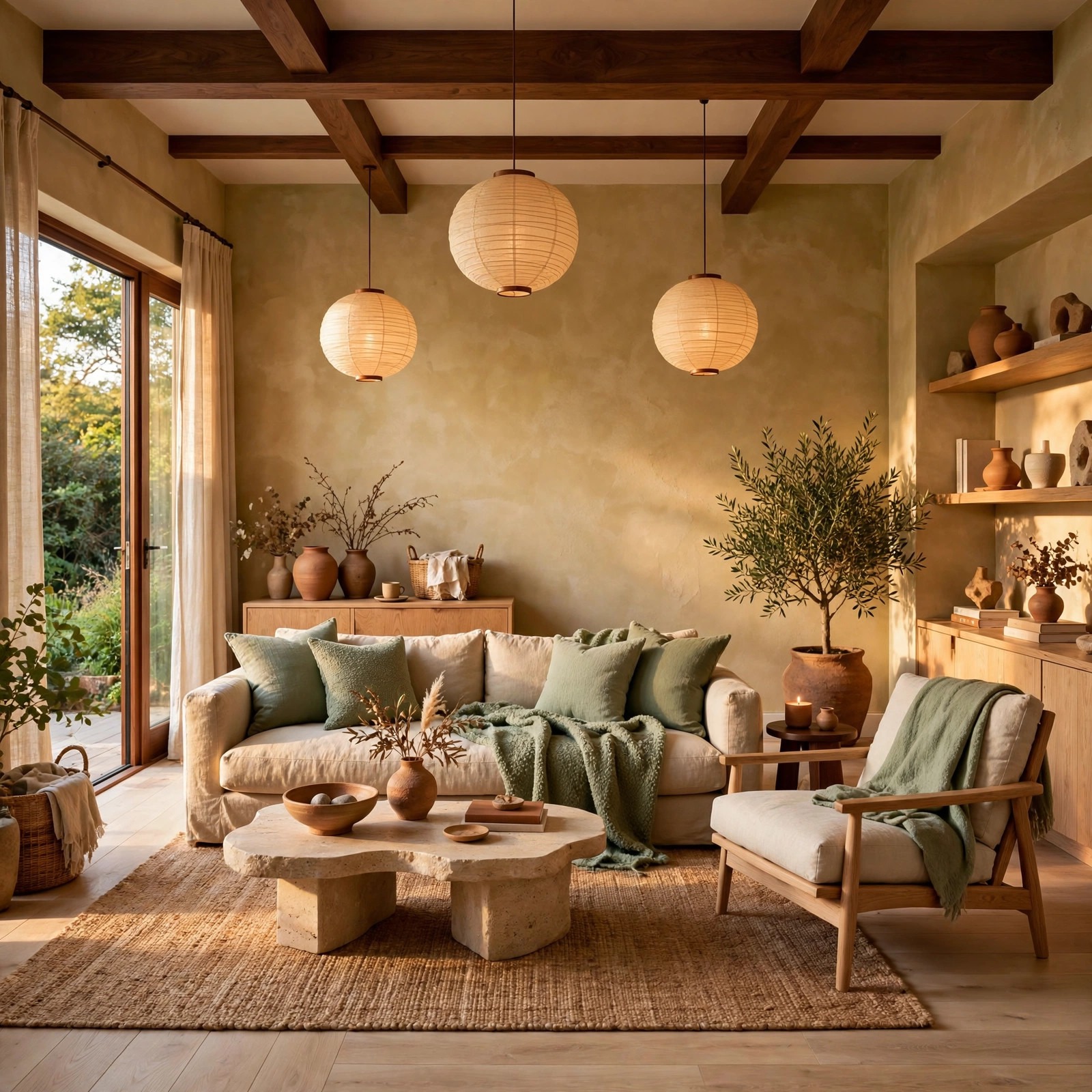
29. Black steel window frames
Slim black steel window frames give a japandi living room its architectural backbone. They draw crisp dark lines against soft limewash walls, framing the garden view like a hanging scroll. The contrast is the 2026 update in miniature: darkness used as structure, not moodiness. If replacing windows is out of reach, painting existing frames in a soft black achieves most of the effect. Either way, the room gains definition and the view gains importance.
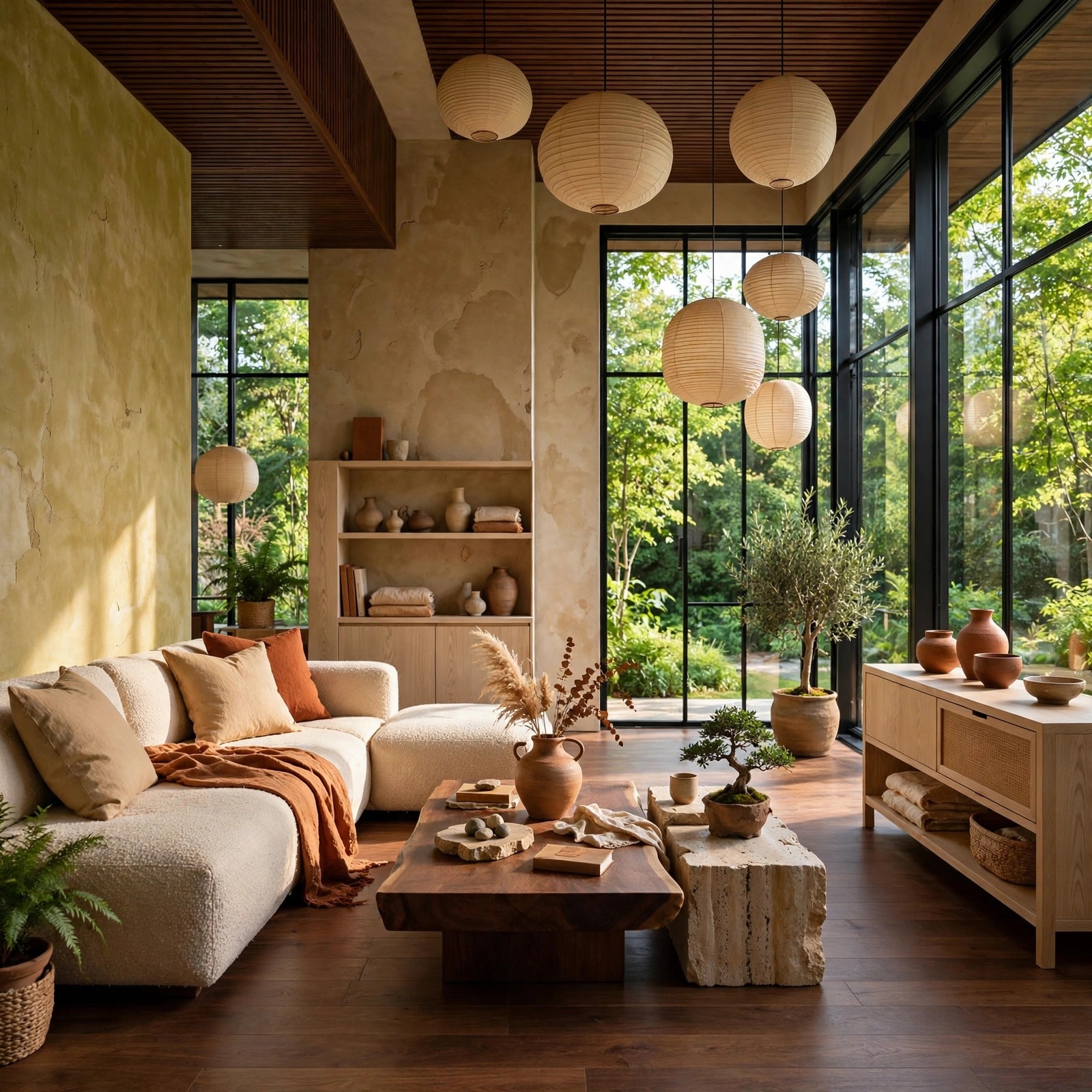
30. The low dining ledge
In an open japandi living room, a low platform dining ledge extends the style’s grounded philosophy to shared meals. A long, low table with floor cushions turns dinner into something ceremonial and relaxed at once, closer to the food, closer to each other — the same dressed-table ceremony as christmas dining room decor ideas. It asks for simpler serving: beautiful bowls, shared dishes, candlelight. Not every meal needs chairs; some of the best conversations happen closer to the ground, and this ledge makes that a daily option. The same open flow shapes the kitchen too, and these open kitchen ideas keep the calm moving from room to room. And when the low table has to host a feast, these luxury thanksgiving table decor ideas keep the same ceremonial calm.
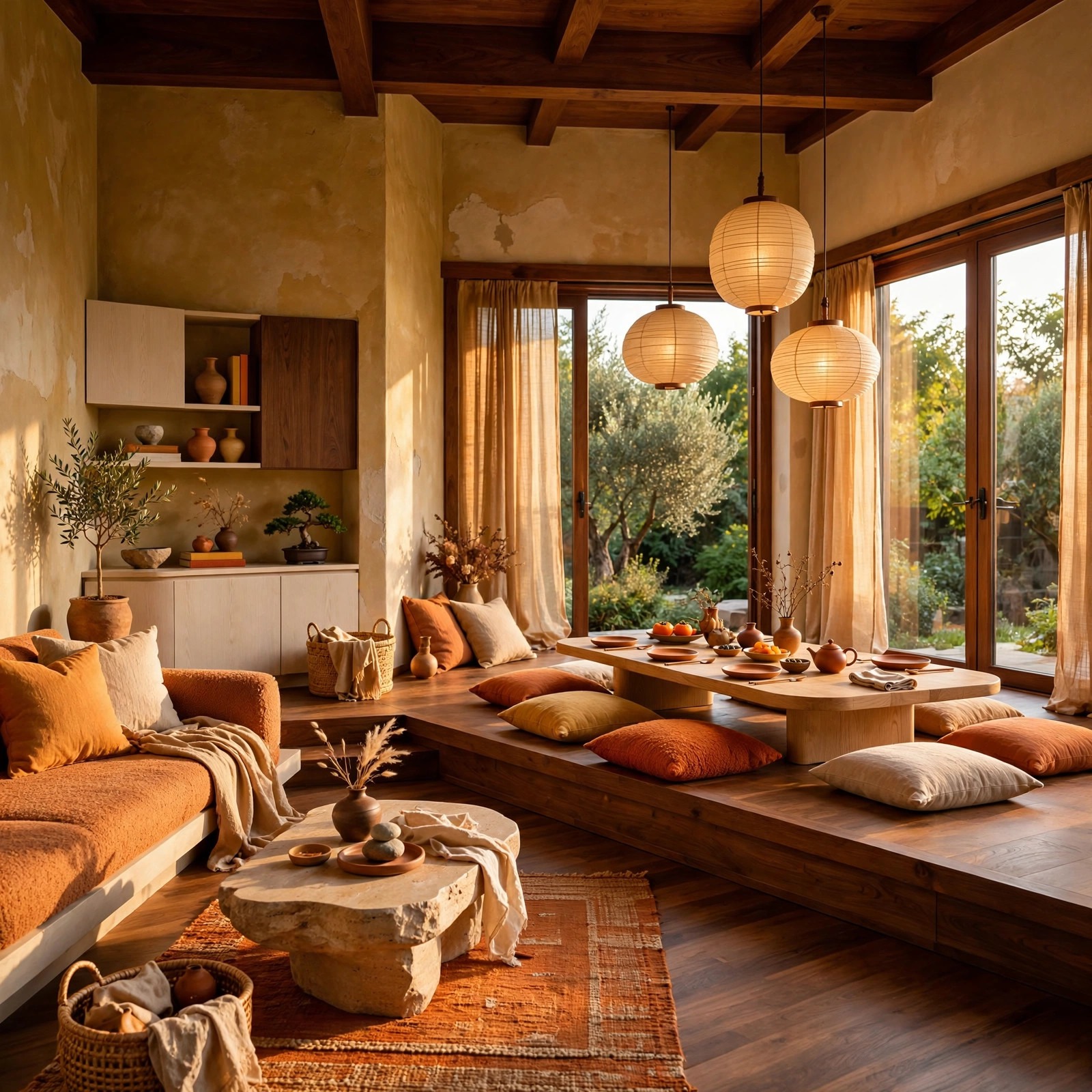
31. The handmade ceramic collection
A wall of oak shelving holding handmade ceramics is a japandi living room’s autobiography in clay. Each bowl and vase carries a maker’s fingerprints, and together they prove the room values the human hand. Curate slowly: one beautiful piece at a time, each with space around it. The quiet craftsmanship echoes the honest joinery of farmhouse kitchens, where materials are celebrated rather than concealed. Displayed with discipline, ceramics become the room’s art collection.
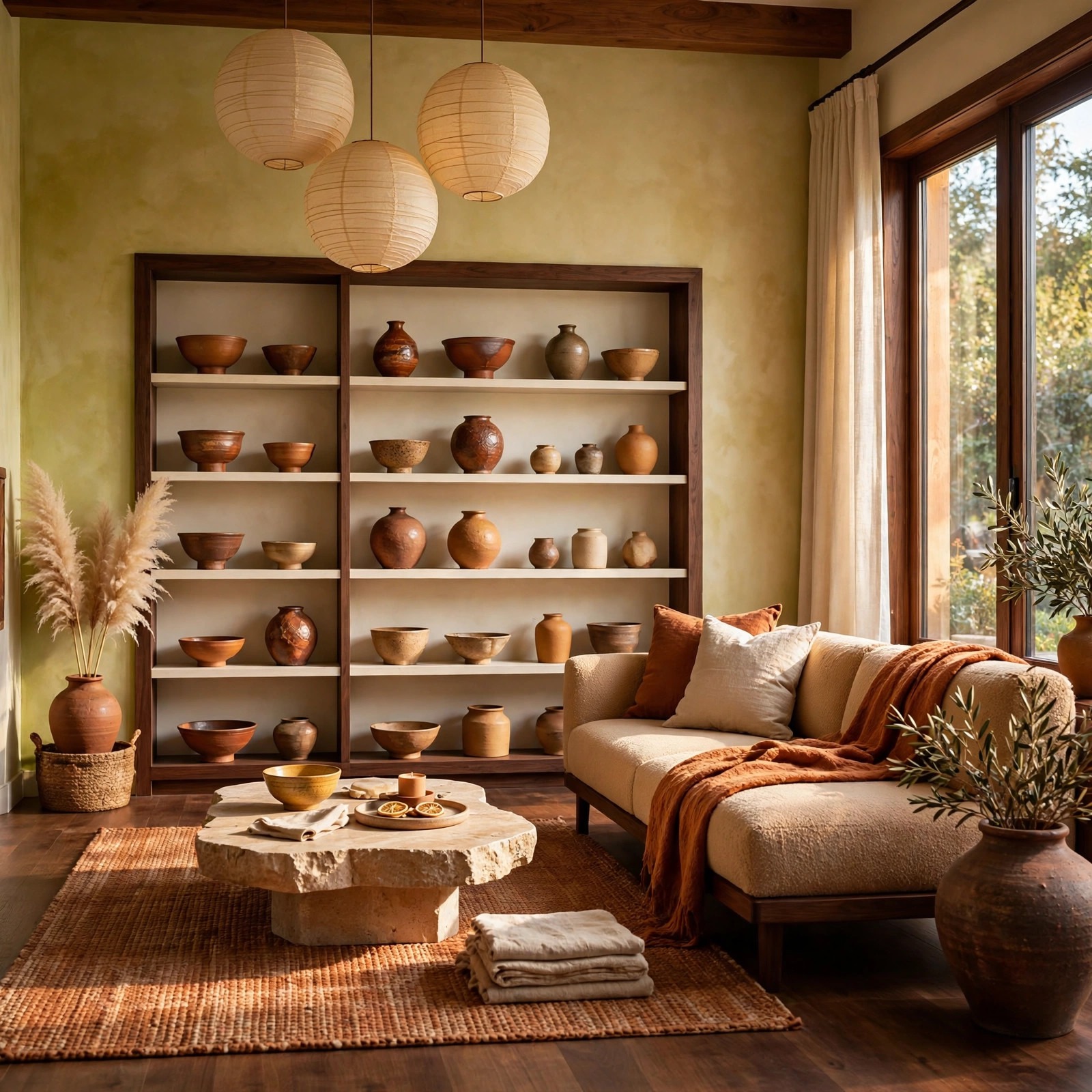
32. Wool and jute layering
Layering rugs is a japandi living room’s secret for depth without pattern. Start with a large flat jute rug for texture and grounding, then float a smaller, softer wool rug where feet actually land. The two natural fibers talk to each other beautifully: crisp underfoot, soft underfoot, both honest. Keep the palette within one warm family so the layers read as one landscape. Your feet will notice the luxury long before your eyes name it.
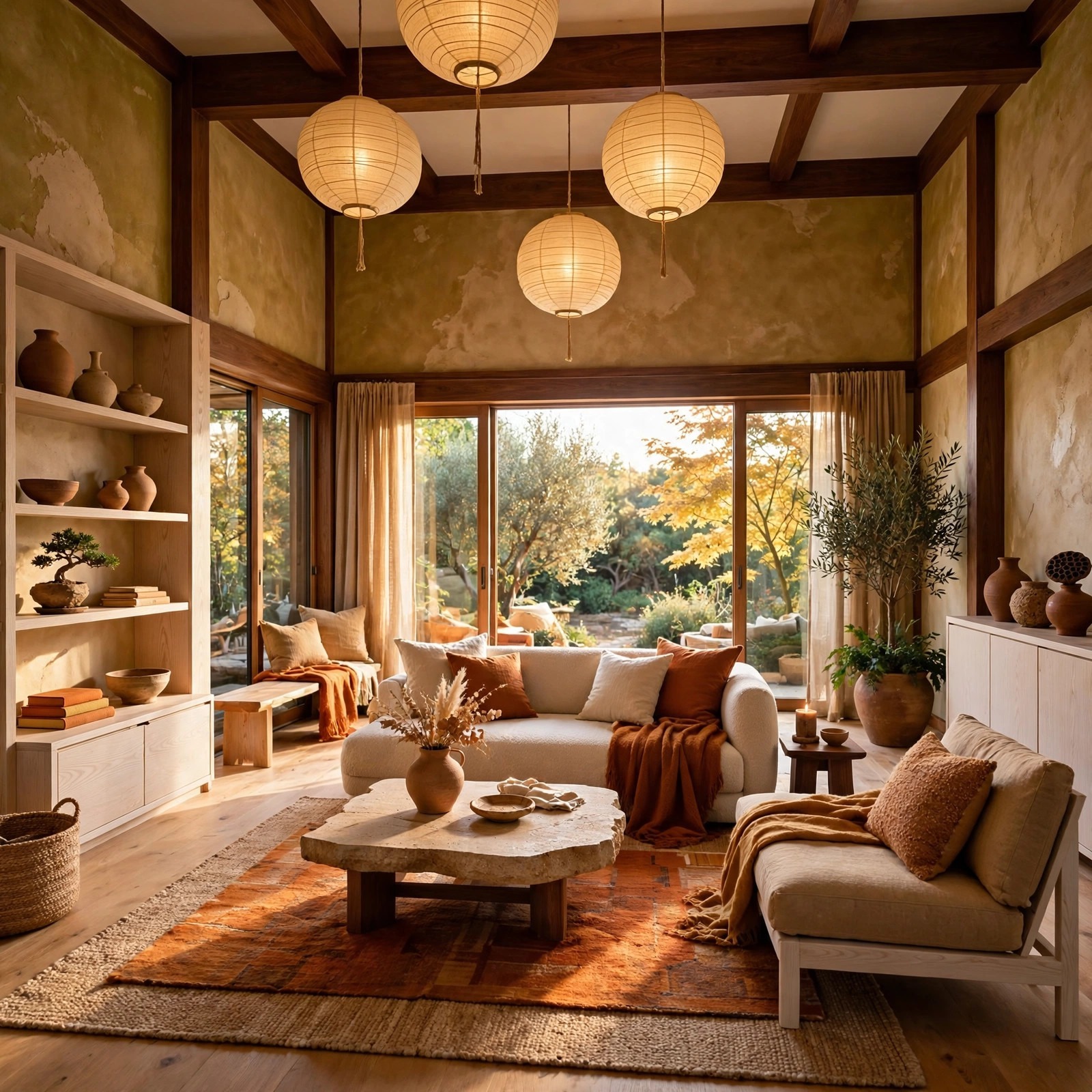
33. The reading light ritual
Give reading its own ceremony in your japandi living room: one low chair, one small walnut side table, one warm brass lamp that clicks on at dusk. The ritual matters more than the furniture; the same corner, the same light, every evening, trains your mind to slow down on arrival. Keep a stack of books within arm’s reach and nothing else. In a home full of screens, a dedicated analog corner is a small rebellion, and this style was built for exactly that kind of quiet resistance.
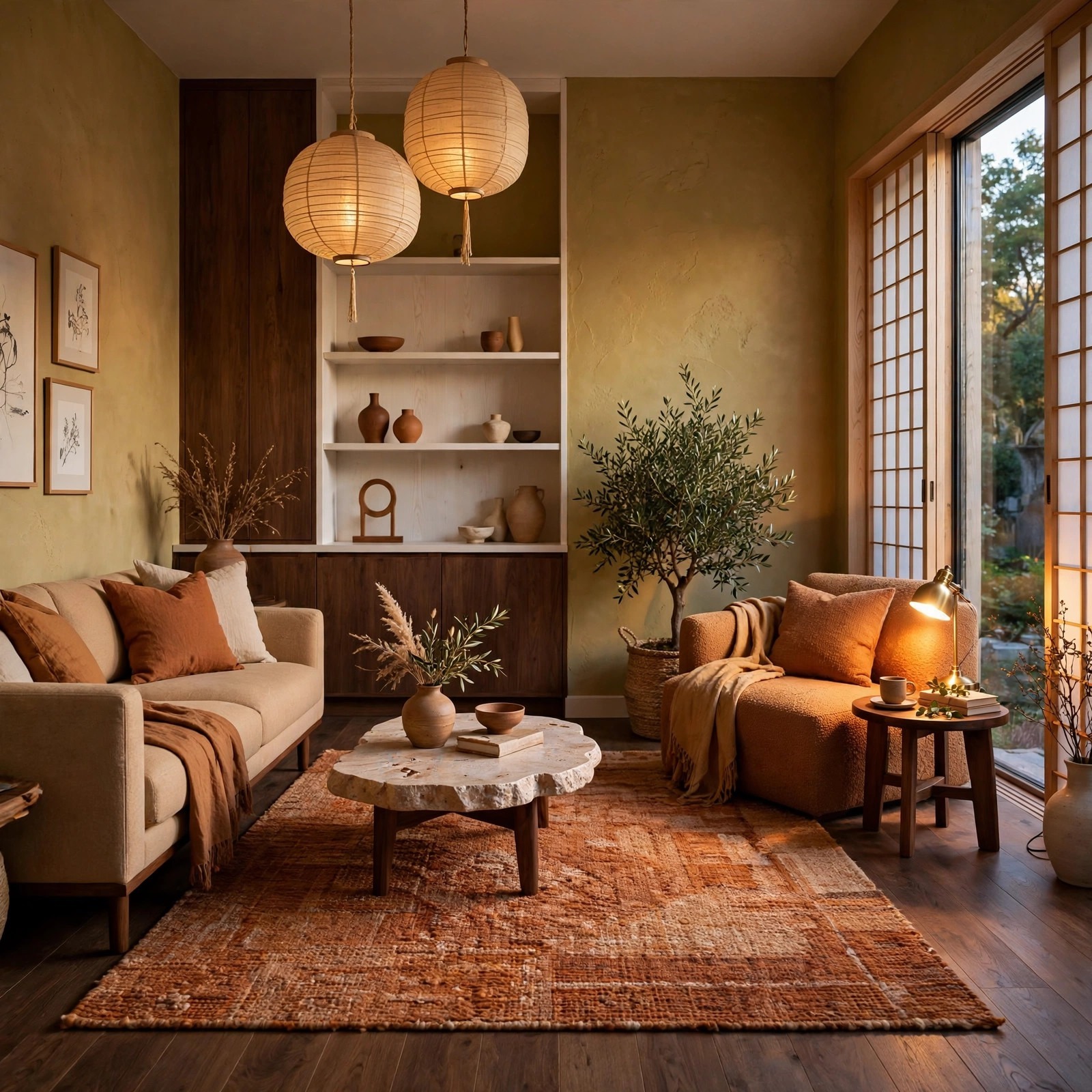
34. The sliding door wardrobe wall
Shoji-style sliding doors along one wall give a japandi living room seamless hidden storage with authentic craft. The light oak frames and rice-paper panels glide silently, concealing everything from media equipment to linens behind their calm faces — the same hidden-storage craft as luxury walk in closet ideas. The wall becomes texture rather than furniture. It is the ultimate expression of the style’s core promise: a room that looks like it holds nothing, because everything has its perfect hidden place.
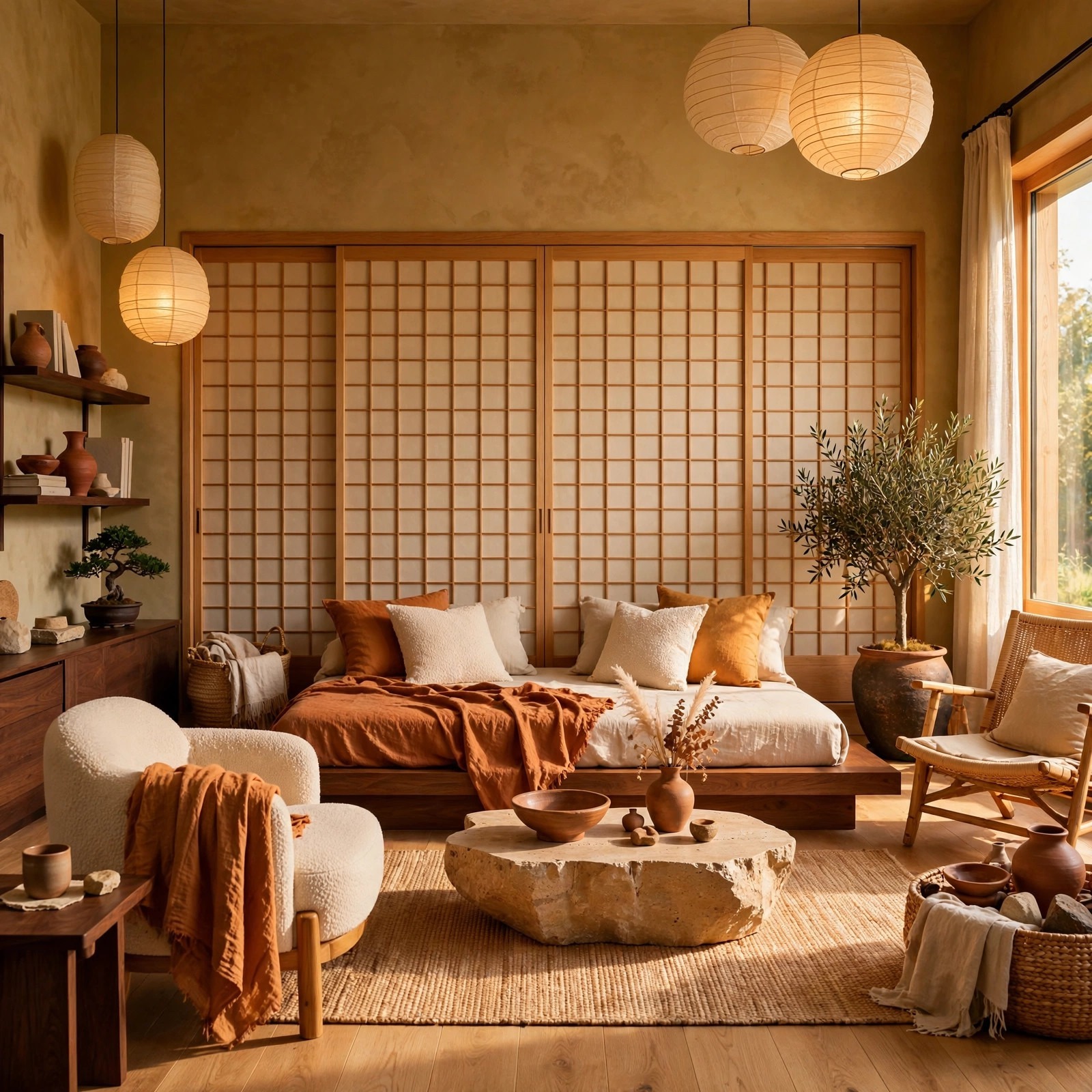
35. The warm beige color drench
Color drenching, painting walls, ceiling, and trim in one enveloping tone, finds its gentlest expression in a japandi living room done in warm beige. The monochrome wrap erases visual boundaries so the room feels like a warm breath held around you — color drenching kitchen ideas take the same one-color commitment through a whole room. Vary the finish, matte walls, soft sheen on woodwork, to keep it from falling flat. Against this seamless ground, dark walnut furniture and one green plant become pure sculpture.
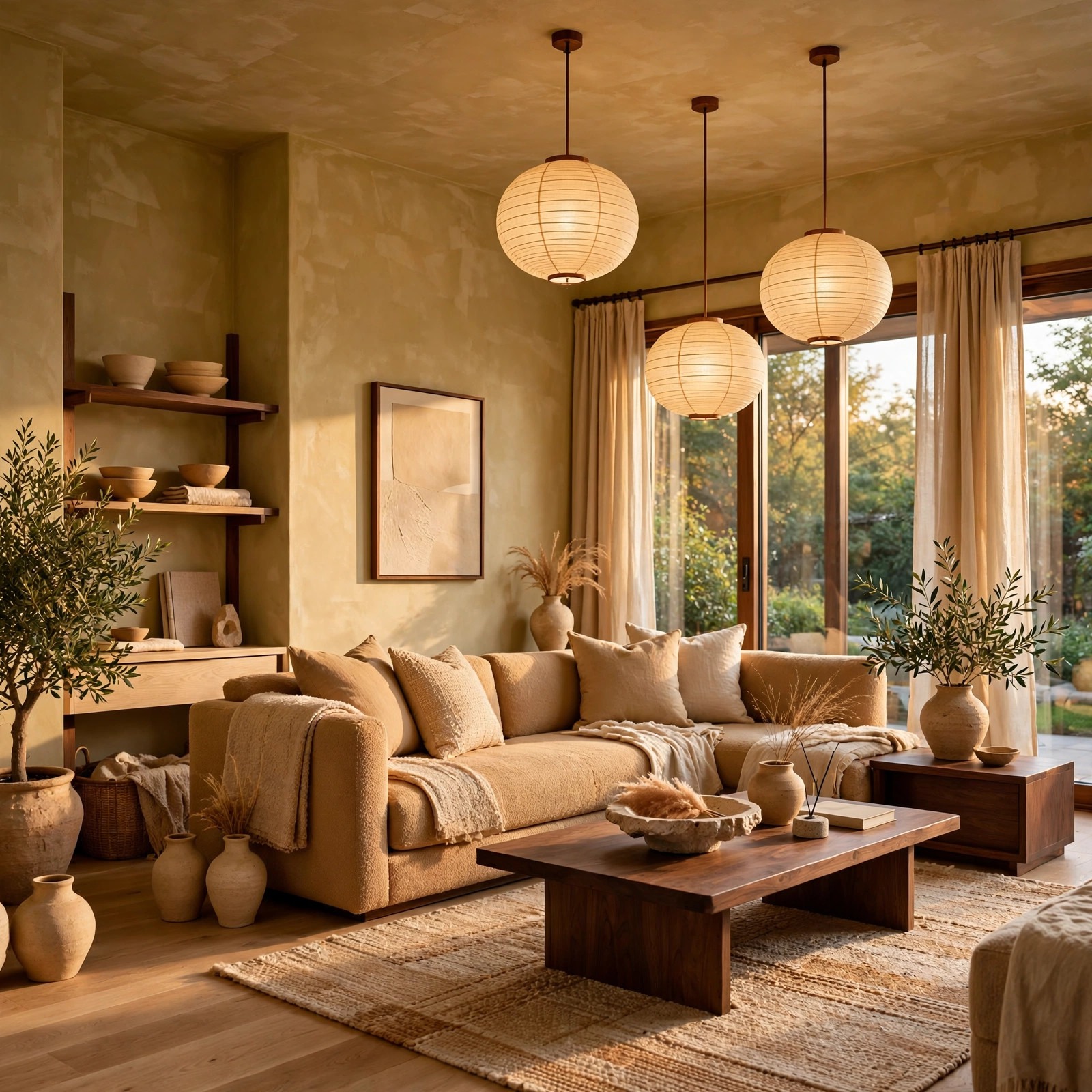
36. The statement rock
One large natural boulder, placed with intention, can be the most powerful object in a japandi living room. Japanese gardens have revered stones for centuries, and indoors the effect is startling: millions of years of geology holding still amid your daily life. Choose a stone with character, lichen, fissures, an interesting silhouette, and give it real space. It asks nothing, needs nothing, and somehow makes the whole room feel more grounded.
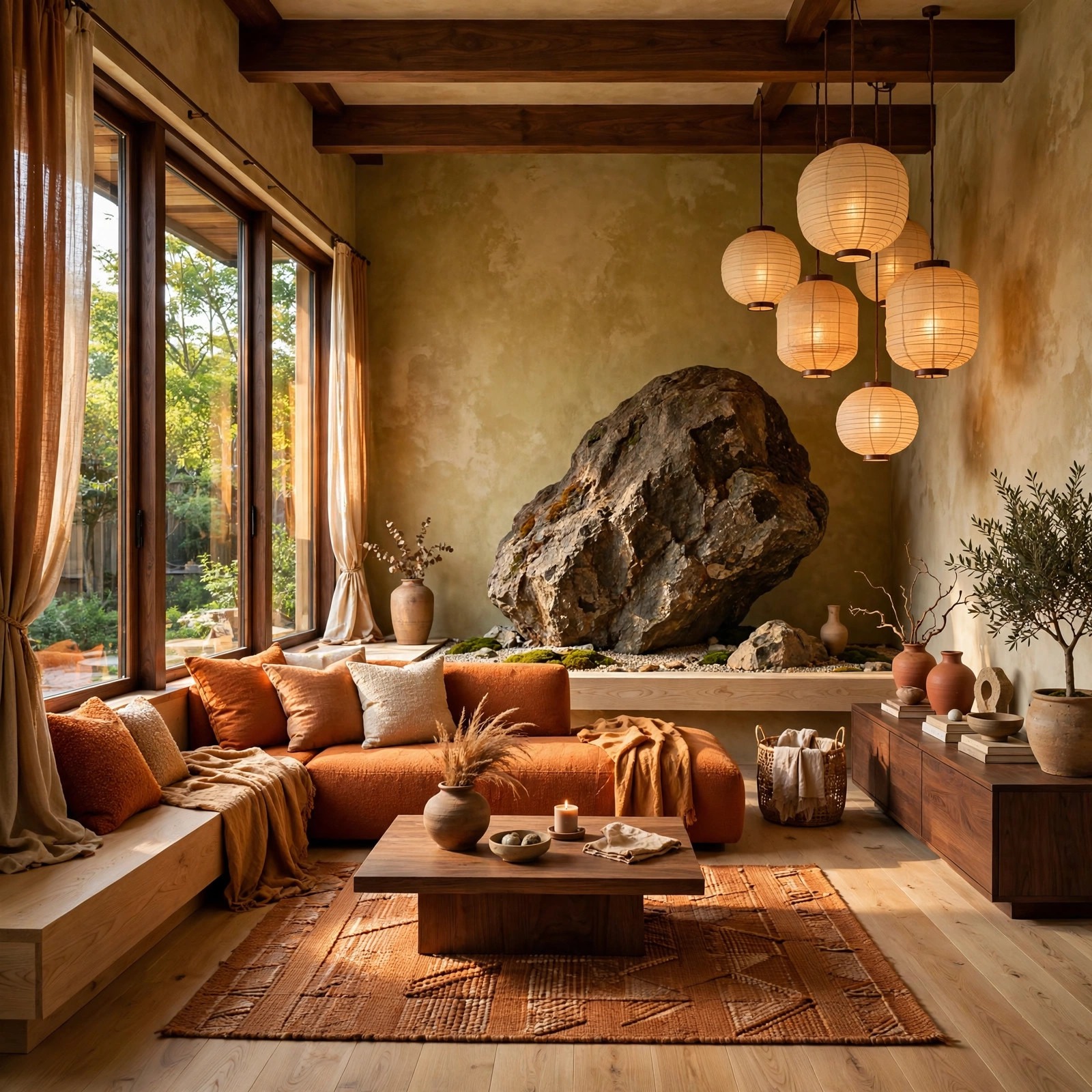
37. The low media console
Even the television can live peacefully in a japandi living room if it sits on a low, beautiful console. A long dark-walnut credenza with clean lines and hidden cable management keeps technology visually quiet, and flanking it with paper lanterns softens its presence further. Mount the screen low, at seated eye level from your platform sofa. The goal is not to hide modern life but to give it manners: present, calm, and never the loudest thing in the room.
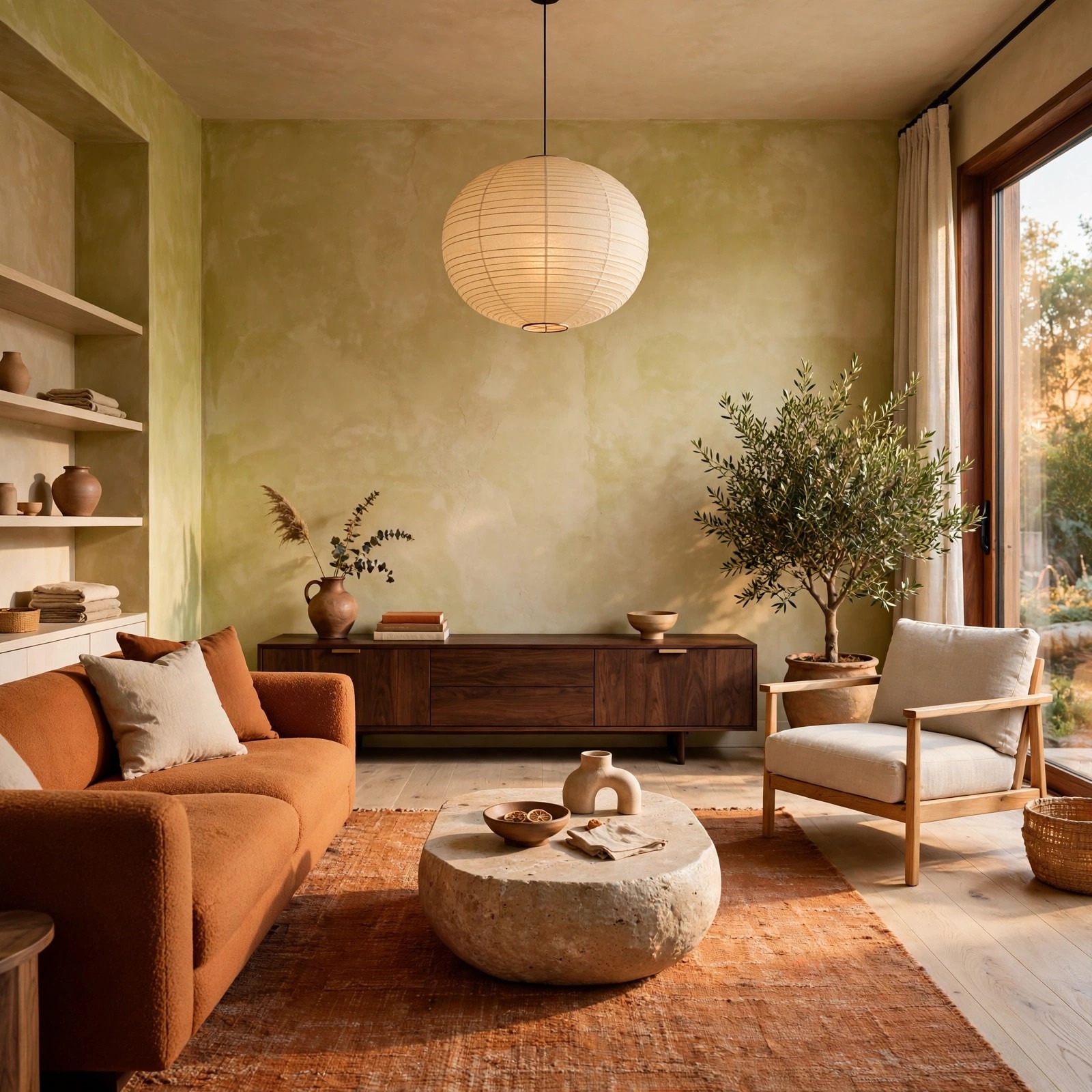
38. Sheer linen curtains
Sheer natural-linen curtains are how a japandi living room breathes light. They soften harsh daylight into something golden and diffused, so the room glows rather than glares. Hang them high and let them pool slightly on walnut floors for that relaxed, unstudied luxury. The weave’s tiny imperfections filter sun into texture. In the evening they become veils of privacy that still let the room feel open to the night beyond.
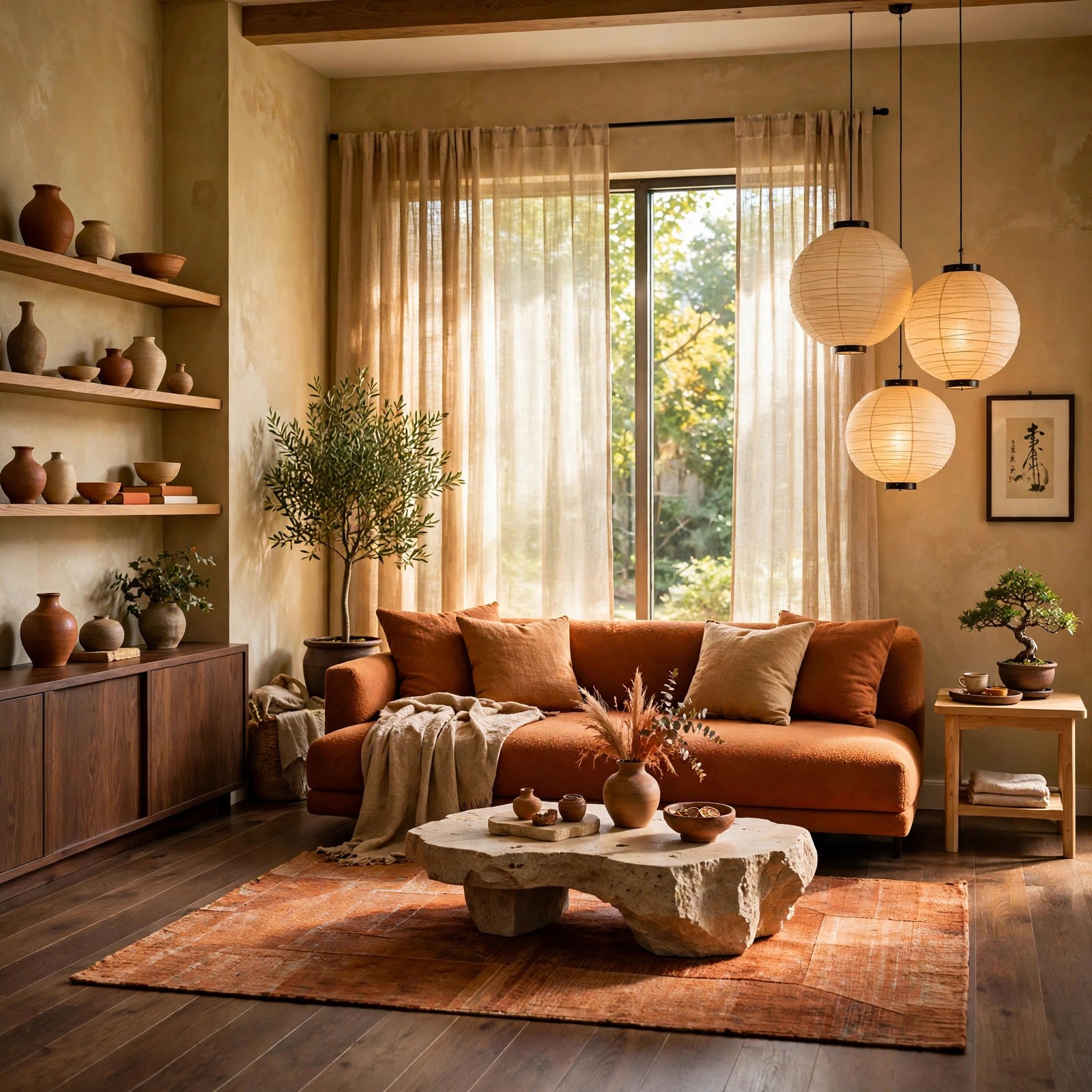
39. The earthy art piece
One large artwork in earthy clay, sand, and stone tones gives a japandi living room its emotional anchor. Abstract and textural beats literal here: think layered plaster, raw pigment, the colors of a riverbed. Hang it low over an oak credenza so it joins the furniture’s horizon line rather than floating above it. The piece should feel excavated rather than painted, as if the room grew it. One strong work outranks a gallery wall in this philosophy every time.
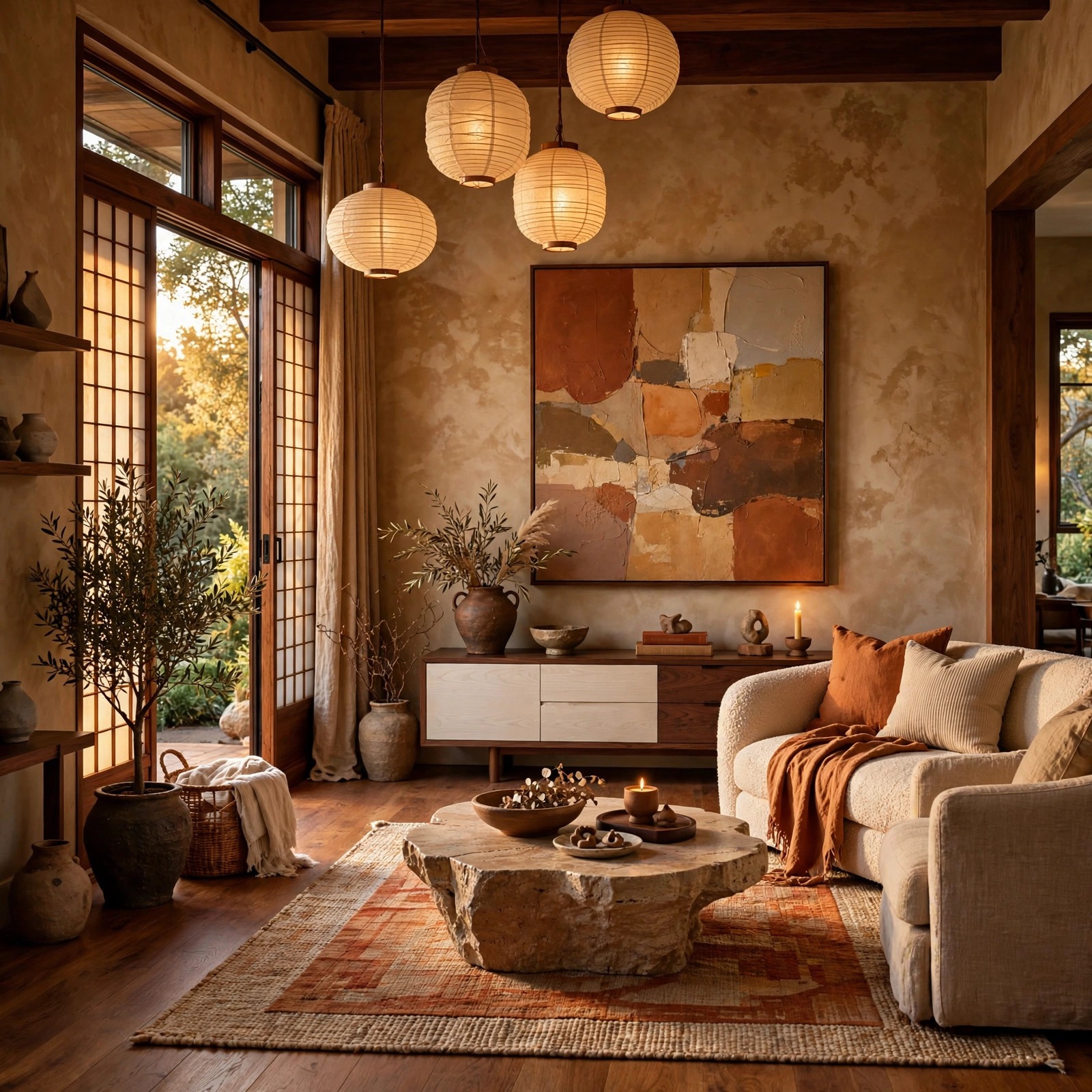
40. Dark stained ceiling beams
Dark stained ceiling beams bring the 2026 moodiness of japandi overhead, drawing the eye up to architecture you might otherwise ignore. Against pale limewash walls, the beams read as calligraphy: bold dark strokes organizing the space. Keep everything else in the room light and low so the contrast sings. The beams add history and weight, making even a new-build living room feel rooted, as if the house has stories the walls are still keeping.
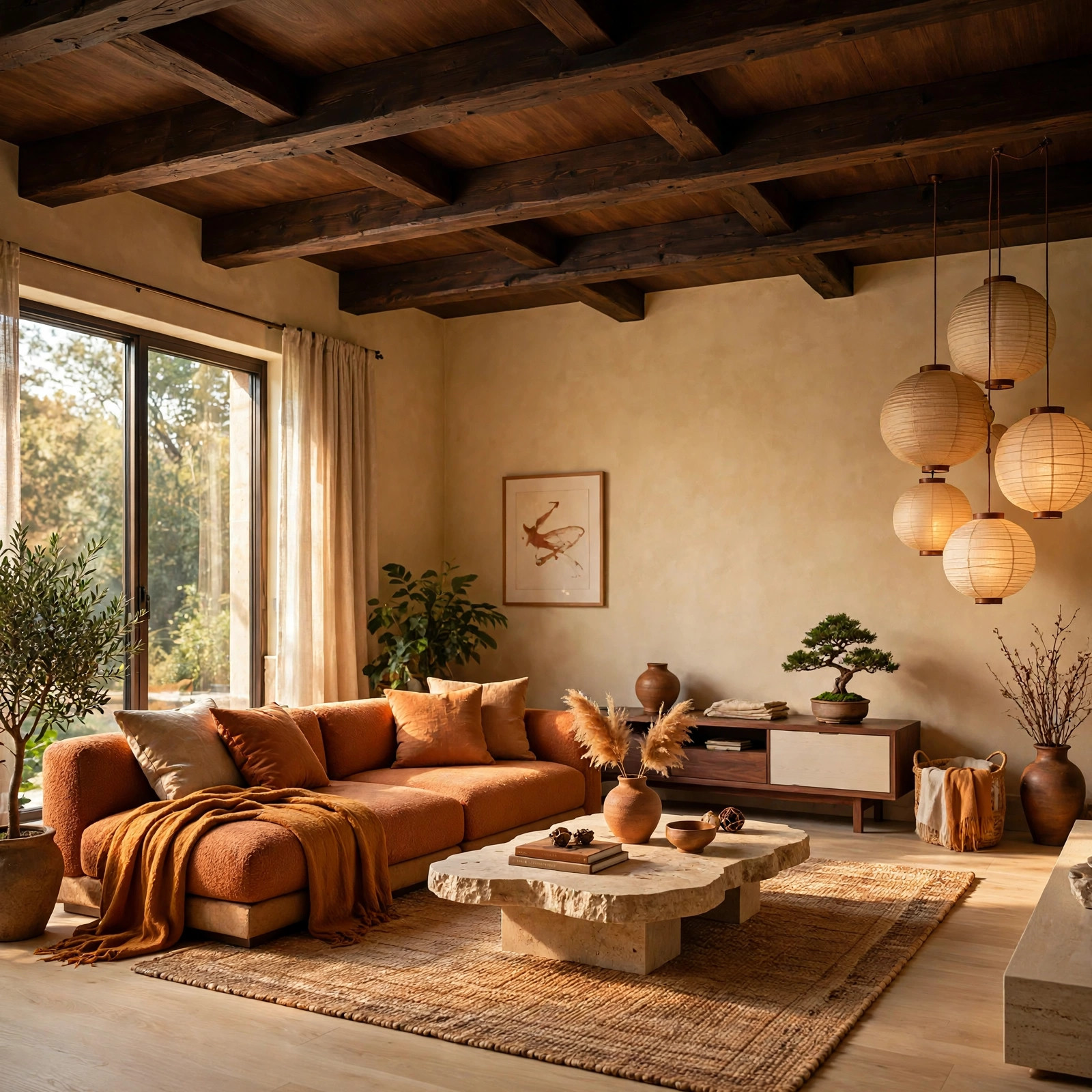
41. The zabuton seating set
A set of zabuton, the traditional Japanese floor cushions, is the most flexible seating a japandi living room can own. Thick, square, and covered in natural or charcoal linen, they stack neatly when not needed and deploy in seconds when friends arrive. Their low profile keeps the room’s calm geometry intact. Invest in quality fills that spring back; cheap cushions go flat and sad. Done well, floor seating feels not like a compromise but like a choice.
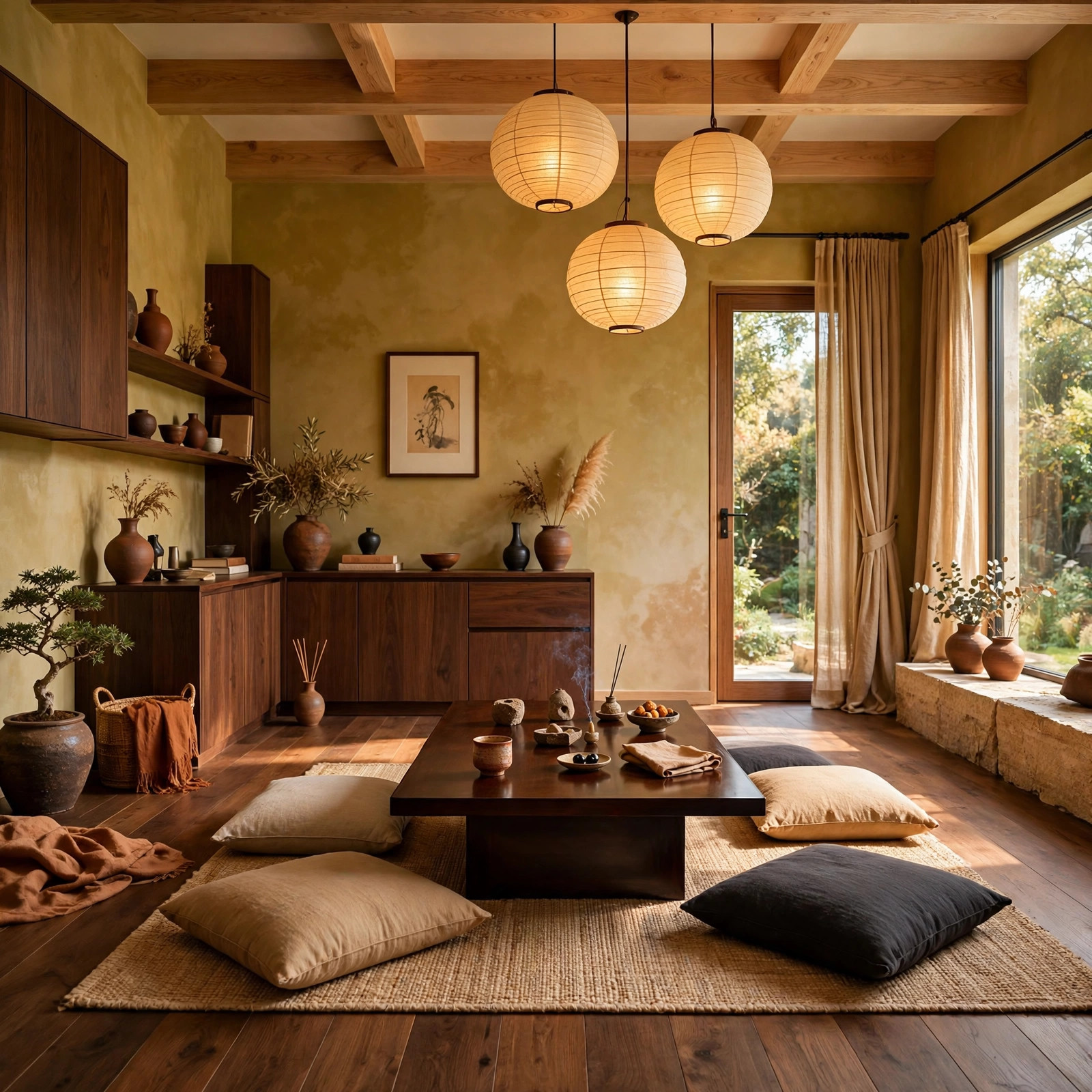
42. The travertine side table
A travertine side table brings ancient geology to arm’s reach in your japandi living room. The stone’s pitted surface and warm honey tones are wabi-sabi in mineral form: beautiful because of its imperfections, not despite them — the same honey-toned stone as luxury travertine bathroom ideas. Its weight anchors a light linen chair the way an anchor holds a boat. Let it age naturally, rings and all; sealing out every mark would miss the point. Some materials are meant to record a life being lived.
43. Muted terracotta touches
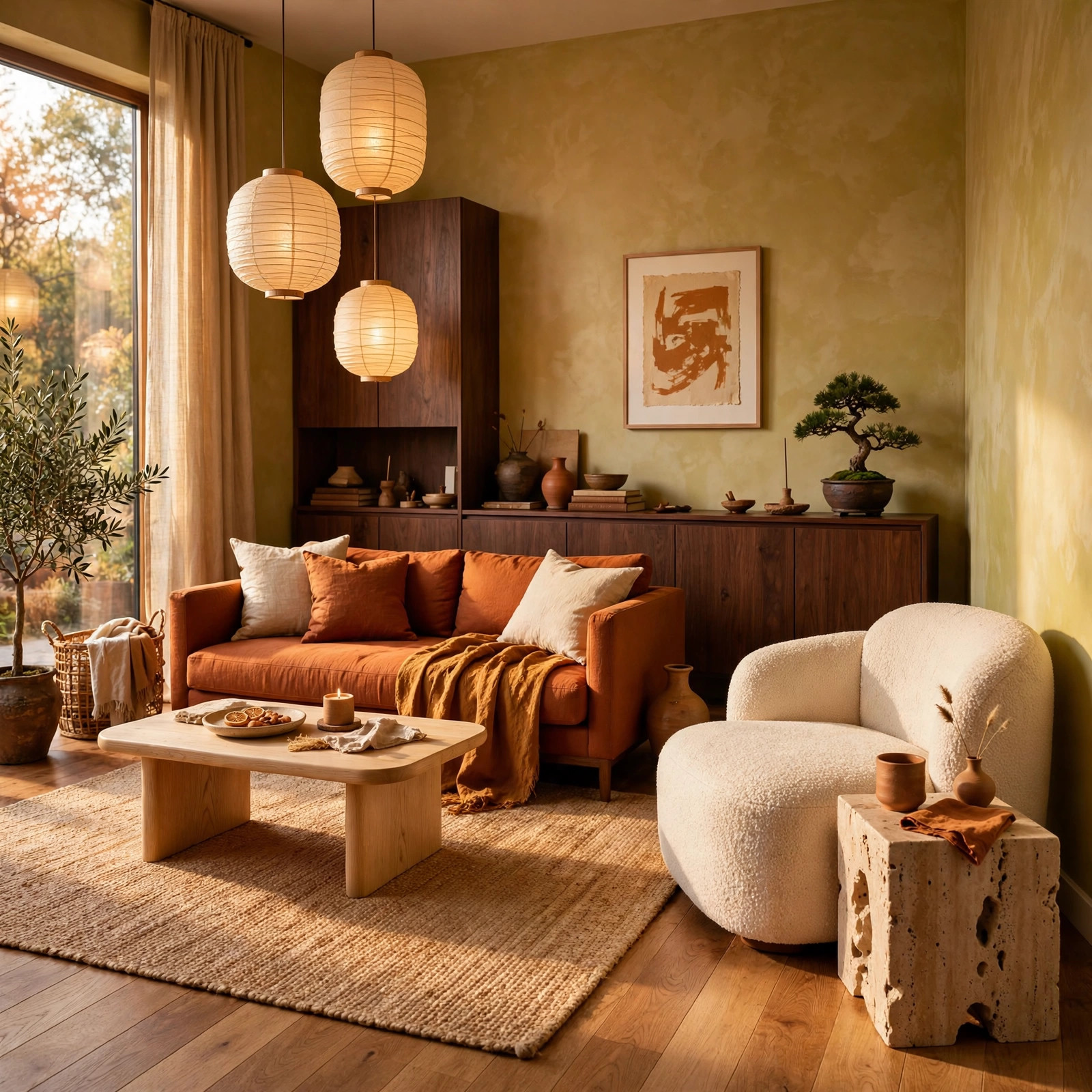
Muted terracotta is the warm ember in the japandi living room palette: cushions, a handmade pot, a folded throw in baked-clay tones that glow against beige and walnut. Keep it desaturated and earthy, never bright or orangey, so it reads as warmth rather than color. A little goes far; three touches across the room are enough to raise its temperature. It is the sunset the style keeps in reserve, deployed with a restrained hand.
44. The hidden storage platform
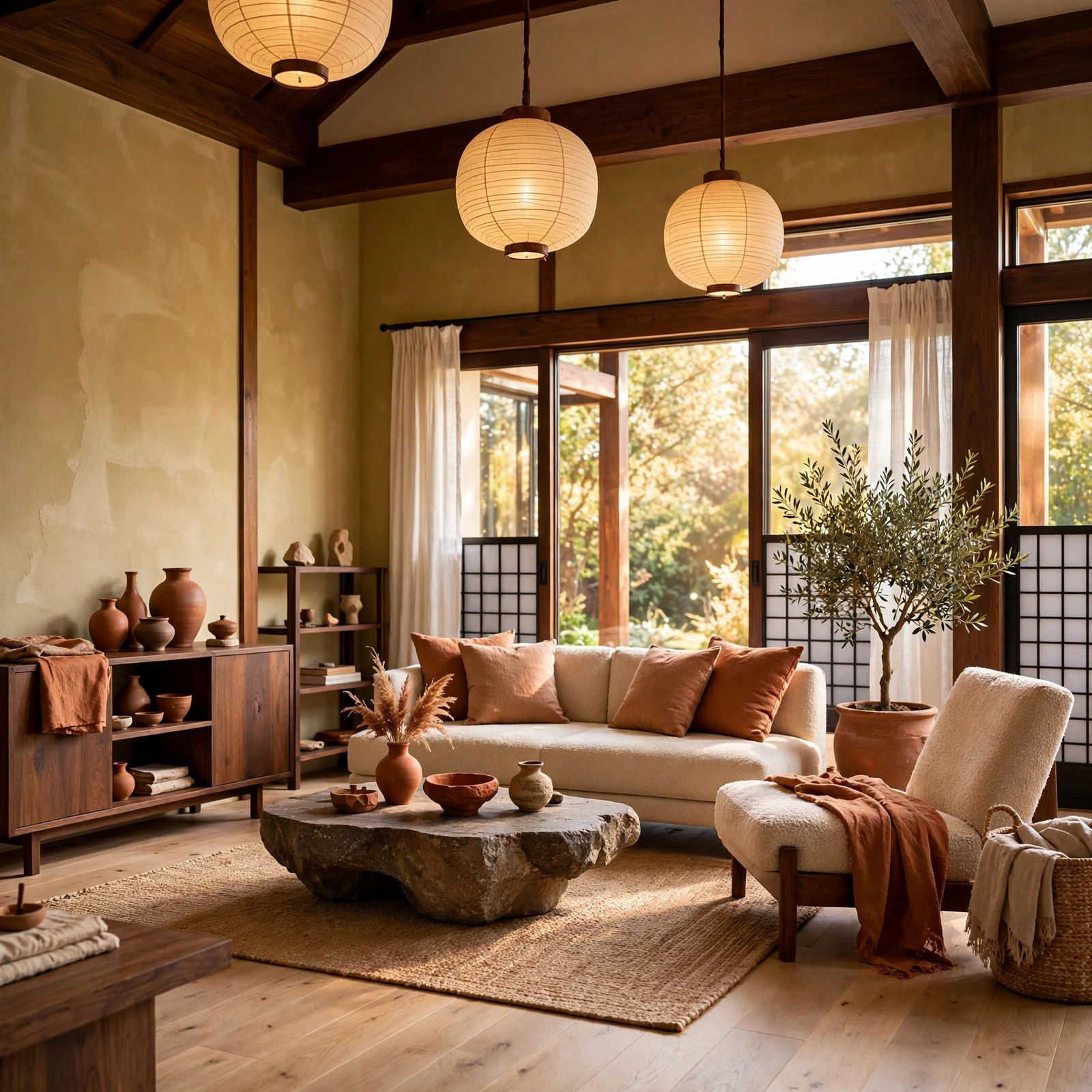
A raised wooden platform with deep hidden drawers solves the japandi living room’s eternal tension: serenity demands empty surfaces, but life demands storage. The platform elevates your seating zone literally and figuratively, while swallowing blankets, books, and clutter inside. Top it with cushions and it becomes a daybed; leave it bare and it is a stage for one perfect object. Architecture that hides the mess is the most luxurious kind.
45. Bamboo blind layers
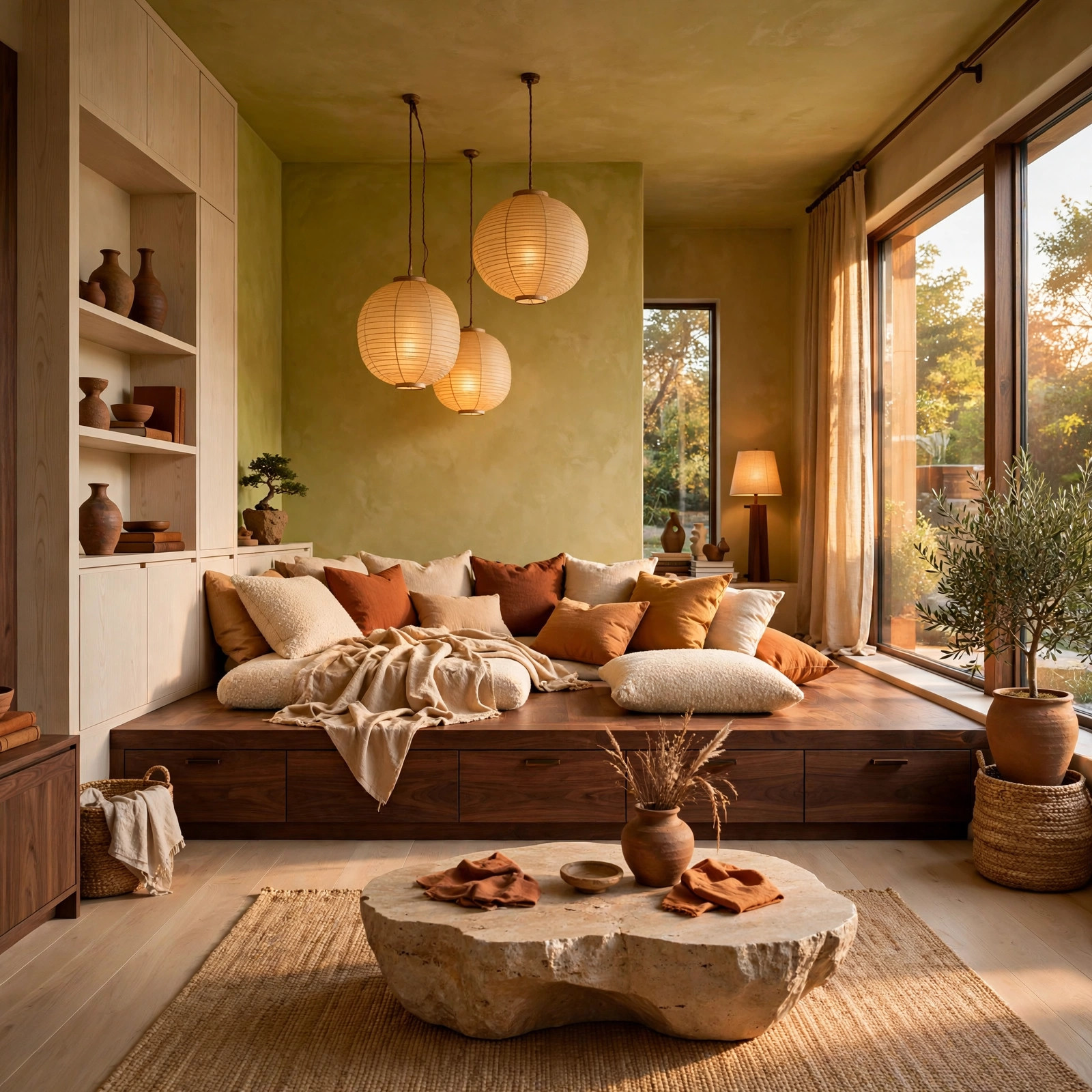
Bamboo roman blinds filter light the way leaves filter sun, in shifting golden patterns that move across your japandi living room through the day. They add a warm natural texture at the window that curtains alone cannot give — and at Christmas the same window becomes a focal point, as christmas window decor ideas show. Layer them under sheer linen panels for full flexibility: bamboo for glow, linen for privacy. The combination is deeply Japanese in spirit and endlessly practical, light control that feels like weather rather than mechanism.
46. The calm gallery ledge
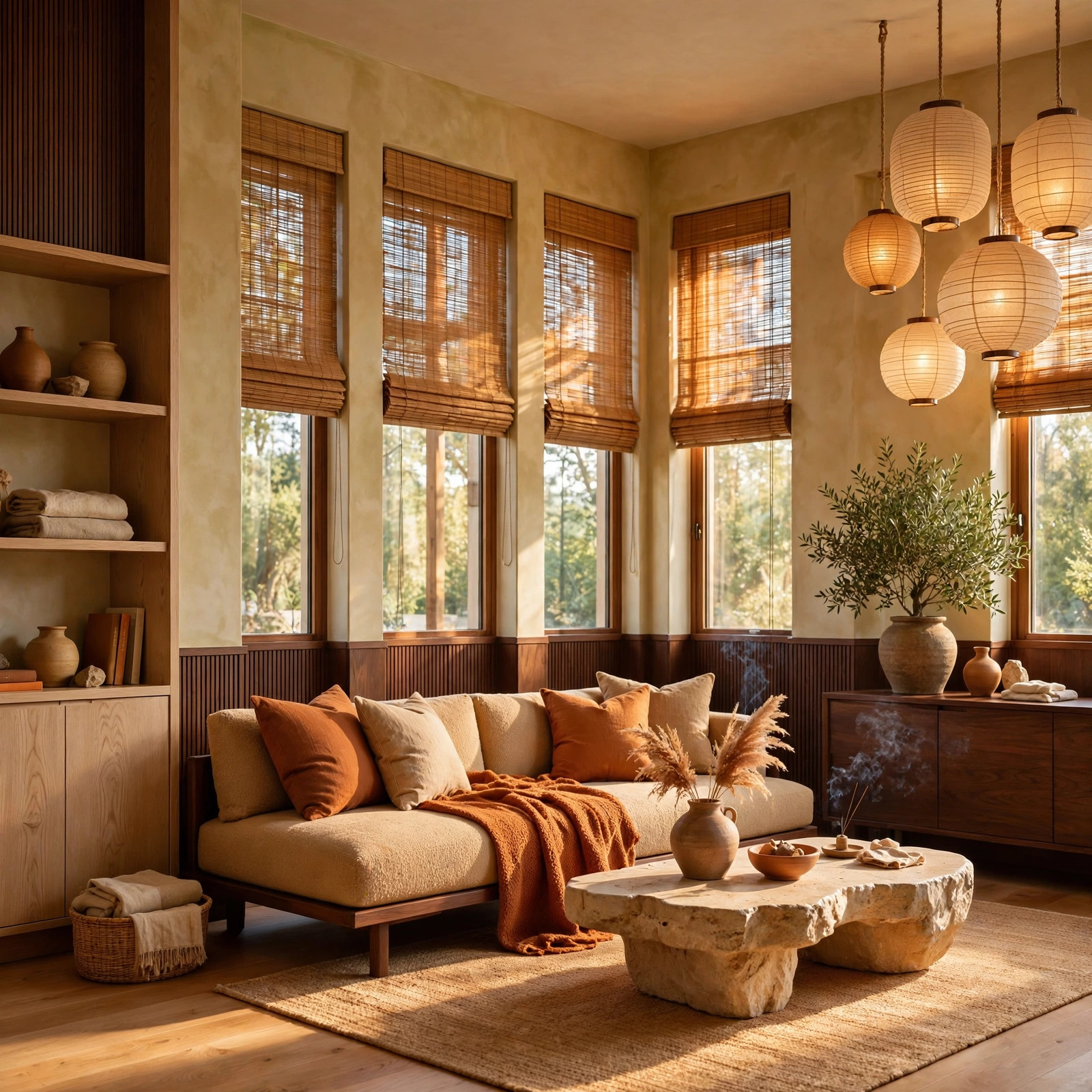
A single oak picture ledge lets your japandi living room’s art breathe and change with your mood. Lean two or three minimal prints against the wall, overlapping slightly, and rotate them seasonally without a single nail hole. The ledge itself becomes a horizon line that organizes the wall. Keep the frames thin and dark or natural oak; the art should float. This is collecting without commitment, and it suits a philosophy that distrusts permanence.
47. The deep forest green accent
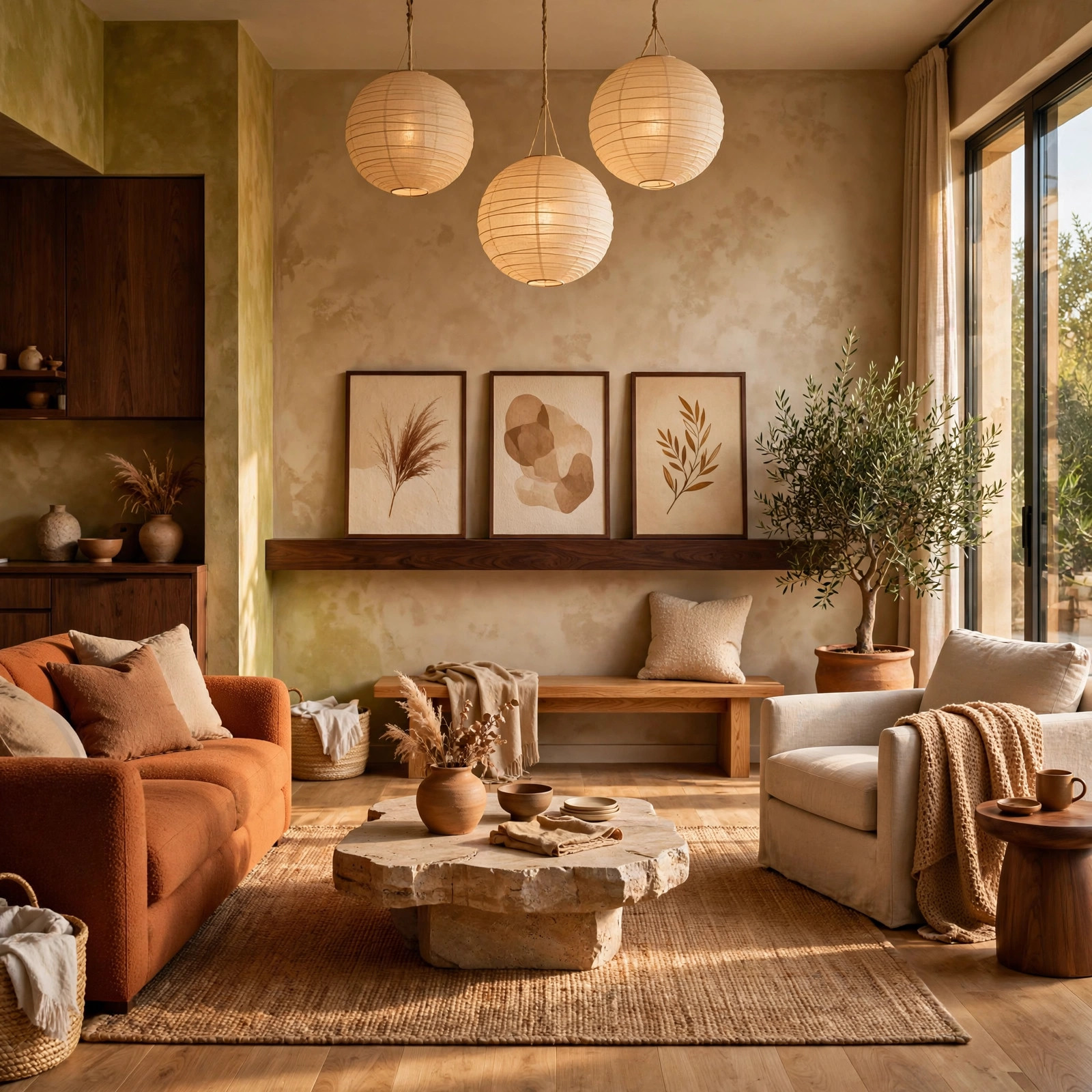
Deep forest green is the one saturated color a japandi living room welcomes without hesitation. It carries the forest indoors: moss, pine, deep shade. One accent wall in this inky green makes floating oak shelves and cream upholstery look museum-worthy. It shares DNA with the serene palettes of a green bedroom, that same promise of nature as calm. Keep it to one wall and let darkness do its cocooning work after sunset.
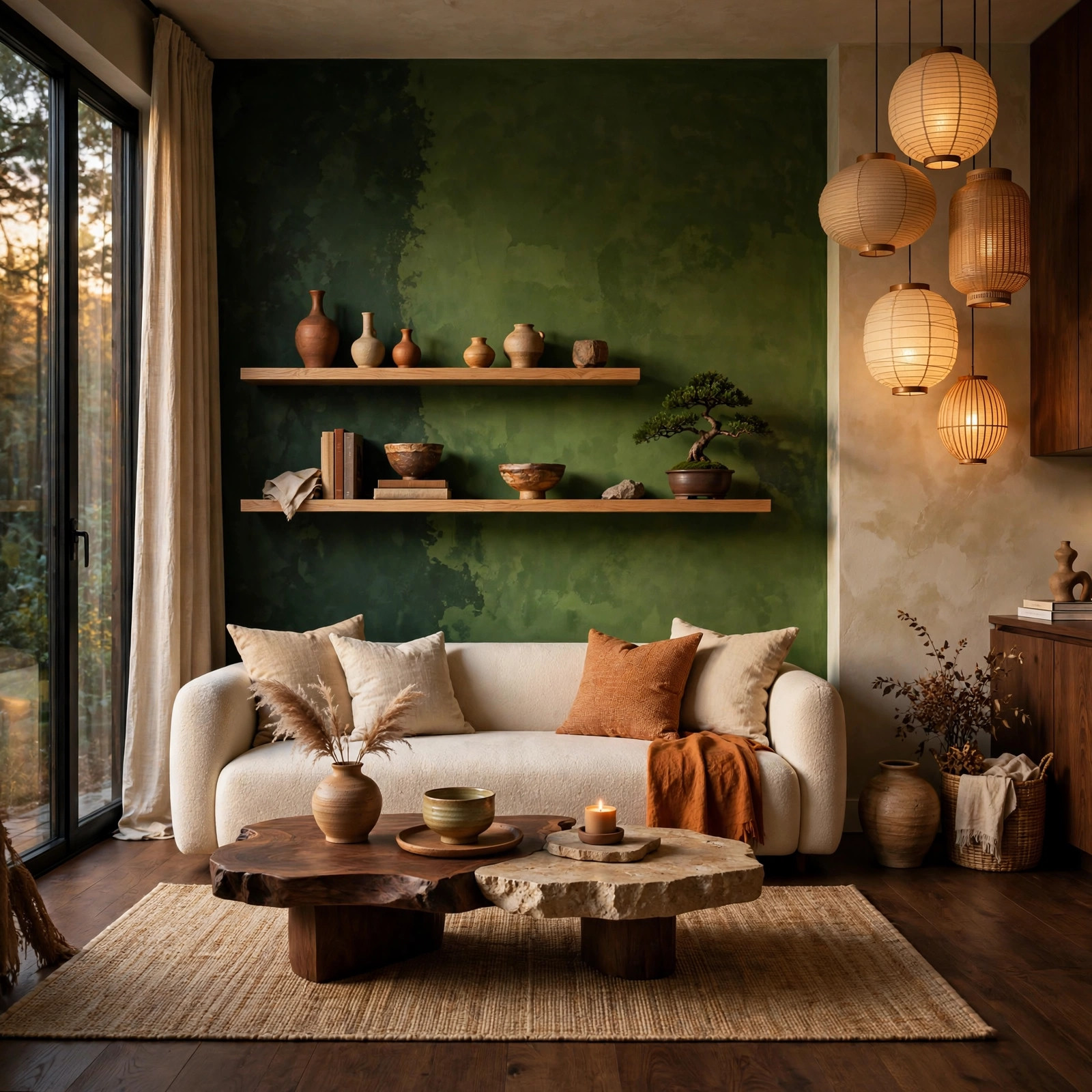
48. The round jute pouf
Round jute poufs are the hardest-working small seats in a japandi living room: footrest, extra chair, side table with a tray on top. Their braided texture adds a crisp natural note that plays against soft boucle and smooth walnut. Tuck two under a console when not needed; pull them out when the room fills. In a style that hates visual noise, furniture that multitasks without looking busy is worth its weight in serenity.
49. Aged brass details
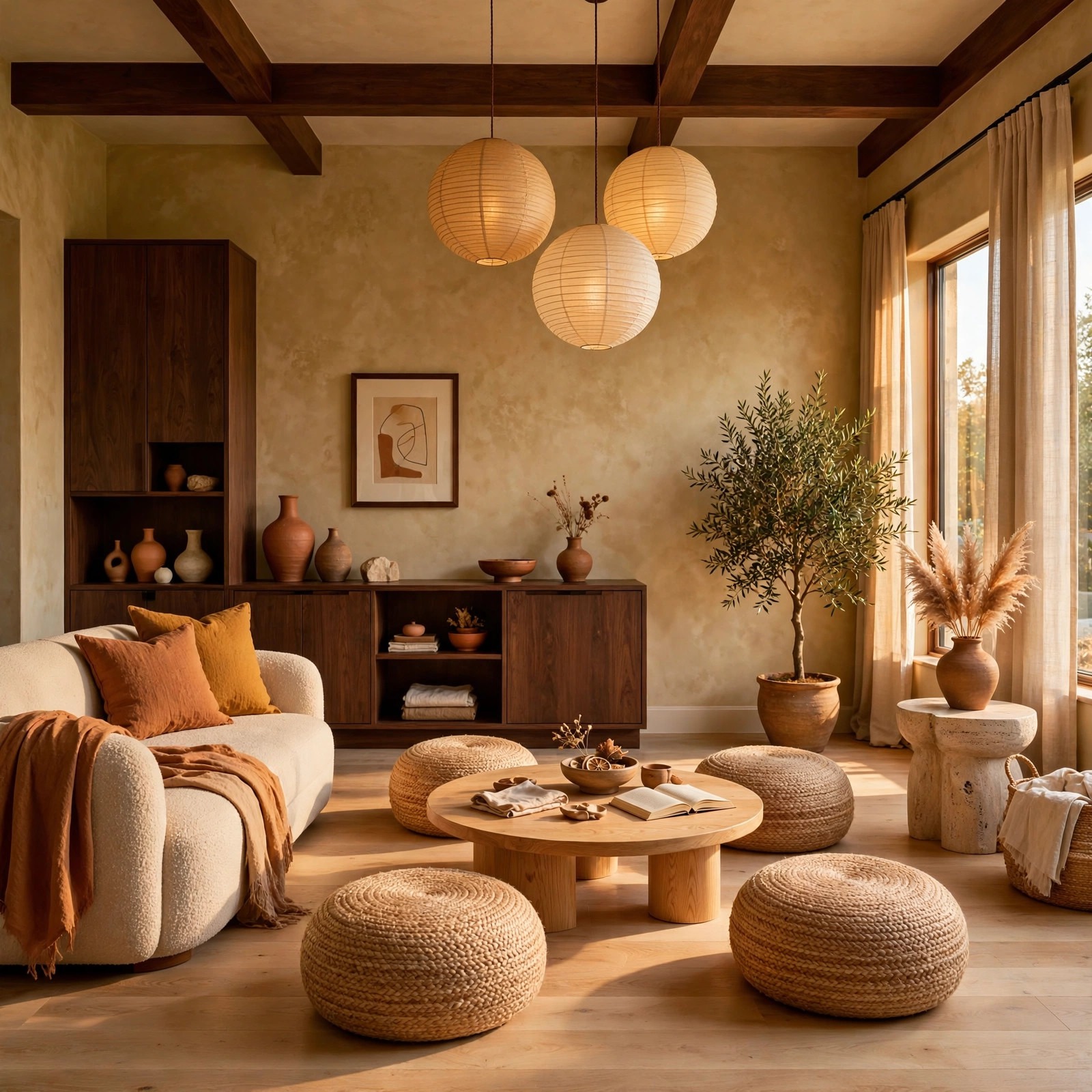
Aged brass is the warm metal a japandi living room deserves: a floor lamp with a soft patina, small aged-brass pulls on dark walnut drawers, a candleholder gone softly dull with time. Unlike polished gold, it does not shine; it glows, and that difference matters in a style built on understatement. Let it tarnish naturally. The gentle darkening is wabi-sabi working on metal, beauty that deepens instead of fading, and it flatters every wood tone in the room. The same warm metal carries a whole kitchen in these luxury brass kitchen ideas.
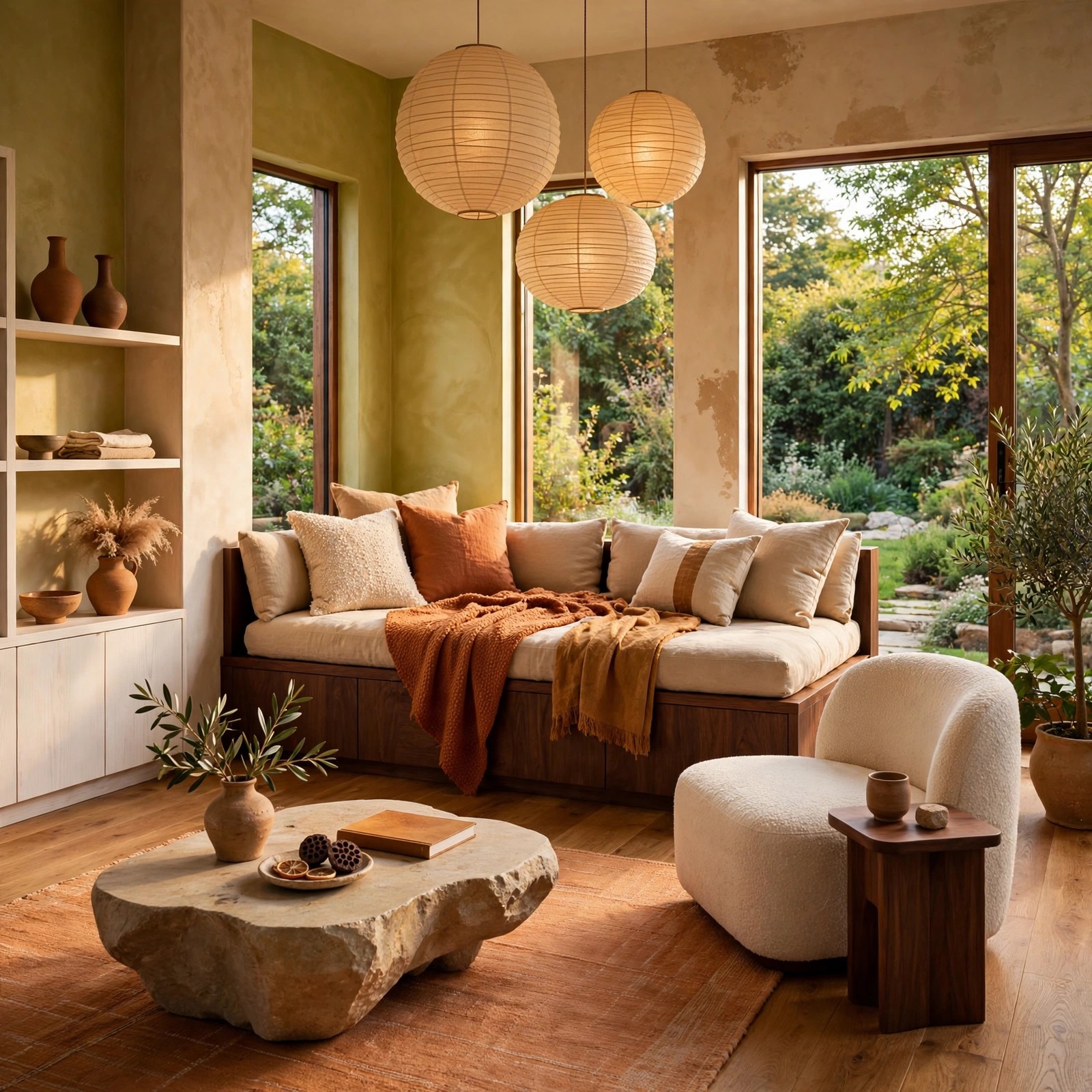
50. The window daybed
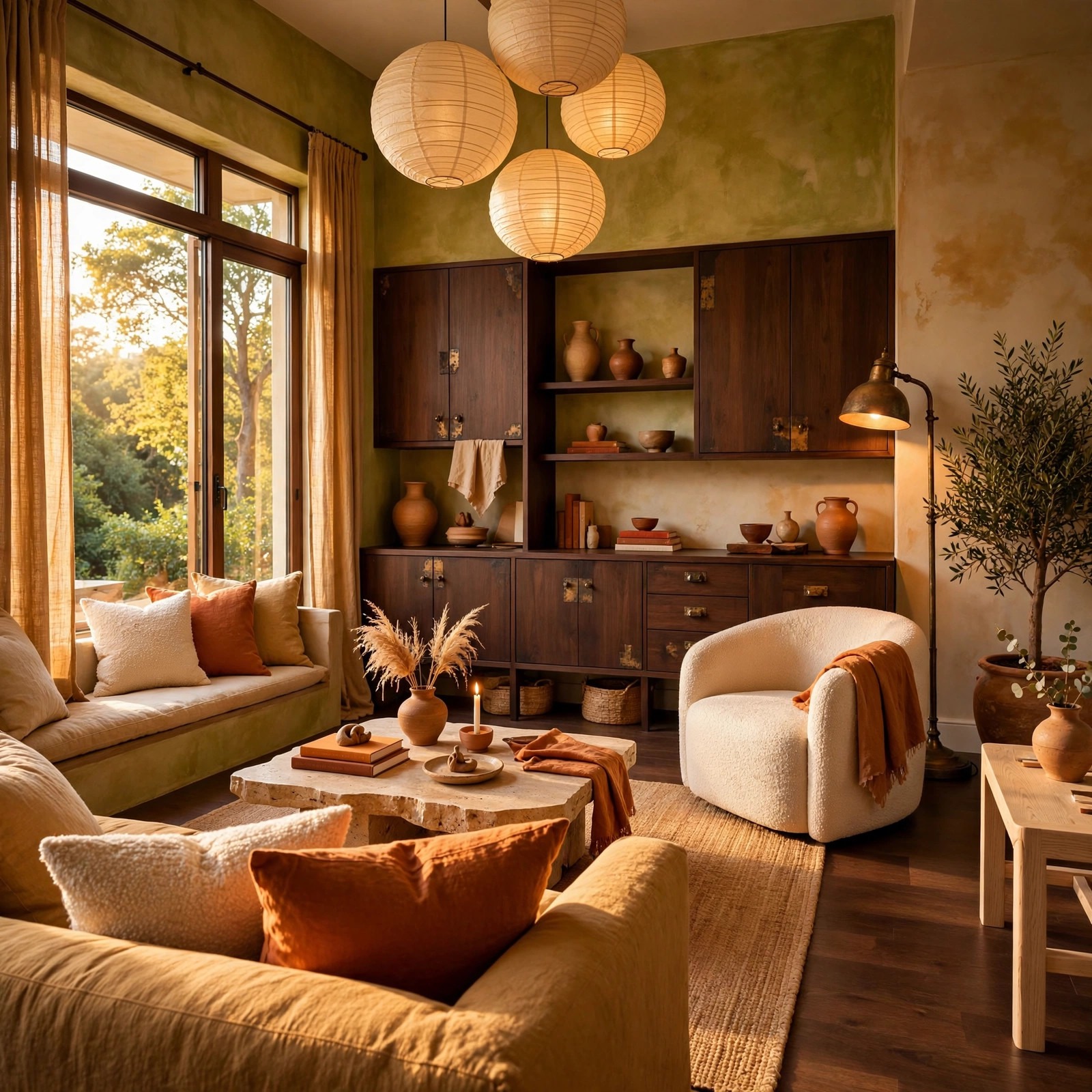
A built-in window daybed turns your best view into the japandi living room’s favorite seat. Deep enough to sprawl, dressed in thick linen cushions and one perfect throw, it becomes the place for rainy afternoons and slow mornings. Build storage into its base and it earns its footprint twice. Position it to catch morning light; there is no better alarm clock than sun arriving through linen curtains onto a bed made for daydreaming. The same layered, low comfort makes a bedroom feel like a retreat, and these cozy winter bedroom ideas show how.
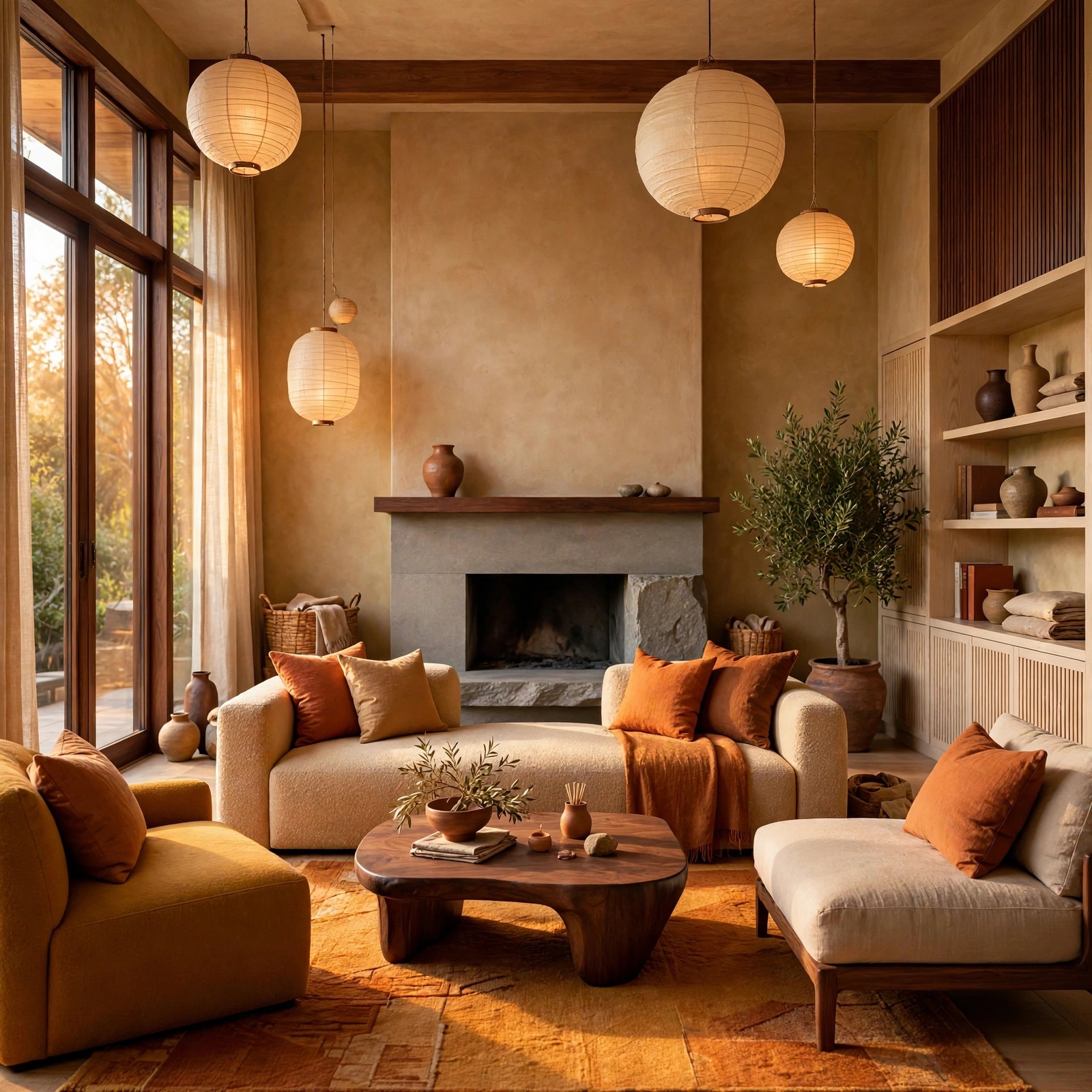
51. The soft gray stone fireplace
A fireplace in honed gray stone gives a japandi living room the permanence of a cliff face. The matte, cool surface contrasts beautifully with warm walnut and cream textiles nearby, and its solid mass anchors even a large open room. Keep the surround simple, no mantel shelf competing for attention, and let the stone’s quiet veining be the ornament — the same veined-stone drama as viola marble kitchen ideas. Fire against stone is one of the oldest comforts humans know; this is luxury at its most elemental. In the cold months, that stone-and-fire pairing becomes the whole comfort of the room, and these winter cozy luxury living room ideas build on exactly that feeling.
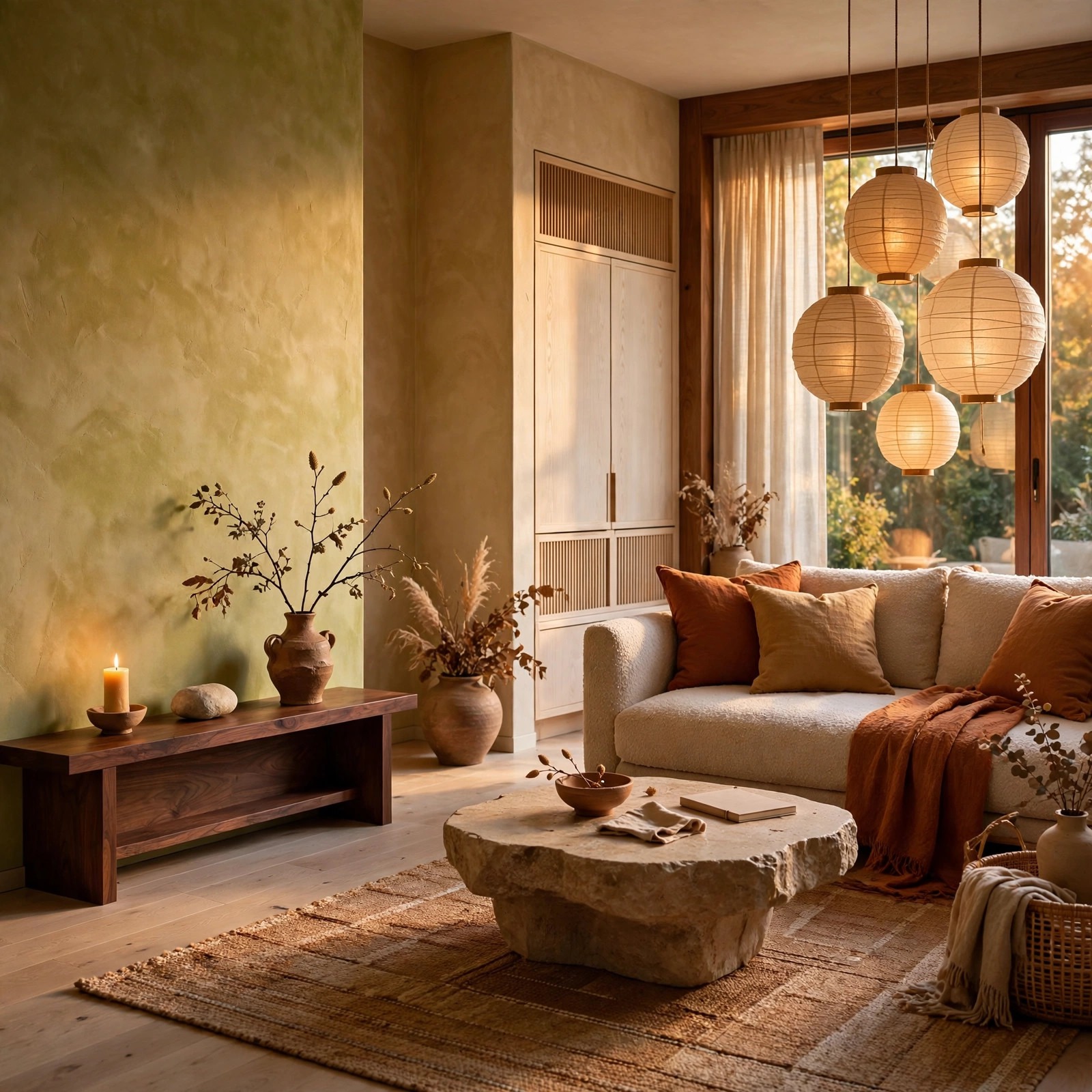
52. The low altar shelf
A single low shelf styled as a quiet altar gives your japandi living room a spiritual center without any religious weight: a candle, a smooth stone, a small branch in a handmade vase. It is a place for the eye to rest and the mind to follow. Change its objects with the seasons, a shell in summer, a pine sprig in winter, and it becomes a tiny calendar of attention. At Christmas, the same shelf carries the season quietly, as these christmas living room decor ideas show. Every calm room needs one spot that exists purely for contemplation.
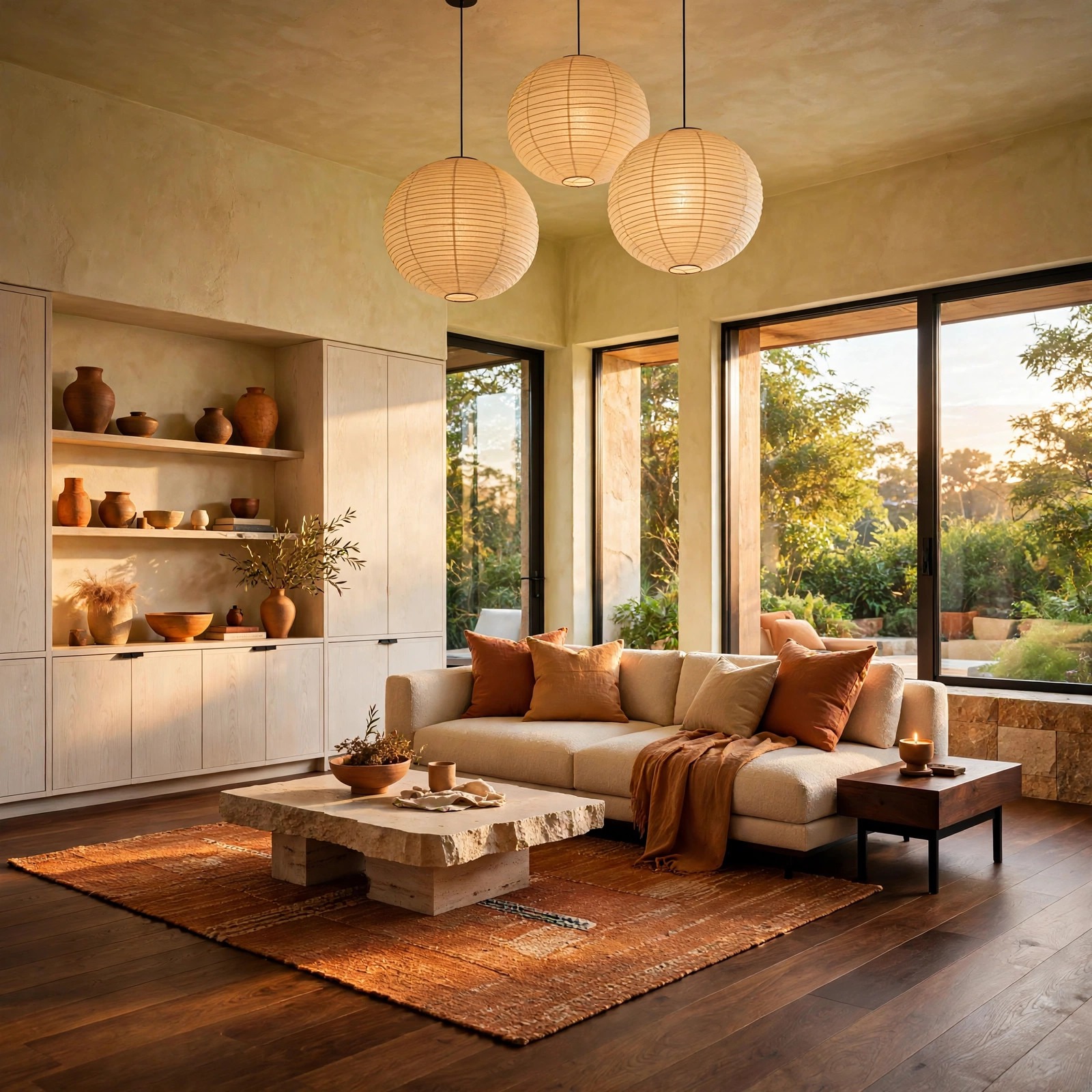
53. Warm white walls, dark floors
The classic japandi contrast, warm white limewash walls floating over dark walnut floors, remains unbeatable for a reason. The light walls lift and expand while the dark ground holds everything steady; the room breathes and anchors at once. This is the same light-dark discipline that makes a white kitchen feel so clean against dark floors. Furnish low and pale, let the architecture do the talking, and the simplicity will never feel simple.
54. The sculptural branch
A tall bare branch in a large handmade vase is ikebana at architectural scale, and it can transform a japandi living room corner in seconds. Its calligraphic lines draw the eye upward, balancing all the low horizontal furniture, and its shadow on a limewash wall becomes a second artwork. Forage responsibly or buy from a floral studio; either way, choose a branch with drama. When a single stick outshines your furniture, you know the styling is right.
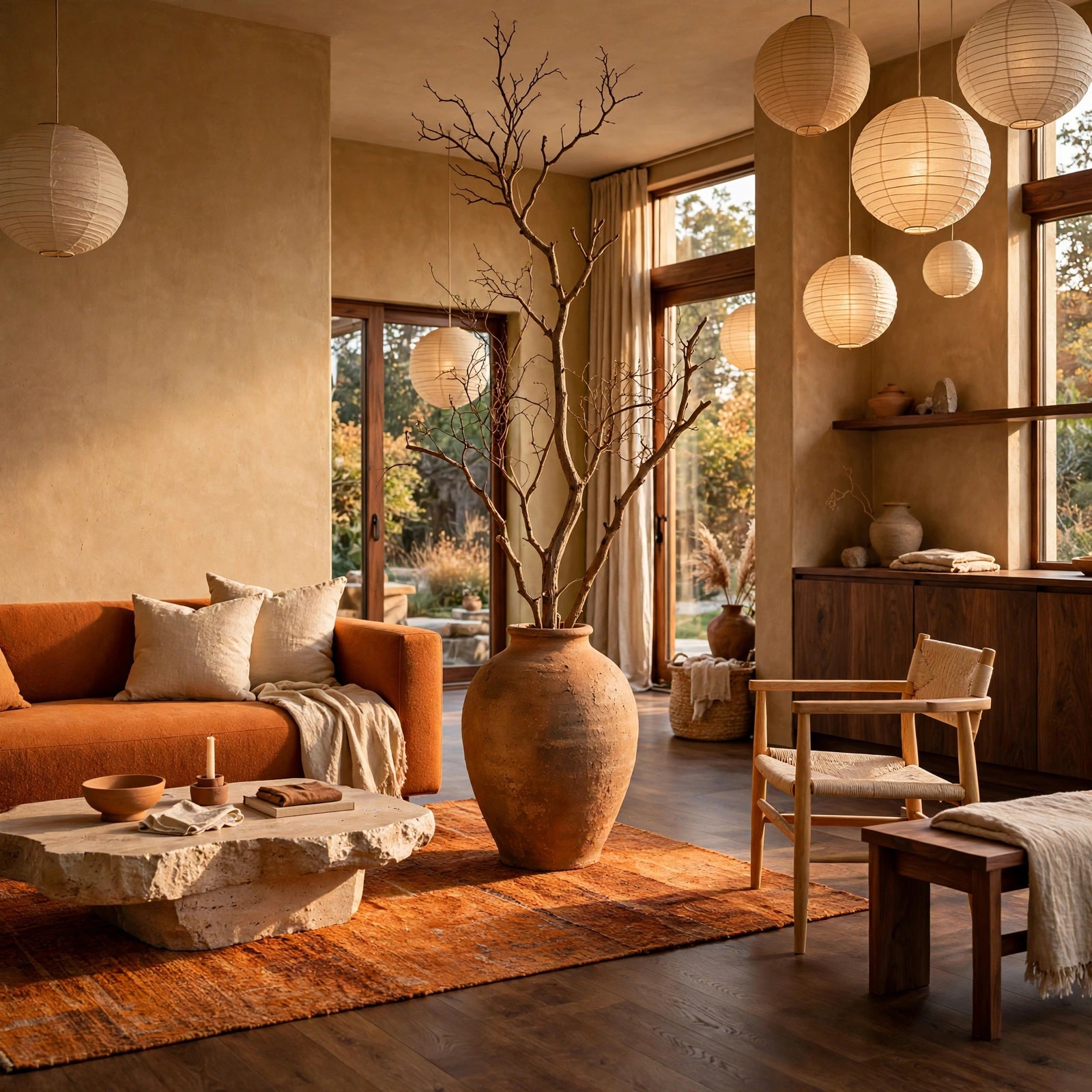
55. Handwoven throw layers
Handwoven throws in cream, oatmeal, and clay, layered with casual intention over a low linen sofa, are the japandi living room’s answer to luxury bedding. The visible weave and slightly irregular edges prove human hands made them, and that provenance is the whole point. Drape, do not fold; the style prefers the honest wrinkle to the pressed crease. In winter these layers invite touch, and a room that invites touch is a room that gets lived in.
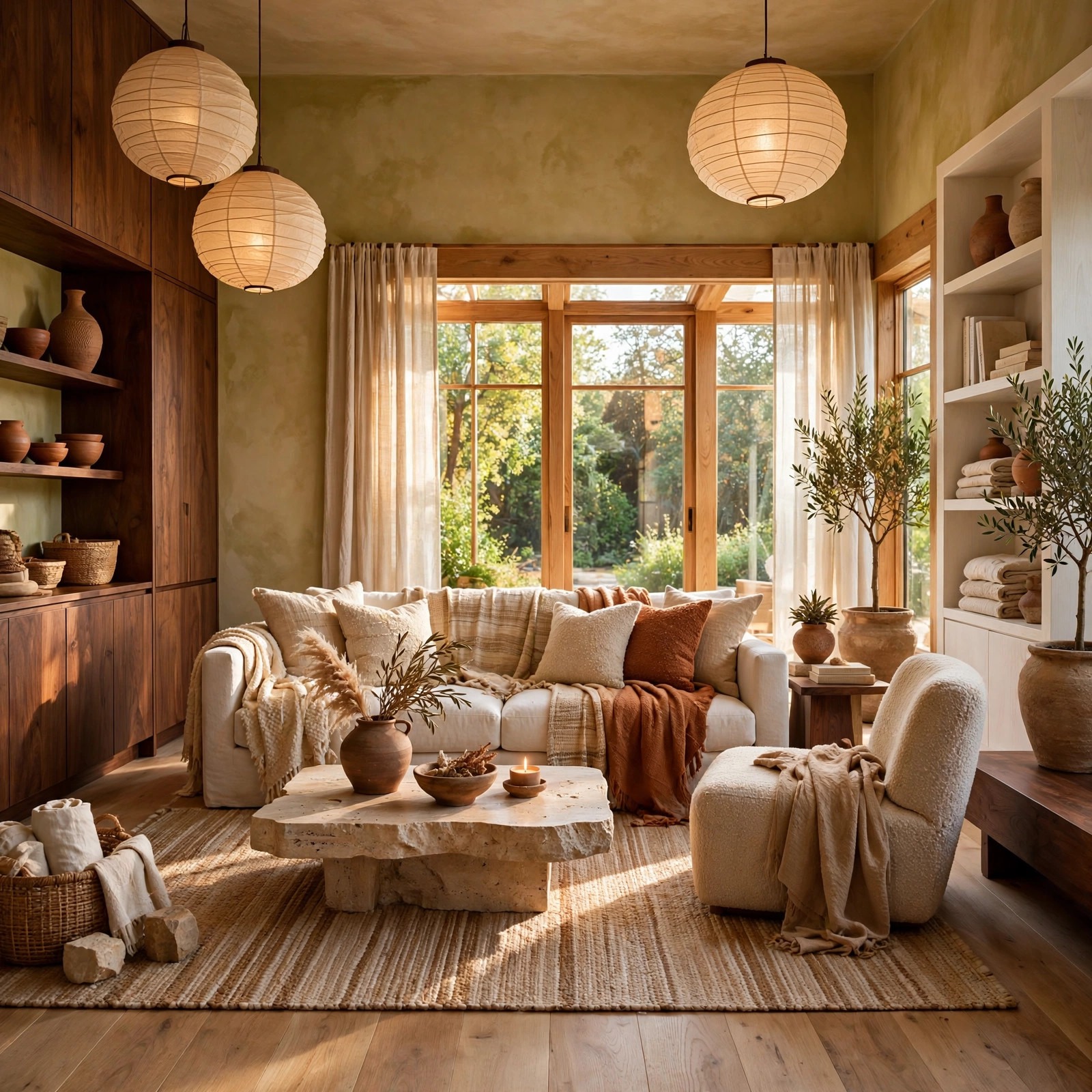
56. The quiet workspace corner
Even work can be calm in a japandi living room if it gets a considered corner: a small oak desk facing the wall, one simple chair, a paper lantern for task light, and absolutely nothing else on the surface. When the laptop closes, the corner should disappear back into the room’s serenity. A shoji screen can hide it entirely in seconds. The discipline of a beautiful workspace is that it teaches the rest of your workday the same restraint.
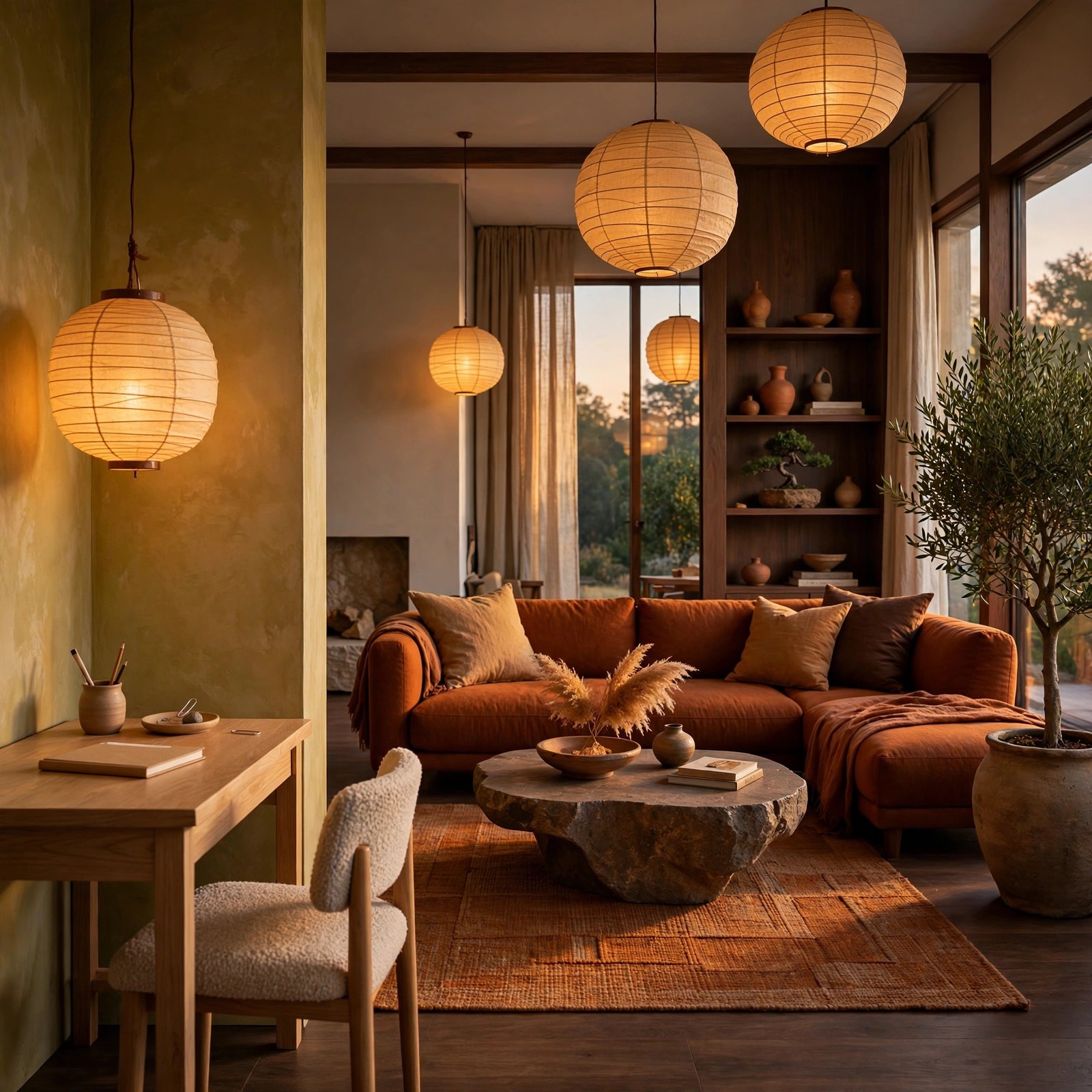
57. Smoked glass accents
Smoked glass brings a moody translucence that the 2026 japandi living room loves: a gray-amber vase, candle holders that glow like embers, a carafe catching window light. It has the depth of dark wood but the lightness of air, sitting beautifully between the style’s solid and soft materials. Use it in small doses on a walnut console where it can catch light. These quiet, smoky notes keep the palette sophisticated after dark, when the room turns cinematic.
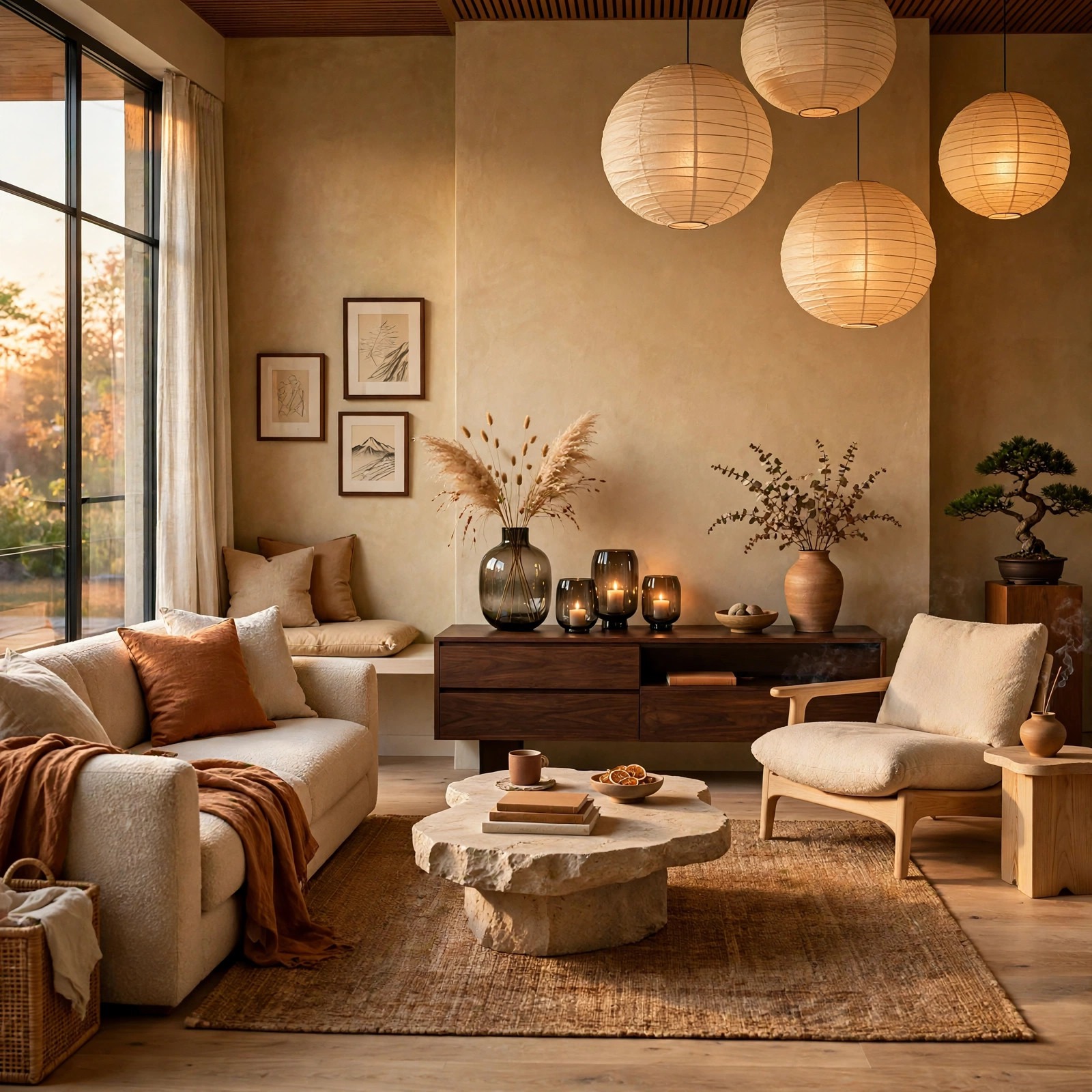
58. The layered lighting plan
A japandi living room should never rely on one overhead light. Layer instead: a paper floor lamp for reading, a small table lamp for warmth, candles for ceremony, each on its own dimmer or switch. As evening deepens, you lower the room through stages of glow like the sun setting indoors. This choreography of light is what makes the style feel so profoundly calming after dark. Overhead lighting, used alone, is the fastest way to kill everything this room is trying to be.
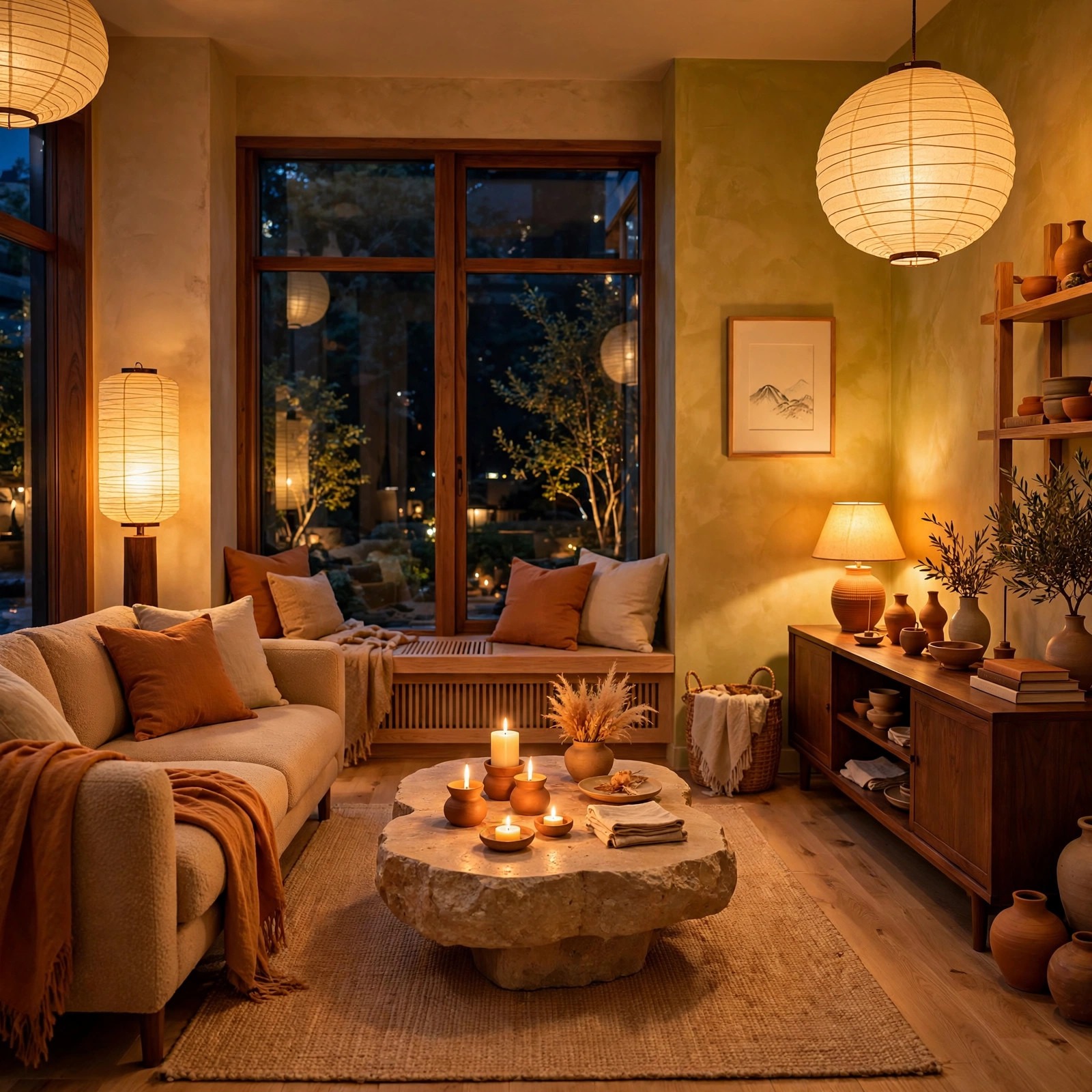
59. Dark bronze hardware
Swap bright hardware for dark bronze and watch your japandi living room’s cabinetry go quiet in the best way. The deep, oil-rubbed finish disappears against walnut while catching just enough light to show its craftsmanship. It is a tiny change with a whole-room effect, like lowering your voice in a conversation. Details at this scale are where luxury actually lives; nobody photographs a drawer pull, but everybody feels the calm it contributes.
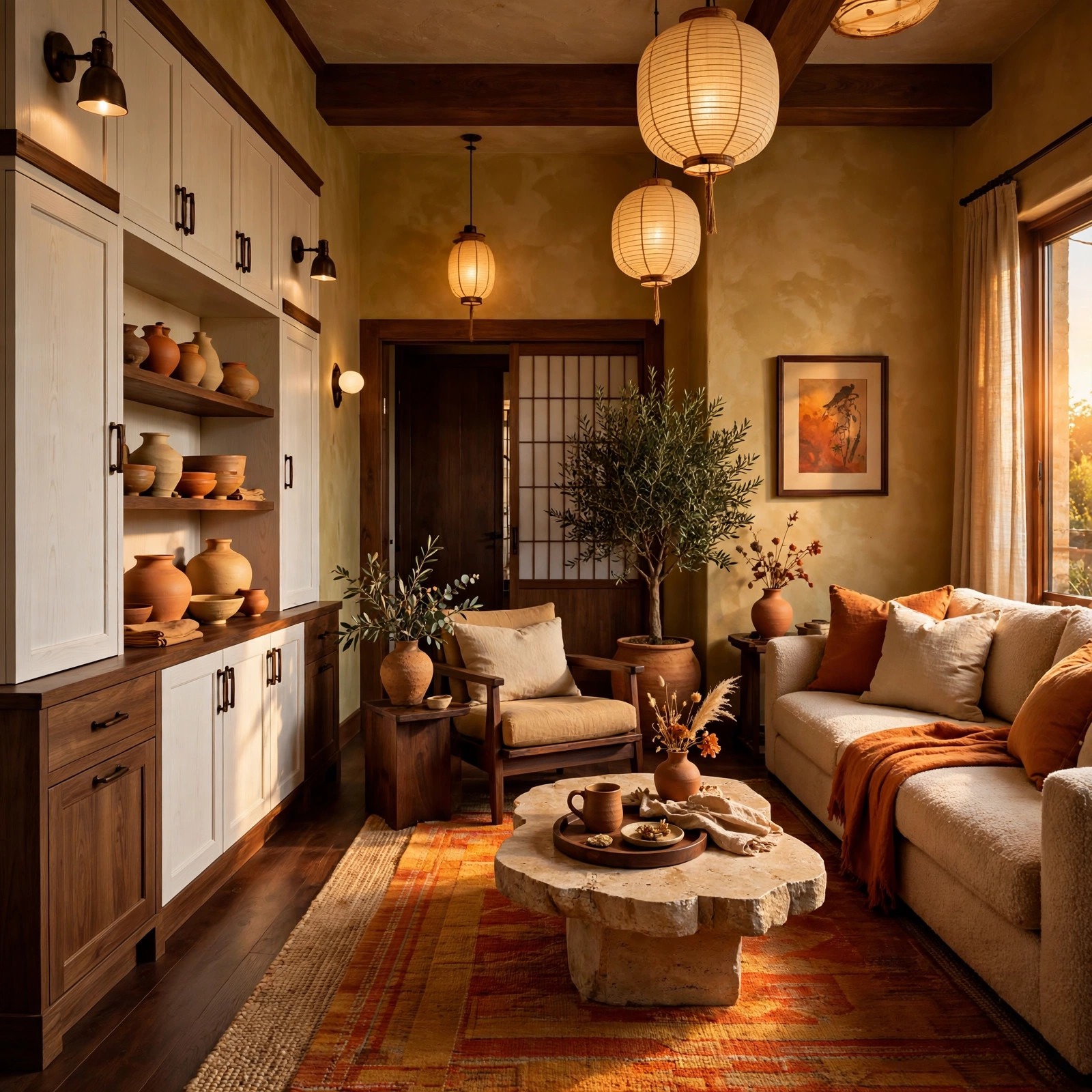
60. The evening candle ritual
End each day the japandi way: as daylight fades, light a cluster of candles on your low stone coffee table and let electric light wait. The flickering glow on limewash walls and walnut is the room’s most beautiful hour, and the ritual of striking the match marks the boundary between doing and being. Use unscented beeswax for a clean flame. Ten minutes of candlelight will do more for your nervous system than any wellness app, and your living room becomes the instrument.
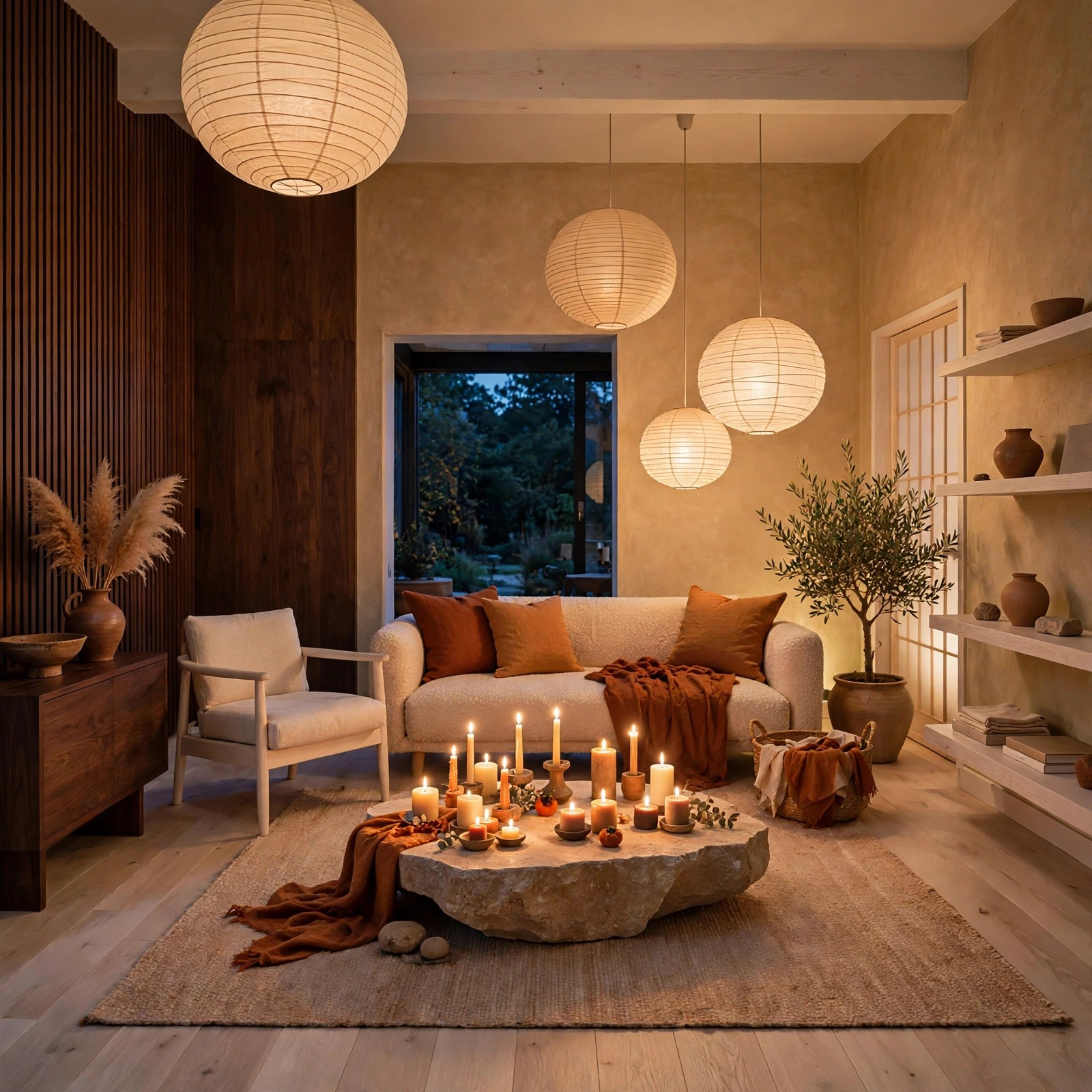
61. Warm oak and black contrast
The dialogue between warm oak and matte black is the 2026 japandi living room’s sharpest tailoring. A black pendant over an oak table, black side tables beside a honey-toned sofa, dark window frames against pale walls: each pairing makes both materials more themselves — the same dark-stone drama as black marble kitchen ideas. It is the same confident contrast you see in a black kitchen warmed by wood. Keep the black matte and architectural, never glossy, and the room stays serene rather than stark.
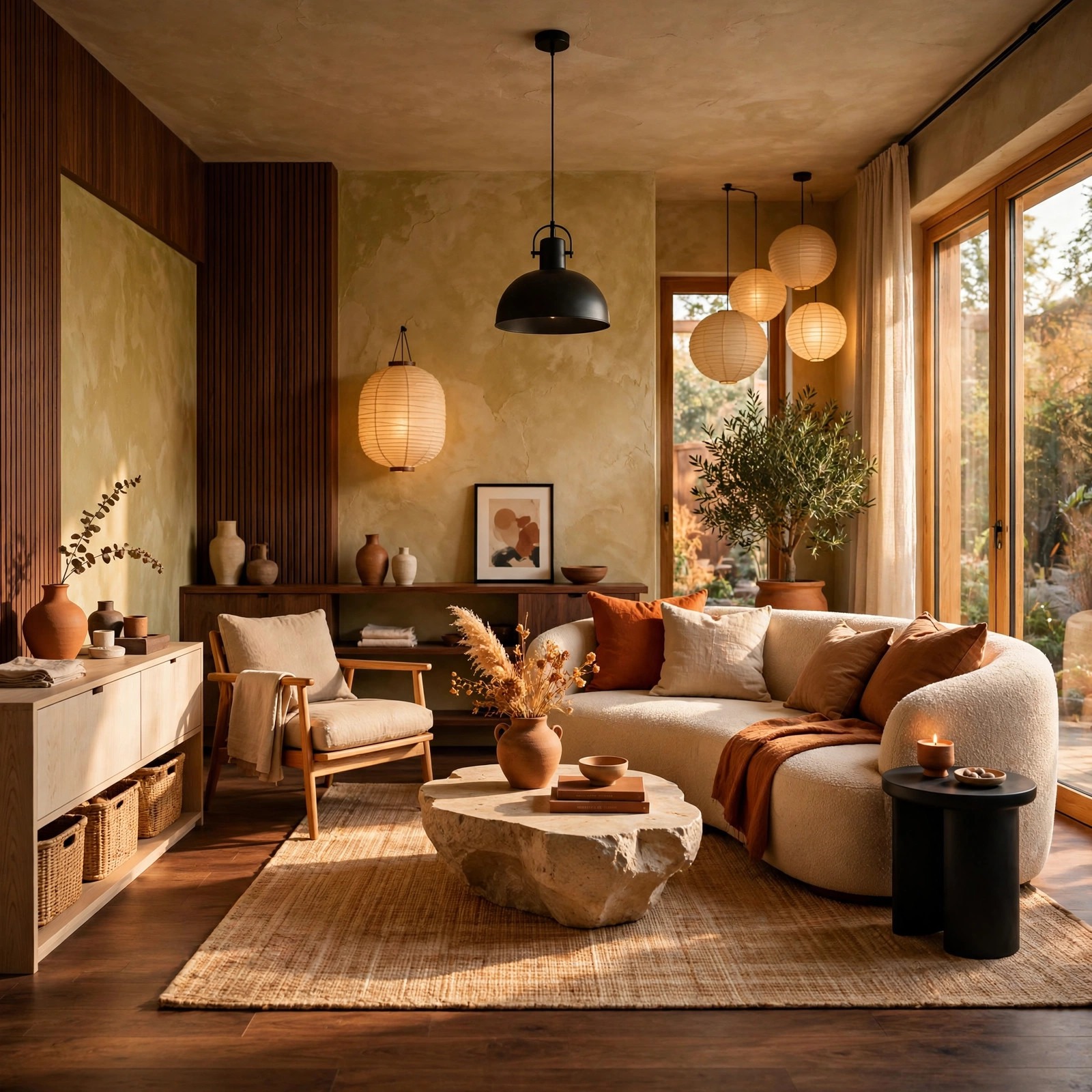
62. The curated empty space
The bravest japandi living room idea is also the simplest: leave one area beautifully, deliberately empty. A stretch of walnut floor, a limewash wall, nothing on it, a space that exists purely for the eye to rest. This is the ma of Japanese aesthetics, the pregnant emptiness that gives everything else meaning. Resist the urge to fill it. In a world of maximalism, a curated void is the ultimate luxury statement, and it costs absolutely nothing.
The japandi palette
Every japandi living room draws from the same quiet family of tones. Keep your palette inside these five and the room will harmonize itself:
Warm Beige
limewash walls
Dark Walnut
floors and furniture
Soft Charcoal
accents and contrast
Muted Sage
textiles and calm
Natural Clay
vessels and warmth
Styling your shelves the japandi way
Japandi shelving follows a simple rhythm: two-thirds books and beautiful objects, one-third breathing room. Group items in odd numbers, vary heights, and let empty space be a deliberate design choice rather than an unfinished one. Step back often; if any shelf looks busy, remove one thing. The goal is a shelf that looks collected over years, not decorated in an afternoon.
Three mistakes that make it look themed
Going too pale and cold. the early minimalism trap. The 2026 japandi living room needs warm dark woods and texture; all-white everything reads sterile, not serene.
Cluttering the calm. too many small objects. If a surface holds more than three things, edit ruthlessly. Every object should earn its place or leave.
Forgetting the light. one overhead fixture. Layer paper lanterns, floor lamps, and candles, or the room will feel flat no matter how beautiful the furniture.
Shopping checklist
- Low platform sofa or floor cushions
- Washi paper pendant or floor lamp
- Dark walnut or oak anchor piece
- Limewash or plaster wall treatment
- Handmade ceramics, odd numbers
- Natural fiber rug, layered
- One living plant or branch
- Beeswax candles for evenings
Frequently asked questions
What is a japandi living room? A fusion of Japanese and Scandinavian design: low furniture, natural materials, calm palettes, and wabi-sabi texture. The 2026 version runs warmer and darker than before.
What colors work in a japandi living room? Warm beige, dark walnut brown, soft charcoal, muted sage, and clay. Keep everything desaturated and earthy; texture provides the interest.
Is japandi still in style for 2026? Yes, designers call it a quiet but powerful comeback, with limewash walls and dark woods leading the warmer, moodier update.
How do I make a small living room feel japandi? Go low and light: floor cushions, one pale wall, hidden storage, and a single paper lantern. Restraint makes small rooms feel larger.
What is the difference between japandi and minimalism? Minimalism can feel cold; japandi adds Japanese warmth, imperfection, and craft. It is minimalism with a soul and a tea ritual.
A japandi living room is not a look you buy, it is a pace you choose: lower furniture, warmer light, fewer things held to a higher standard. Start with one wall of limewash or one low oak piece and let the calm spread. The style rewards patience; every considered addition makes the room feel more like itself.
Light one paper lantern tonight and sit with it for ten minutes. And when the calm starts spilling into the rest of your home, these living room ideas will help you carry the same warmth everywhere.